
Intermediate Hydraulics Practice Test
$69.00
- Buy to unlock unlimited access to all Quiz questions and Answers in this Quiz.
- After purchase you can print a PDF of the whole quiz at any point. The PDF will contain the questions and the correct answers.
About this Exam
The Intermediate Hydraulics certification is a highly respected credential that validates your understanding of complex fluid power systems and their real-world applications.
This exam is expertly designed for maintenance technicians, mechanical engineering students, and dedicated fluid power specialists who want to elevate their careers.
By taking this assessment, you prove your ability to move beyond basic hydraulic concepts and tackle advanced troubleshooting scenarios with absolute confidence.
It serves as the perfect stepping stone for professionals seeking to demonstrate specialized technical competency to top-tier industrial employers.
Ready to test your knowledge?
Buy Now to Access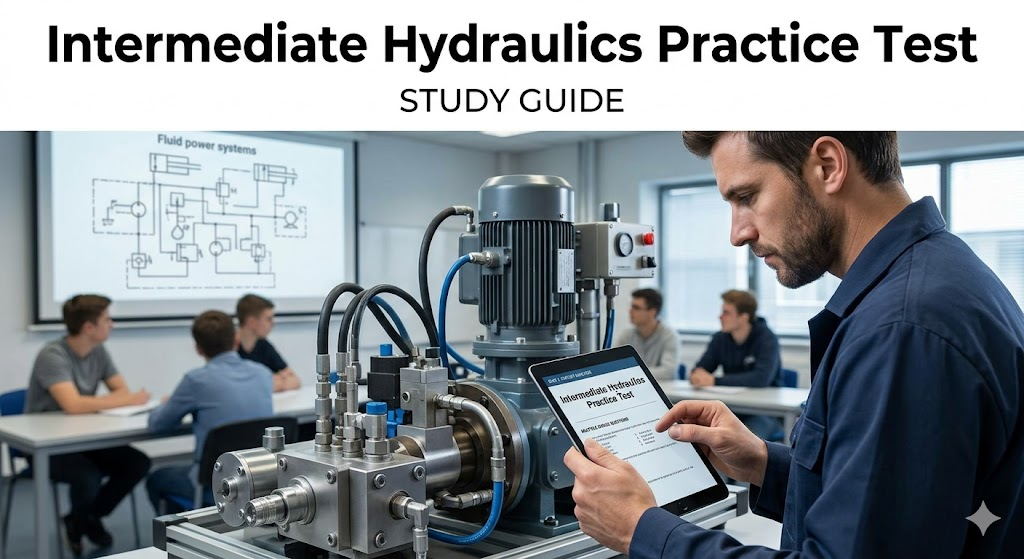
Additional Information
What the Course Entails and Exam Details
This comprehensive course syllabus focuses on the critical mechanical and fluid dynamics skills necessary for modern industrial operations.
You will dive deep into advanced circuit design, exploring how individual hydraulic components interact within a larger, high-pressure system.
Core topics heavily feature proportional control valves, pressure compensation techniques, and the precise operation of variable displacement pumps.
The curriculum also places a major emphasis on reading complex hydraulic schematics and mastering fluid power safety protocols.
By the end of your studies, you will possess a solid grasp of contamination control, fluid thermodynamics, and preventative maintenance strategies.
What to Expect in the Final Exam
The final exam is a rigorous evaluation of your applied knowledge, typically consisting of 75 to 100 multiple-choice and scenario-based questions.
Candidates are generally given a strict time limit of 120 minutes to complete the entire assessment.
To achieve certification, you must reach a minimum passing score of 70%, though some specialized programs may demand a 75% threshold.
You can expect to analyze complex schematics directly on your screen, requiring you to identify faulty components or predict circuit behavior under stress.
The testing environment is entirely closed-book, but candidates are usually permitted to use a standard, non-programmable calculator for fluid dynamics equations.
How to Study and Exam Centers
Success in this exam relies heavily on combining theoretical reading with active, hands-on practice.
You should utilize official study manuals, complete timed practice exams, and repeatedly trace hydraulic circuits using standard ISO symbols.
We highly recommend utilizing physical hydraulic training benches or advanced simulation software to visualize how fluid logic operates in real time.
When you are ready to test, exams are typically administered through secure, global testing networks like Pearson VUE or Prometric.
Additionally, many candidates can take the test at authorized technical colleges, regional Fluid Power Society (IFPS) testing centers, or via strictly monitored online proctoring from home.
Job Opportunities from the Course
Earning your Intermediate Hydraulics certification instantly opens the door to a highly lucrative and specialized job market.
You will be qualified to step into roles that demand critical problem-solving skills in manufacturing, construction, and aerospace sectors.
Here are the specific job titles and career paths this certification directly unlocks:
Fluid Power Specialist: Designing and optimizing custom hydraulic systems for industrial machinery.
Heavy Equipment Mechanic: Troubleshooting and repairing massive high-pressure circuits on construction and mining vehicles.
Hydraulic Maintenance Technician: Conducting preventative maintenance, preventing leaks, and minimizing costly factory downtime.
Mechanical Engineering Technician: Assisting engineers in drafting, prototyping, and testing advanced fluid dynamic components.
Technical Sales Engineer: Utilizing your deep product knowledge to sell specialized hydraulic parts and consult with corporate clients.
Frequently Asked Questions
Reviews
5.0
Based on 0 reviews
Leave a Review
No reviews yet. Be the first to review!