
Intermediate Scaffolding Practice Test
$69.00
- Buy to unlock unlimited access to all Quiz questions and Answers in this Quiz.
- After purchase you can print a PDF of the whole quiz at any point. The PDF will contain the questions and the correct answers.
About this Exam
The Intermediate Scaffolding certification is a vital credential for construction and industrial professionals seeking to advance their careers.
It is specifically designed for individuals who have already mastered basic scaffolding concepts and are ready to tackle more complex, high-risk structures.
By taking this certification, workers prove their competence in building safe, reliable frameworks that support heavy loads and multiple personnel.
Ultimately, this qualification demonstrates a high level of expertise, making you an invaluable asset on commercial, residential, and industrial job sites.
Ready to test your knowledge?
Buy Now to Access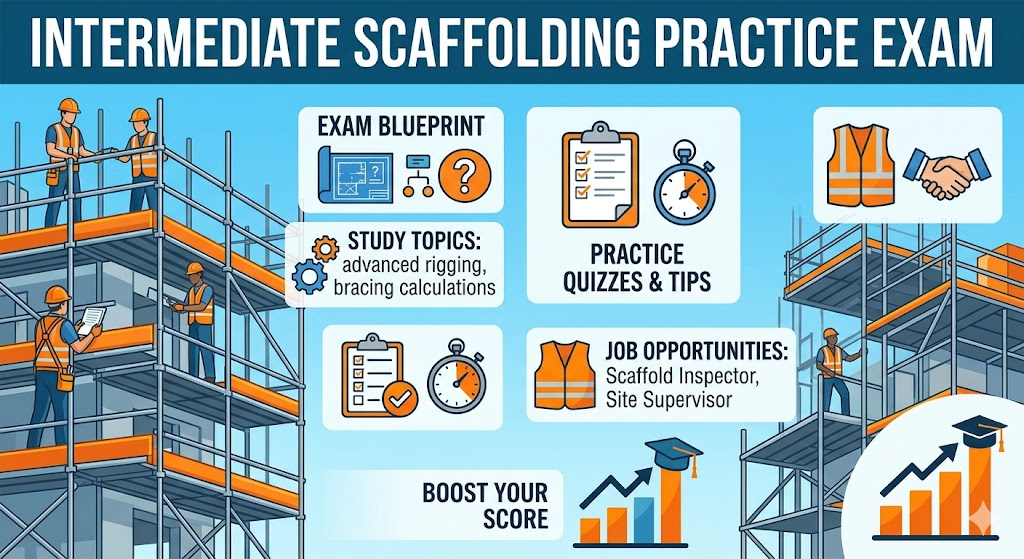
Additional Information
What the Course Entails and Exam Details
An intermediate scaffolding course builds heavily upon foundational scaffolding knowledge.
You will dive deep into the specific techniques required to erect, alter, and dismantle complex setups.
Core topics covered in the syllabus include the construction of cantilevered scaffolds, spurred scaffolds, barrow ramps, and sloping platforms.
You will also learn advanced skills related to rigging, installing perimeter safety screens, and utilizing tube and coupler scaffolding systems.
Furthermore, the curriculum emphasizes critical safety calculations, weight distribution rules, load capacities, and strict adherence to occupational health and safety regulations.
What to Expect in the Final Exam
The final exam is typically divided into two rigorous parts: a written theoretical assessment and a hands-on practical evaluation.
The written portion usually consists of multiple-choice and short-answer questions designed to test your knowledge of safety protocols, load calculations, and equipment standards.
The practical assessment places you in a controlled environment where you must physically erect and dismantle an intermediate scaffold structure safely and efficiently.
Passing score requirements generally demand an 80% or higher on the theoretical section, alongside a flawless demonstration of safety in the practical exam.
Time limits are strictly enforced, often giving candidates between two to three hours for the written test and a designated half-day block for the practical build.
How to Study and Exam Centers
Preparation is the key to passing your intermediate scaffolding test on the first attempt.
Start by thoroughly reviewing your region's occupational health and safety guidelines, as safety regulations make up a massive portion of the test.
Take advantage of practice exams to familiarize yourself with the multiple-choice format and to identify any knowledge gaps in load calculations or specific terminology.
For the practical portion, nothing beats on-the-job experience; practice building and inspecting complex scaffolds under the supervision of a licensed senior scaffolder.
When it comes to taking the exam, you will need to register with a Registered Training Organisation (RTO) or an authorized construction training facility.
While theoretical exams may occasionally be offered via secure online portals like Pearson VUE, the mandatory practical assessment requires you to attend a specialized physical testing center equipped with the necessary scaffolding materials.
Job Opportunities from the Course
Earning your intermediate scaffolding ticket immediately unlocks a variety of lucrative and highly respected career paths in the construction sector.
Advanced Scaffolder: Take on leadership roles in erecting complex structures on large-scale commercial sites.
Scaffolding Supervisor: Oversee teams of basic and intermediate scaffolders, ensuring all builds are compliant with strict safety regulations.
Scaffold Inspector: Specialize in auditing and inspecting erected scaffolds to certify they are safe for workers to use before the day begins.
Rigging Specialist: Combine scaffolding knowledge with advanced rigging techniques in the mining, oil, or maritime industries.
Construction Site Manager: Use your in-depth knowledge of site safety and temporary structures to transition into broader site management and logistical planning roles.
Frequently Asked Questions
Reviews
5.0
Based on 0 reviews
Leave a Review
No reviews yet. Be the first to review!