
Internal Medicine End of Rotation (EOR) Practice Exam
$69.00
- Buy to unlock unlimited access to all Quiz questions and Answers in this Quiz.
- After purchase you can print a PDF of the whole quiz at any point. The PDF will contain the questions and the correct answers.
About this Exam
Welcome to the ultimate preparation resource for the Internal Medicine End of Rotation (EOR) Practice Exam! This assessment is a crucial milestone designed specifically for Physician Assistant (PA) students. It is typically administered towards the end of your internal medicine clinical rotation. The goal of this exam is to evaluate your understanding of core medical concepts and clinical knowledge acquired during this intense and vital rotation. By passing this exam, you demonstrate your readiness to practice medicine effectively under supervision and move one step closer to your final certification. This practice exam is your best tool to simulate the real testing environment and identify key areas for further review.
Ready to test your knowledge?
Buy Now to Access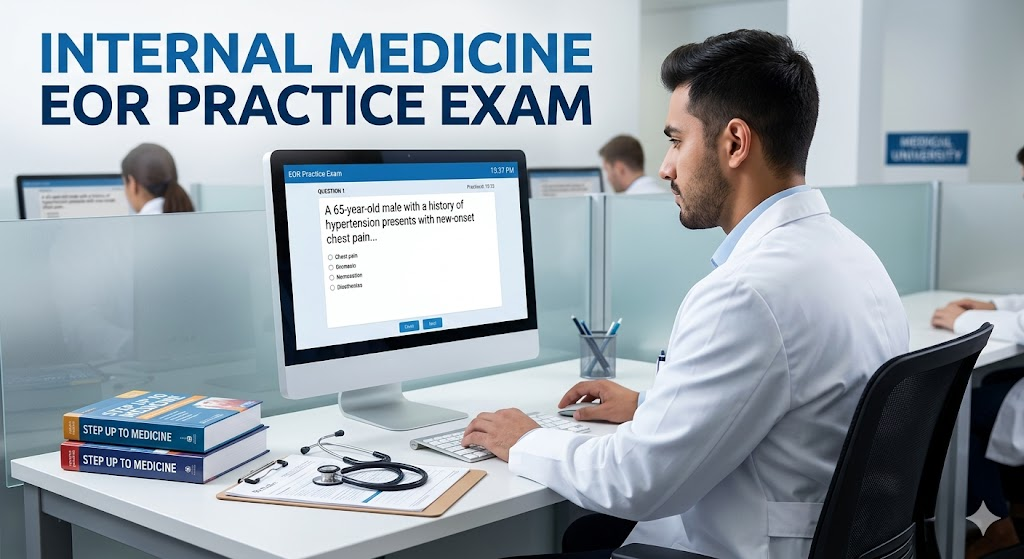
Additional Information
What the Course Entails and Exam Details
The Internal Medicine EOR course and subsequent exam cover a vast array of topics that are essential for any aspiring healthcare provider in this field. You can expect to be tested on your ability to diagnose, manage, and prevent a wide variety of diseases and conditions.
Core syllabus topics include, but are not limited to:
Cardiology: Hypertension, heart failure, arrhythmias, and ischemic heart disease.
Pulmonology: Asthma, COPD, pneumonia, and pulmonary embolism.
Gastroenterology: GERD, peptic ulcer disease, inflammatory bowel disease, and liver disorders.
Endocrinology: Diabetes mellitus, thyroid disorders, and adrenal insufficiency.
Nephrology: Acute kidney injury, chronic kidney disease, and electrolyte imbalances.
Hematology/Oncology: Common anemias, leukemias, and general cancer screening guidelines.
Infectious Disease: HIV/AIDS, common bacterial and viral infections, and antibiotic selection.
Rheumatology: Rheumatoid arthritis, lupus, and gout.
A comprehensive Internal Medicine rotation provides you with the foundational skills and knowledge needed for the PANCE (Physician Assistant National Certifying Examination) and, ultimately, your career as a practicing PA in internal medicine or related subspecialties.
What to Expect in the Final Exam
The final Internal Medicine End of Rotation exam is typically administered online by the PAEA (Physician Assistant Education Association). It is designed to be challenging yet fair, accurately reflecting the knowledge you should have gained during your rotation.
Here is a general breakdown of what to expect:
Exam Format: The test consists of multiple-choice questions (MCQs). These are often clinical vignettes that require you to apply your knowledge to solve real-world patient scenarios.
Number of Questions: There are usually 120 questions on the standard PAEA Internal Medicine EOR exam.
Time Limit: Students typically have 60 minutes for each 60-question block, for a total of two hours (120 minutes) to complete the entire exam.
Passing Score: The PAEA does not set a universal passing score. Instead, your individual PA program will determine what constitutes a passing grade.
Rules: The exam is strictly proctored, and no outside resources are allowed. Understanding your program’s specific policies on testing is crucial.
This practice exam is designed to mimic these conditions precisely, providing a realistic assessment of your current knowledge and exam-taking speed.
How to Study and Exam Centers
Successfully passing the Internal Medicine EOR exam requires a dedicated and structured study plan.
Here are some highly effective, actionable strategies:
Utilize the PAEA Blueprint: Start by downloading the official PAEA Internal Medicine EOR Topic List and Blueprint. This document outlines exactly which topics are covered and in what proportions. Prioritize your studying based on these percentages.
Review Your Rotation Notes: Your experiences in the clinic are invaluable. Review patient cases, common diagnoses you encountered, and treatments you prescribed.
Practice with Purpose: Don't just take practice tests; review every single answer, especially the ones you got wrong. Understand why the correct answer is right and why the other options are wrong. Our Internal Medicine EOR Practice Exam is an ideal resource for this.
Use High-Yield Resources: Focus on comprehensive yet concise review books like PANCE Prep Pearls or Step-Up to Medicine, which are tailored to medical students and PA students on rotation.
Form Study Groups: Collaborating with your peers can help reinforce difficult concepts and provide diverse perspectives on clinical scenarios.
Where to Take the Exam: The final, official Internal Medicine EOR exam is rarely taken at external centers like Pearson VUE. Instead, it is usually administered directly by your PA program. You will likely take it on a designated day in a computer lab on your campus or, occasionally, remotely with online proctoring services like ProctorU. Please check with your program coordinator for specific dates and locations.
Job Opportunities from the Course
The Internal Medicine EOR exam is a vital step toward becoming a licensed Physician Assistant. Successfully completing your rotation and passing this exam opens the door to numerous fulfilling and lucrative career paths. PAs are in high demand across a variety of settings.
Here are specific job opportunities and career paths this certification journey unlocks:
Internal Medicine Physician Assistant: Working in an outpatient primary care clinic or as a "hospitalist" caring for inpatients.
Family Medicine Physician Assistant: Providing comprehensive primary care to patients of all ages, from pediatrics to geriatrics.
Subspecialty Physician Assistant: Opportunities in fields like Cardiology, Gastroenterology, Endocrinology, Pulmonology, and Infectious Disease.
Emergency Medicine Physician Assistant: Diagnosing and treating acute illnesses and injuries in the ER.
Urgent Care Physician Assistant: Providing immediate care for non-life-threatening conditions in a fast-paced environment.
Surgical Physician Assistant: Assisting in various surgical subspecialties like General Surgery, Orthopedics, or CT Surgery.
By passing this rotation exam and ultimately the PANCE, you join a trusted profession that is essential to the modern healthcare team. Good luck with your studies!
Frequently Asked Questions
Reviews
5.0
Based on 0 reviews
Leave a Review
No reviews yet. Be the first to review!