
International Baccalaureate (IB) Mathematics Practice Test
$69.00
- Buy to unlock unlimited access to all Quiz questions and Answers in this Quiz.
- After purchase you can print a PDF of the whole quiz at any point. The PDF will contain the questions and the correct answers.
About this Exam
The International Baccalaureate (IB) Mathematics course is a cornerstone of the prestigious IB Diploma Programme, designed for students aged 16 to 19 worldwide. This rigorous program aims to develop not only mathematical knowledge but also critical thinking, problem-solving skills, and a deep appreciation for the universal language of numbers. Students can choose between two distinct pathways, each offering a Standard Level (SL) and Higher Level (HL) option: Analysis and Approaches (AA) for a theoretical, proof-based focus, and Applications and Interpretation (AI) for a greater emphasis on modeling, statistics, and the use of technology. This study guide and the associated practice tests are essential tools for any student aspiring to excel in these challenging and rewarding exams, unlocking significant opportunities for higher education.
Ready to test your knowledge?
Buy Now to Access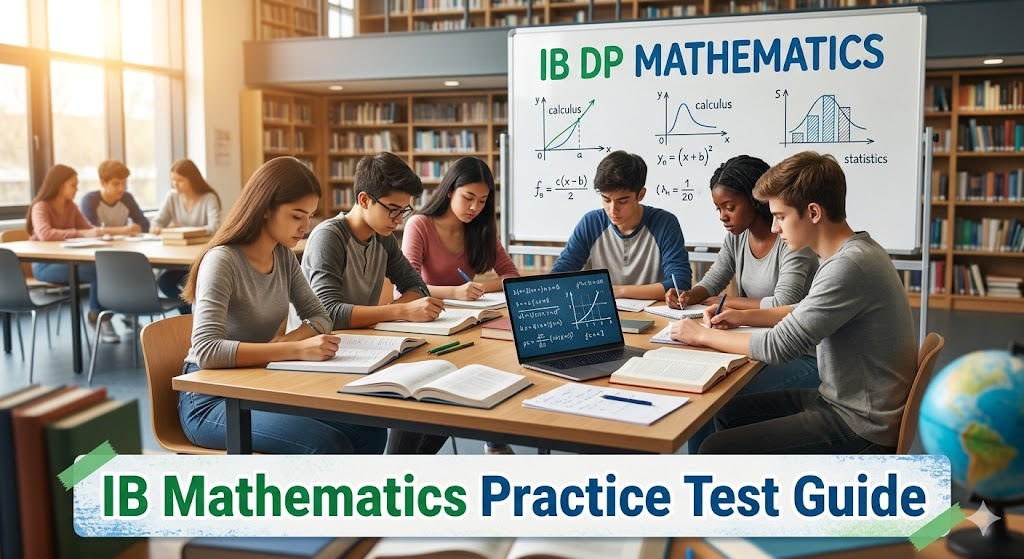
Additional Information
What the Course Entails and Exam Details
The IB Mathematics syllabus is comprehensive, yet the two pathways offer unique focuses.
Both courses cover five core topics, but with different weightings and depths:
Number and Algebra: From foundational concepts to complex numbers and mathematical induction (at HL).
Functions: Exploring relationships, transformations, and diverse function types.
Geometry and Trigonometry: Investigating shapes, space, and periodic functions.
Statistics and Probability: Analyzing data, understanding distributions, and making predictions.
Calculus: The study of continuous change, with significant differentiation between AA and AI (AA has more extensive calculus requirements, especially at HL).
The primary difference lies in the approach: Analysis and Approaches is geared towards abstraction and analytical methods, suitable for students interested in engineering, physical sciences, or mathematics itself. Applications and Interpretation focuses on practical problem-solving using mathematics as a tool, ideal for social sciences, business, or biology.
Practice tests are crucial as they mirror the final exam structure and assess your understanding of this extensive curriculum.
What to Expect in the Final Exam
The final IB Mathematics assessment is a culmination of externally assessed papers and an Internal Assessment (IA) which you complete during the course.
The exam structure varies by course and level, but generally includes:
Analysis and Approaches (AA) SL/HL:
Paper 1 (SL/HL): Non-calculator, focusing on analytical skills and proofs.
Paper 2 (SL/HL): Calculator required, with a mix of short and extended response questions.
Paper 3 (HL only): Calculator required, featuring two extended, multi-part problems often set in unfamiliar contexts.
Applications and Interpretation (AI) SL/HL:
Paper 1 (SL/HL): Calculator required, focusing on short response questions.
Paper 2 (SL/HL): Calculator required, with extended response questions.
Paper 3 (HL only): Calculator required, featuring two extended, data-driven problems.
Passing requires achieving a minimum total score across all assessed components. The final grade (1-7) is determined by global grade boundaries, with your Internal Assessment typically contributing 20% to your final course grade. Time limits range from 1.5 to 2 hours per paper (1 hour for Paper 3). Specific rules, particularly concerning permitted calculators (typically dynamic graphing calculators, GDCs) and the non-calculator format of Paper 1 for AA, are strictly enforced.
How to Study and Exam Centers
Effective preparation demands a combination of consistent study, active learning, and strategic practice.
Proven Study Strategies:
Regular Practice: Math is not a spectator sport. Work through problems daily, not just from your textbook but also from past paper questions.
Utilize Past Papers & Mark Schemes: These are your most powerful resources. They reveal patterns, common phrasing, and the exact level of detail examiners expect. Practice under timed conditions and carefully review mark schemes.
Master Your GDC: Know your graphing calculator inside out, as it is a vital tool for all but one paper. Practice statistical analysis, equation solving, and curve fitting.
Understand Command Terms: Familiarize yourself with verbs like "Find," "Explain," "Show that," and "Verify," as each requires a specific type of response.
Form Study Groups: Collaborating with peers can provide new perspectives and deepens understanding through explanation.
Seek Help Early: If you don't understand a concept, ask your teacher or a tutor immediately. Concepts build upon each other.
Use Online Resources: Many educational websites, including Save My Exams, RevisionDojo, and official IB materials, offer comprehensive notes and practice questions.
Exam Centers: Final IB Mathematics exams are administered only at authorized IB World Schools. These are physical testing centers, and your school will have a specific exam schedule and will be part of a global exam zone for security and timing consistency. Online portals or other third-party centers do not conduct these official final exams.
Practice tests, however, are readily available through your school (as mock exams), official IB publications, various textbooks, and reputable online platforms. These should be an integral part of your study plan leading up to the final exams.
Job Opportunities from the Course
A strong performance in IB Mathematics, especially at the Higher Level, is highly valued by universities and opens doors to a wide range of rewarding careers and fields.
Possible Career Paths and Job Titles:
Data Scientist: Using mathematical models and algorithms to analyze and interpret complex data.
Engineer (e.g., Civil, Mechanical, Software, Aerospace): Applying mathematical principles to design, build, and maintain diverse systems and structures.
Financial Analyst: Evaluating financial data and trends to inform investment and business decisions.
Economist: Studying the production, distribution, and consumption of goods and services using mathematical models.
Statistician: Collecting, analyzing, and interpreting numerical data to support research and decision-making.
Actuary: Assessing financial risks using mathematics and statistics, primarily in the insurance and finance industries.
Computer Scientist: Developing algorithms, computational methods, and software systems.
Mathematics Teacher: Inspiring the next generation of problem-solvers in schools or universities.
Research Scientist: Using mathematical modeling and analysis in fields such as physics, biology, and environmental science.
Quantitative Analyst (Quant): Developing and implementing complex mathematical models used in financial trading and risk management.
Additionally, IB Math is an essential requirement or strongly recommended for university entry into demanding disciplines like Medicine, Computer Science, and Engineering.
Frequently Asked Questions
Reviews
5.0
Based on 0 reviews
Leave a Review
No reviews yet. Be the first to review!