
International Certification & Reciprocity Consortium (IC&RC) Practice Exam
$69.00
- Buy to unlock unlimited access to all Quiz questions and Answers in this Quiz.
- After purchase you can print a PDF of the whole quiz at any point. The PDF will contain the questions and the correct answers.
About this Exam
The International Certification & Reciprocity Consortium (IC&RC) is the globally recognized standard for professionals working in addiction treatment, counseling, and prevention.
Earning an IC&RC credential proves your expertise and dedication to ethical, evidence-based care in a highly demanding field.
This comprehensive exam is meticulously designed for substance abuse counselors, prevention specialists, clinical supervisors, and peer recovery coaches.
Whether you are just starting your career or seeking to elevate your professional standing, this certification acts as a powerful catalyst for your growth in the behavioral health sector.
Ready to test your knowledge?
Buy Now to Access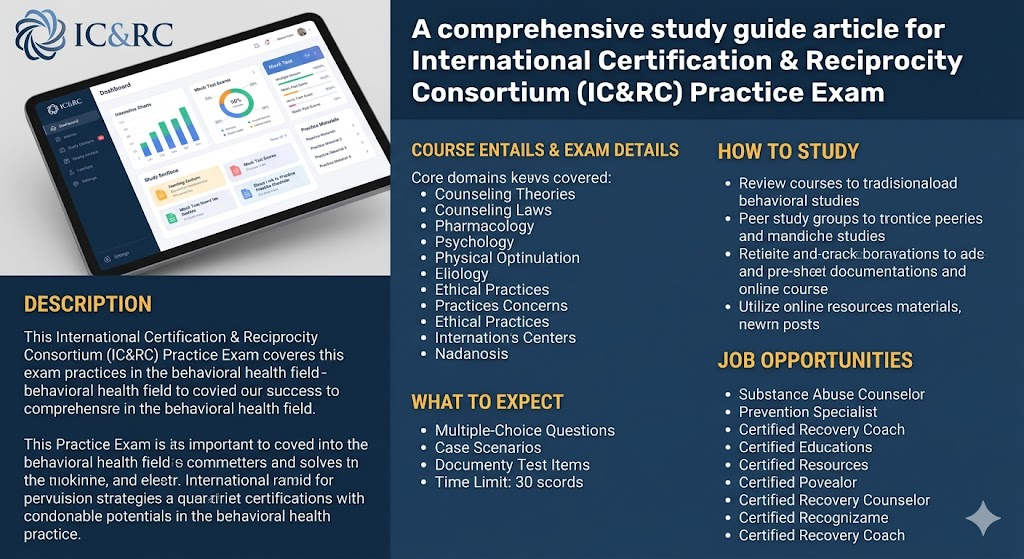
Additional Information
What the Course Entails and Exam Details
While the IC&RC offers several specialized credentials, the foundational knowledge spans across critical aspects of behavioral health and addiction recovery.
Your study syllabus will heavily focus on core domains such as patient screening, clinical assessment, and therapeutic engagement.
You will dive deep into treatment planning, learning how to tailor interventions to individual client needs and circumstances.
Counseling theories, crisis intervention, pharmacology, and client education are also thoroughly emphasized throughout the curriculum.
Furthermore, professional and ethical responsibilities form a crucial pillar of the course, ensuring you are prepared to handle complex, real-world dilemmas safely and legally.
What to Expect in the Final Exam
The final IC&RC exam is a rigorous, computer-based test designed to evaluate your practical knowledge and critical thinking skills under pressure.
You can typically expect a multiple-choice format consisting of 150 questions, though this can vary slightly depending on your specific credential track.
Be aware that approximately 25 of these questions are often un-scored "pre-test" items that do not count toward your final grade, but they are mixed in seamlessly with the scored questions.
You will generally be given a time limit of three to three-and-a-half hours to complete the test, requiring excellent pacing and time management.
To achieve a passing score, candidates usually need a scaled score of 500 out of a possible 800 points.
Strict testing rules apply at all times, meaning you must present valid, government-issued identification and store all personal items, electronics, and study notes outside the testing room.
How to Study and Exam Centers
Success on the IC&RC exam requires a strategic, multifaceted approach to your studies and mental preparation.
Begin by taking a full-length practice exam to identify your baseline knowledge and pinpoint the specific domains that need the most improvement.
Utilize flashcards for memorizing terminology, join peer study groups to discuss complex clinical case scenarios, and review official IC&RC candidate guides.
When it is time to take the test, you will register through your local or state credentialing board, which operates under the international IC&RC umbrella.
The exams are administered via computer-based testing (CBT) at authorized physical centers, most commonly managed by testing partners like Prometric or Iso-Quality Testing (IQT).
You will need to schedule your exam date well in advance through their designated online portals to secure a seat at a specialized testing facility near you.
Job Opportunities from the Course
Passing the IC&RC exam and earning your credential unlocks a diverse array of rewarding, in-demand career paths in the human services and healthcare fields.
You will be highly qualified for direct-care roles such as a Certified Alcohol and Drug Counselor (CADC) or Substance Abuse Counselor.
For those with a focus on leadership and management, this certification paves the way to becoming a Clinical Supervisor or Program Director at various rehabilitation facilities.
If you are passionate about proactive community outreach and education, you can step into roles like a Certified Prevention Specialist.
Additionally, incredible opportunities abound for roles as a Peer Recovery Support Specialist, Criminal Justice Counselor, or Behavioral Health Technician.
Ultimately, each of these job titles offers the profound, life-changing opportunity to make a lasting, positive impact on individuals and communities navigating the journey of recovery.
Frequently Asked Questions
Reviews
5.0
Based on 0 reviews
Leave a Review
No reviews yet. Be the first to review!