
International General Certificate of Secondary Education (IGCSE) Chemistry Practice Exam
$69.00
- Buy to unlock unlimited access to all Quiz questions and Answers in this Quiz.
- After purchase you can print a PDF of the whole quiz at any point. The PDF will contain the questions and the correct answers.
About this Exam
The International General Certificate of Secondary Education (IGCSE) Chemistry exam is a globally recognized qualification that assesses a student's understanding of fundamental chemical principles and their application. Designed typically for students aged 14 to 16, this comprehensive exam serves as a gateway to further study in science, particularly for those aiming for A-Levels, the International Baccalaureate (IB) Diploma, or careers in medicine, engineering, and environmental science. It is tailored for individuals who wish to develop a critical foundation in the 'central science,' combining theoretical knowledge with essential practical skills.
Ready to test your knowledge?
Buy Now to Access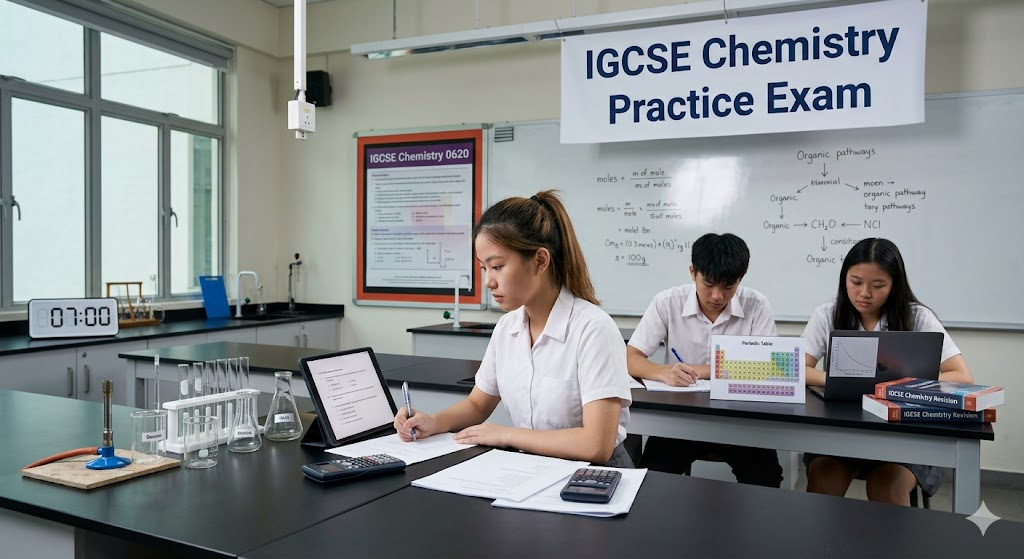
Additional Information
What the Course Entails and Exam Details
This course provides a robust introduction to the world of molecules, reactions, and the material universe. The IGCSE Chemistry syllabus covers a wide array of core topics, including the states of matter and the particle model. Students delve into atomic structure, learning about elements, compounds, and isotopes. A significant portion of the course focuses on chemical bonding, stoichiometry (the mole concept), and chemical calculations, which are essential for practical application. Other critical areas include chemical energetics, rates of reaction, reversible reactions, and equilibrium. Students will also master concepts surrounding acids, bases, and salts, alongside redox reactions and electrochemistry. A thorough exploration of the Periodic Table, the chemistry of metals, environmental chemistry, and a substantial introduction to organic chemistry rounds out the theoretical framework. The course strongly emphasizes experimental techniques and data analysis, which are tested in a dedicated practical or alternative-to-practical component.
What to Expect in the Final Exam
The IGCSE Chemistry final exam structure typically involves a combination of papers, allowing students to demonstrate their abilities across different competencies. Depending on the specific exam board (e.g., Cambridge, Edexcel), students usually sit two or three papers. For the theory-based assessment, there are often two tiers: a Core curriculum, leading to grades C to G, and an Extended curriculum, leading to grades A* to G, which includes both the Core and Supplement content. A typical extended assessment profile includes Paper 1 (Multiple Choice, Core), Paper 2 (Multiple Choice, Extended), Paper 3 (Theory, Core), or Paper 4 (Theory, Extended). The multiple-choice papers are usually 45 minutes long, with 40 marks, contributing around 30% to the final grade. The theory papers are generally 1 hour 15 minutes, with 80 marks, contributing 50%. A crucial part of the IGCSE is the practical component, where students either take Paper 5 (Practical Test) or Paper 6 (Alternative to Practical). Both focus on experimental skills and investigation, are typically 1 hour long, have 40 marks, and weigh 20% of the overall qualification. There isn't a single 'passing score'; rather, students are awarded grades from A* to G, with A* being the highest. All required data, such as the Periodic Table, is provided in the exam.
How to Study and Exam Centers
Effective preparation for the IGCSE Chemistry exam requires a strategic mix of consistent study and active practice. First, develop a comprehensive understanding of the entire syllabus, prioritizing areas where you feel less confident. Utilize diverse resources, such as recommended textbooks, revision guides, and online educational platforms, to reinforce your learning. Create concise revision notes, mind maps, and flashcards, focusing on definitions, chemical formulae, reaction conditions, and key processes like the extraction of metals or organic pathways. Consistent use of spaced repetition is highly beneficial. One of the most powerful study techniques is working through past exam papers under timed conditions. This familiarizes you with the exam format, the style of questions, and improves your time management. Always mark your work using the official marking schemes to understand what examiners are looking for. Practice drawing and labeling apparatus, planning experiments, and interpreting data to excel in the practical paper (or alternative). To take the actual exam, you must register through an authorized IGCSE examination center. This is typically done through your current school, or, for private candidates, via local British Council offices or authorized independent schools. In some regions and for certain exam boards, components may be facilitated through online portals or specialized centers like Pearson VUE, especially for computer-based aspects or specific certifications.
Job Opportunities from the Course
A strong performance in IGCSE Chemistry opens numerous pathways for future academic and career progression. It is a foundational requirement for many science-based careers and further educational opportunities. Below are specific job titles and career paths this qualification can unlock or contribute to:
Further Study: Acts as a critical prerequisite for A-Level Chemistry, IB Diploma Science, and T-Level science and healthcare courses.
Healthcare: Pathway to roles such as Pharmacist, Nurse, Dentist, Veterinarian, and Doctor (GP or Specialist).
Chemical and Process Engineering: Leads to careers as a Chemical Engineer, Materials Engineer, or Nuclear Engineer.
Laboratory Careers: Specific roles including Laboratory Technician, Analytical Chemist, Research Scientist, and Quality Control Chemist.
Environmental and Geosciences: Jobs like Environmental Consultant, Toxicologist, Agricultural Scientist, and Geotechnician.
Forensic and Legal: Unlocks careers such as Forensic Scientist and Patent Attorney (specializing in chemical patents).
Industry and Manufacturing: Roles in Food Science, Brewery and Distillery Work, and the development of new materials, paints, or pharmaceuticals.
Education and Communication: Leads to being a Chemistry Teacher, Science Writer, or Science Communicator.
By providing a robust understanding of the composition, properties, and interactions of matter, an IGCSE Chemistry qualification empowers students with both a detailed knowledge base and the transferrable problem-solving skills highly valued in the modern workforce.
Frequently Asked Questions
Reviews
5.0
Based on 0 reviews
Leave a Review
No reviews yet. Be the first to review!