
International Human Rights Practice Test
$69.00
- Buy to unlock unlimited access to all Quiz questions and Answers in this Quiz.
- After purchase you can print a PDF of the whole quiz at any point. The PDF will contain the questions and the correct answers.
About this Exam
The International Human Rights Practice Test is a crucial tool designed for anyone looking to validate or improve their knowledge of the international human rights system. This practice assessment is tailored for students of international law, political science, global studies, and related fields. It is also an excellent resource for professionals working in non-governmental organizations (NGOs), government agencies, and international bodies who need to ensure they possess a current, rigorous understanding of the field. The core purpose of this test is to simulate the challenging nature of real-world human rights examinations, ensuring candidates are fully prepared for academic or professional certification in this vital discipline.
Ready to test your knowledge?
Buy Now to Access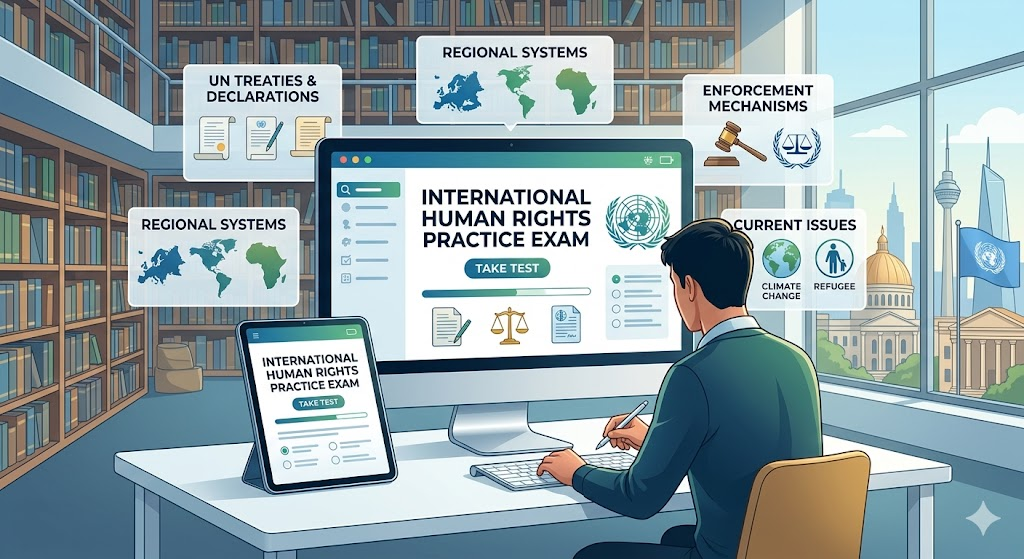
Additional Information
What the Course Entails and Exam Details
This comprehensive study guide covers the full spectrum of topics often found in an advanced international human rights course. Mastery of these areas is essential to success on the practice test.
Core Topics Include:
Foundations of Human Rights: Understanding the historical development, philosophical origins, and theoretical frameworks of human rights, including concepts of universalism and cultural relativism.
The UN Human Rights System: Detailed knowledge of the UN Charter, the Universal Declaration of Human Rights (UDHR), and the major international treaties, including the International Covenant on Civil and Political Rights (ICCPR) and the International Covenant on Economic, Social and Cultural Rights (ICESCR).
Regional Human Rights Systems: Analysis of the African, Inter-American, and European human rights systems, their respective treaties, and judicial bodies (e.g., the European Court of Human Rights).
Specialized Human Rights Issues: In-depth study of specific areas, including women’s rights, children’s rights, indigenous rights, refugee and migrant rights, and the prevention of genocide.
Mechanisms of Enforcement and Monitoring: Examination of the roles of UN treaty bodies, special procedures, the Human Rights Council’s Universal Periodic Review (UPR), and international criminal tribunals.
Human Rights in Practice: Analyzing the role of NGOs, human rights defenders, and the challenges of implementing human rights standards in diverse political and cultural contexts.
What to Expect in the Final Exam
While the exact structure of a final, official exam can vary by institution or certifying body, the International Human Rights Practice Test is designed to mimic the most common formats and rigors.
Typical Exam Components:
Format: A combination of multiple-choice questions to test broad knowledge and recall, short-answer questions for concise analysis, and essay questions or case studies to assess in-depth understanding, critical thinking, and the ability to apply legal frameworks to complex scenarios.
Time Limit: Expect a timed exam, typically ranging from 2 to 4 hours, forcing candidates to demonstrate efficiency in their analysis.
Passing Score: Most professional and academic exams require a passing score of at least 70% to 75%.
Specific Rules: Exams may be closed-book, although some components (especially legal case analysis) might allow access to primary treaty documents.
How to Study and Exam Centers
Preparing for the International Human Rights Practice Test demands a structured and comprehensive study approach. It is not an exam that can be passed through simple memorization.
Actionable Study Strategies:
Master Primary Sources: The absolute foundation of your study must be the primary legal texts. Read, re-read, and analyze the UDHR, ICCPR, ICESCR, and other key conventions and declarations.
Analyze Landmark Cases: Study pivotal cases from international courts and UN treaty bodies. Understand the legal reasoning and the precedent they set.
Use Active Recall and Spaced Repetition: Use flashcards for key terms, dates, treaties, and case names. Create summaries of complex enforcement mechanisms.
Take Multiple Practice Tests: This is crucial. Use mock exams to familiarize yourself with the question formats, identify knowledge gaps, and practice under timed conditions.
Form a Study Group: Discussing complex human rights dilemmas with peers is an excellent way to deepen your understanding and explore multiple perspectives.
Where to Take the Exam:
Practice tests are often available through various channels:
Online Learning Portals: Many universities and specialized online education platforms (like Fiveable, Coursera, or edX) offer practice quizzes as part of their human rights courses.
University Learning Management Systems: If you are a enrolled student, check your university’s internal portal (e.g., Canvas, Blackboard) for mock exams provided by your department.
Authorized Schools and Organizations: Some specific certificate programs may direct you to their own secure online platform or to an authorized local testing center.
Job Opportunities from the Course
A strong performance on the International Human Rights Practice Test and subsequent certification opens doors to a diverse and impactful range of career paths across multiple sectors.
Specific Job Titles and Career Paths:
Human Rights Officer (International Organizations like the UN): Monitoring, reporting, and advocating for human rights.
Human Rights Lawyer/Advocate: Representing victims of violations and working on strategic litigation.
Program Manager/Director (Human Rights NGOs): Designing and implementing human rights projects and campaigns.
Policy Analyst/Advisor (Government and International Bodies): Developing and implementing human rights policies.
Researcher/Academic (Universities and Think Tanks): Conducting in-depth research on human rights issues.
Diplomat/Foreign Service Officer: Representing national interests while promoting human rights globally.
Corporate Social Responsibility (CSR) Specialist: Ensuring businesses adhere to human rights standards.
Journalist/Media Specialist: Reporting on human rights abuses and advocating for justice.
By following this guide and utilizing the International Human Rights Practice Test, you are taking a definitive step toward mastering a critical field and advancing a career dedicated to protecting the fundamental rights of people worldwide. Good luck with your studies!
Frequently Asked Questions
Reviews
5.0
Based on 0 reviews
Leave a Review
No reviews yet. Be the first to review!