
International Logistics Practice Test
$69.00
- Buy to unlock unlimited access to all Quiz questions and Answers in this Quiz.
- After purchase you can print a PDF of the whole quiz at any point. The PDF will contain the questions and the correct answers.
About this Exam
The International Logistics certification is a highly sought-after credential designed for supply chain professionals, global trade specialists, and import/export managers.
It validates a candidate's ability to navigate the complex web of global commerce, cross-border transportation, and international supply chain strategies.
This exam is specifically tailored for individuals aiming to prove their expertise in moving goods efficiently across international borders while maintaining compliance with diverse regulatory frameworks.
Whether you are looking to advance in your current logistics role or transition into a global trade career, passing this test demonstrates that you possess the practical and theoretical knowledge required by top-tier multinational corporations.
Ready to test your knowledge?
Buy Now to Access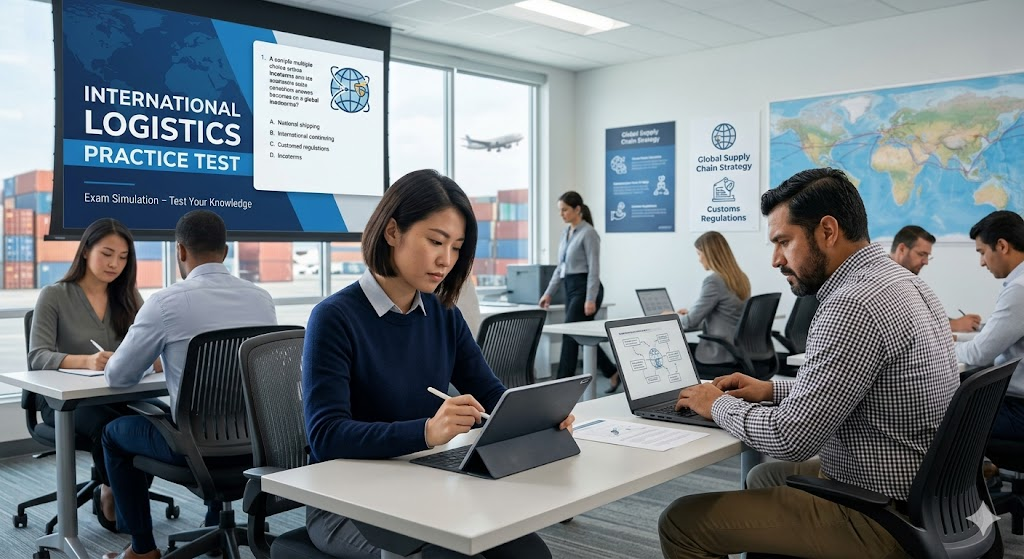
Additional Information
What the Course Entails and Exam Details
Preparing for this exam requires a deep understanding of the global supply chain ecosystem.
Candidates will delve into core topics such as international freight forwarding, inventory management across multiple geographic nodes, and global risk mitigation strategies.
A significant portion of the syllabus is dedicated to mastering customs and trade compliance, ensuring that goods can clear borders without costly delays.
Furthermore, the course heavily emphasizes Incoterms (International Commercial Terms), cross-border documentation, marine insurance, and the selection of appropriate international transport modes, including air, ocean, and rail freight.
What to Expect in the Final Exam
The final examination is rigorously structured to test both your factual knowledge and your ability to apply concepts to real-world scenarios.
You can generally expect a computer-based format consisting of 100 to 150 multiple-choice questions, alongside several detailed case studies that require critical analysis.
To achieve certification, candidates must typically secure a passing score of at least 70% to 75%, depending on the specific certifying body.
The time limit is usually set between two to three hours, requiring excellent time management skills.
Please note that this is typically a closed-book exam, and strict proctoring rules apply, meaning no outside materials or unauthorized devices are permitted in the testing area.
How to Study and Exam Centers
Success in this exam relies on a structured, disciplined, and proactive study strategy.
We highly recommend utilizing a combination of flashcards for memorizing Incoterms, comprehensive mock exams to build stamina, and active recall techniques.
Taking multiple practice tests is crucial, as it familiarizes you with the phrasing of the questions and highlights any weak areas in your knowledge base.
When it comes to taking the actual test, candidates have flexible options provided by global testing networks like Pearson VUE or Prometric.
You can choose to sit for the exam at an authorized physical testing center, which provides a quiet and secure environment, or you can opt for secure online proctoring portals, allowing you to take the exam from the comfort of your own home or office under remote supervision.
Job Opportunities from the Course
Earning this certification unlocks a wide array of lucrative and dynamic career paths in the global market.
Global Supply Chain Manager
International Freight Forwarder
Import/Export Compliance Specialist
Customs Broker
Global Logistics Analyst
Trade Compliance Manager
International Procurement Officer
Ocean/Air Freight Operations Manager
Frequently Asked Questions
Reviews
5.0
Based on 0 reviews
Leave a Review
No reviews yet. Be the first to review!