
International Powerlifting Federation (IPF) Referee Practice Exam
$69.00
- Buy to unlock unlimited access to all Quiz questions and Answers in this Quiz.
- After purchase you can print a PDF of the whole quiz at any point. The PDF will contain the questions and the correct answers.
About this Exam
Embarking on the journey to become a certified referee for the International Powerlifting Federation (IPF) is a testament to your dedication to the sport. The IPF referee certification is designed for knowledgeable enthusiasts, experienced lifters, and existing regional officials who seek to uphold the highest standards of integrity, consistency, and technical accuracy in powerlifting competitions globally.
Achieving this prestigious qualification validates your expertise in the intricate technical rules governing squats, bench presses, and deadlifts within the IPF framework. This guide provides comprehensive resources and insights into the preparation, exam structure, and career path for aspiring and improving referees, helping you contribute significantly to the sport's fairness and professionalism.
Ready to test your knowledge?
Buy Now to Access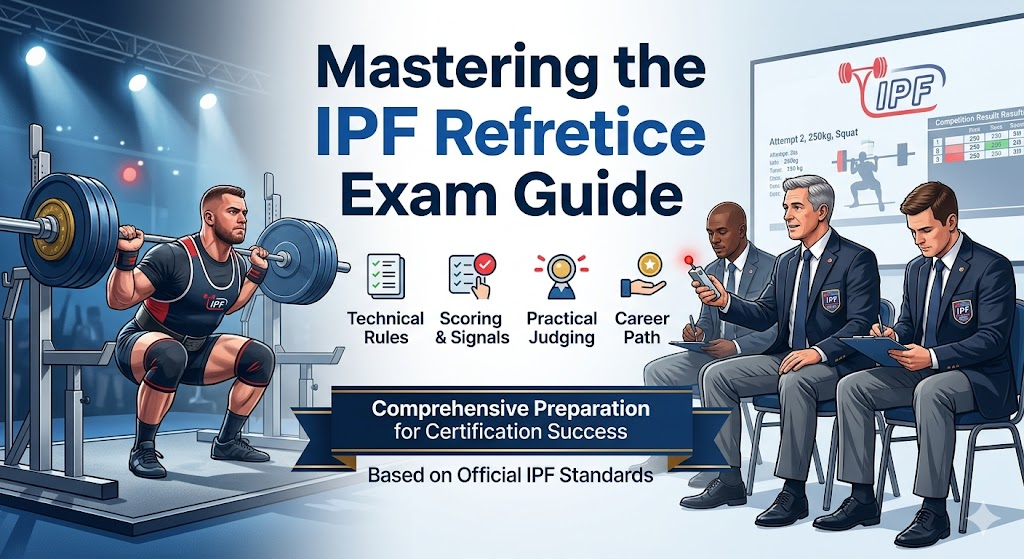
Additional Information
What the Course Entails and Exam Details
While not always structured as a formal "course" in all regions, preparing for the IPF Referee certification fundamentally requires an in-depth study of the current IPF Technical Rulebook. This comprehensive document details every aspect of a powerlifting competition, and your understanding must be thorough and precise.
The core topics you must master include:
Rules of Performance: Understanding the exact technical requirements and failure criteria for each of the three competitive lifts: the Squat, Bench Press, and Deadlift.
Referee Commands & Signals: Memorizing the precise timing, content, and visual/audible execution of all essential commands for the Chief Referee and duties of Side Referees.
Equipment and Apparel Standards: Knowing the strict specifications for approved lifting gear (suits, shirts, belts, wraps, etc.), personal attire, and competition equipment.
General Competition Rules: Understanding weigh-in procedures, attempt order, scoring, drug testing protocols, jury operations, and general conduct within the competition arena.
Referee Responsibilities & Ethics: Grasping the crucial role, professionalism, impartiality, and code of conduct expected from all IPF referees.
Your local or national federation may offer seminars, workshops, or mentoring, but ultimately, consistent self-study of the Rulebook and practical application are paramount.
What to Expect in the Final Exam
The actual IPF referee examination typically consists of two distinct parts to rigorously evaluate your theoretical knowledge and practical competence. Initial provincial or divisional certifications might have simpler, sometimes open-book online exams, but progressing towards national and international status involves more demanding assessments.
Theory Examination (Written):
Format: The written exam is commonly a multiple-choice assessment consisting of approximately 80 to 100 questions. It is designed to be challenging and closed-book, often with a time limit (e.g., 2 hours).
Content: Questions cover the entire scope of the technical rulebook, testing your detailed knowledge of lift standards, equipment specifications, procedures, and ethical scenarios.
Passing Score: Achieving a high percentage, often 80% to 90%, is necessary to proceed.
Practical Assessment:
Format: Upon successfully passing the written component (especially for National and International levels), candidates must undergo a practical examination conducted during a sanctioned powerlifting competition.
Procedure: Under the supervision of highly qualified and experienced examiners (such as Senior International Referees), you will be assigned to officiate as a platform referee.
Content: Your judging decisions on numerous attempts (e.g., up to 40 squats, 30 bench presses, and 30 deadlifts) across different lifting groups will be meticulously recorded and evaluated against the consensus of the jury or examiners. You must accurately determine white light (good lift) or red light (no lift) decisions and specify infractions for invalid attempts. Running weigh-in procedures may also be part of the evaluation.
Passing Score: Consistency is key. A very high level of agreement, typically 90?curacy or better with the examiners’ decisions across the full spectrum of observed lifts, is required to achieve certification.
Specific exam details and scoring thresholds can vary slightly between member federations and are updated periodically by the IPF Technical Committee.
How to Study and Exam Centers
Effective preparation demands dedication and a multifaceted approach. Leveraging official resources and engaging with the powerlifting community is essential. Actionable study strategies include:
Download and Master the IPF Technical Rulebook: Obtain the absolute latest version from the official IPF website. Dedicate significant time to studying every section repeatedly until you have near-encyclopedic knowledge.
Watch and Analyze Videos: Review extensive footage of powerlifting competitions (both live and recorded). Critically observe each lift, practicing making immediate decisions in real-time. Discuss challenging cases with experienced referees.
Observe Competitions: Attend as many local and national competitions as possible. Actively observe the officiating from a spectator's perspective, paying close attention to consistency and any calls you find difficult.
Mock Judging: If possible, practice judging during training sessions at a local gym with understanding lifters, mimicking competition conditions as closely as you can.
Seek Mentorship: Connect with existing certified referees and national federations. Many experienced officials are willing to offer valuable guidance and feedback.
Use Practice Exams: While not always officially sanctioned online "practice exams," seek out and complete any available reliable practice questions or scenarios to test your knowledge retention, such as those that might be shared within national federation groups.
Exam Centers & Process:
Member Federations: The certification process usually originates and is administered through your National Powerlifting Federation affiliated with the IPF. You must be a member in good standing and adhere to their specific pathway.
Written Exam Delivery: Initial or divisional written exams may be proctored in person or increasingly delivered via secure online portals or software supervised by the national body.
Practical Exam Location: Practical assessments always take place at official, sanctioned powerlifting competitions within your nation, regional championships, or potentially international events once you meet the progression criteria. Your national federation will coordinate this phase upon successful written exam completion. Physical testing centers like Pearson VUE are not typically used for these specialized exams.
Always contact your local or national powerlifting association to obtain accurate information regarding current application procedures, available resources, upcoming exam opportunities, and required pathways in your region.
Job Opportunities from the Course
Upon achieving and progressing through the various levels of IPF referee certification, you unlock rewarding opportunities within the global powerlifting community. This path allows you to advance from local events to officiating at the most prestigious international competitions. While primarily volunteer positions initially, these roles offer unique experiences and contribute significantly to the sport. Specific roles and levels include:
Provincial / Divisional Referee
National Referee
IPF Category II Referee
IPF Category I Referee
Jury Member
Technical Controller
Referee Examiner
Competition Director
The IPF referee journey represents a significant commitment and a profound way to serve the powerlifting community, ensuring the sport's fairness and integrity across all levels.
Frequently Asked Questions
Reviews
5.0
Based on 0 reviews
Leave a Review
No reviews yet. Be the first to review!