
International Property Maintenance Code Practice Exam
$69.00
- Buy to unlock unlimited access to all Quiz questions and Answers in this Quiz.
- After purchase you can print a PDF of the whole quiz at any point. The PDF will contain the questions and the correct answers.
About this Exam
The International Property Maintenance Code (IPMC) certification is a prestigious credential administered by the International Code Council (ICC). This exam is meticulously designed for code officials, property maintenance inspectors, and housing inspectors who are responsible for the oversight of existing residential and commercial structures. By establishing minimum standards for light, ventilation, space, and safety, the IPMC ensures that all buildings remain safe, sanitary, and fit for human occupation. Achieving this certification proves your technical proficiency in identifying property deficiencies and enforcing code compliance to protect public health and community stability.
Ready to test your knowledge?
Buy Now to Access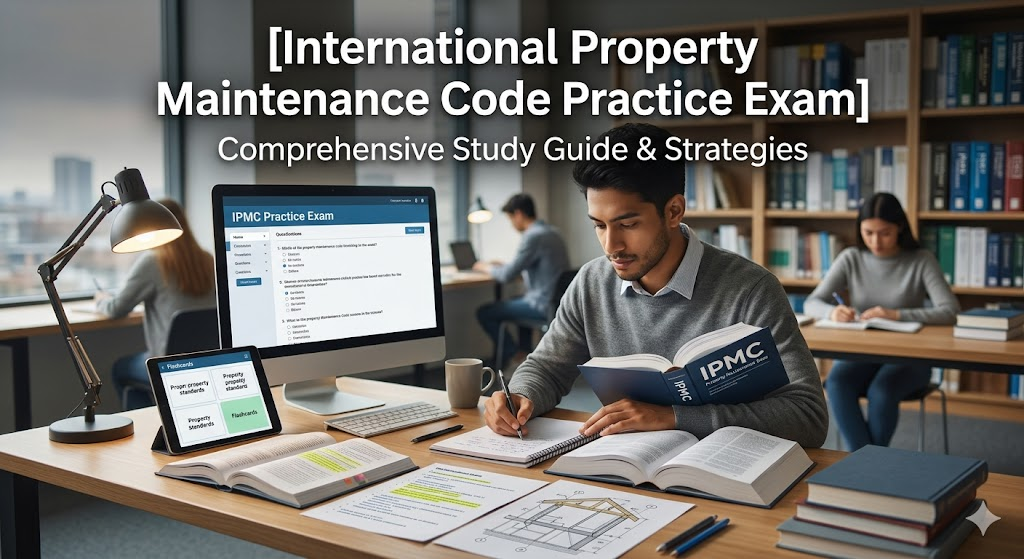
Additional Information
What the Course Entails and Exam Details
Preparing for this exam involves a deep dive into the regulatory framework that governs the upkeep of the built environment. The curriculum focuses heavily on the practical application of the International Property Maintenance Code book.
Core topics and skills covered include:
Administration and Enforcement: Understanding the legal authority of the code official, permit requirements, and the process for serving notices of violation.
General Requirements: Evaluating the exterior and interior of structures, including sanitation, grading, and structural integrity.
Light, Ventilation, and Occupancy: Mastering the minimum standards for window area, room dimensions, and ceiling heights.
Plumbing Facilities and Fixture Requirements: Inspecting for required facilities, water systems, and sanitary drainage.
Mechanical and Electrical Requirements: Identifying hazards in heating facilities, electrical equipment, and duct systems.
Fire Safety Requirements: Ensuring adequate means of egress, fire-resistance ratings, and functional smoke detection systems.
What to Expect in the Final Exam
The final certification exam is a rigorous assessment of your ability to navigate and interpret the code accurately under time pressure.
Exam Format: The test consists of multiple-choice questions. It is typically an "open-book" exam, meaning you are permitted to use the approved edition of the International Property Maintenance Code book.
Number of Questions: Candidates usually face 60 questions.
Time Limit: You are allotted 2 hours (120 minutes) to complete the assessment.
Passing Score: A passing score is generally a 70 or 75 scaled score, depending on the specific ICC jurisdiction and year.
Testing Method: The exam is available via the ICC PRONTO system (online proctored) or at physical testing centers.
How to Study and Exam Centers
Success on the IPMC exam requires a strategic approach that emphasizes navigation speed over rote memorization.
Actionable Study Strategies:
Master the Index: Since the exam is open-book, your ability to find keywords in the index and flip to the correct section quickly is your greatest asset.
Use Practice Tests: Engaging with an "International Property Maintenance Code Practice Exam" allows you to familiarize yourself with the phrasing of ICC questions.
Tab Your Code Book: Use permanent tabs to mark major chapters like "General Requirements" and "Fire Safety" for rapid reference.
Understand Definitions: Many questions hinge on the specific code definition of terms like "Habitable Space" or "Infestation".
Exam Centers:
The exam is administered through the International Code Council. You can choose to take the exam from your home or office using ICC PRONTO, which offers 24/7 online proctored testing. Alternatively, you may schedule an appointment at a Pearson VUE professional testing center for a traditional proctored environment.
Job Opportunities from the Course
Earning your IPMC certification opens doors to various roles within municipal government and private inspection firms.
Code Enforcement Officer: Investigating complaints and performing inspections to ensure local ordinances and international codes are met.
Property Maintenance Inspector: Focusing specifically on the upkeep of existing rental and commercial properties.
Housing Inspector: Evaluating subsidized or public housing to ensure it meets federal and local safety standards.
Building Official: Managing department operations and overseeing the enforcement of all building-related codes.
Private Property Consultant: Assisting real estate investors in identifying potential code violations before purchase.
Frequently Asked Questions
Reviews
5.0
Based on 0 reviews
Leave a Review
No reviews yet. Be the first to review!