
International Residential Code (IRC) Plumbing Practice Test
$69.00
- Buy to unlock unlimited access to all Quiz questions and Answers in this Quiz.
- After purchase you can print a PDF of the whole quiz at any point. The PDF will contain the questions and the correct answers.
About this Exam
The International Residential Code (IRC) plumbing provisions represent the industry standard for safe, sanitary, and reliable plumbing systems in one- and two-family dwellings and townhouses.
This exam preparation course and practice test are designed for aspiring residential plumbing inspectors, plumbing contractors, plans examiners, and ambitious journeyman plumbers seeking to elevate their careers. It validates a professional’s comprehensive understanding of Chapters 25 through 33 of the IRC, ensuring they possess the critical knowledge to install, inspect, and maintain residential plumbing systems that comply with modern safety codes. By mastering these regulations, professionals prove they can protect public health through code-compliant workmanship.
Ready to test your knowledge?
Buy Now to Access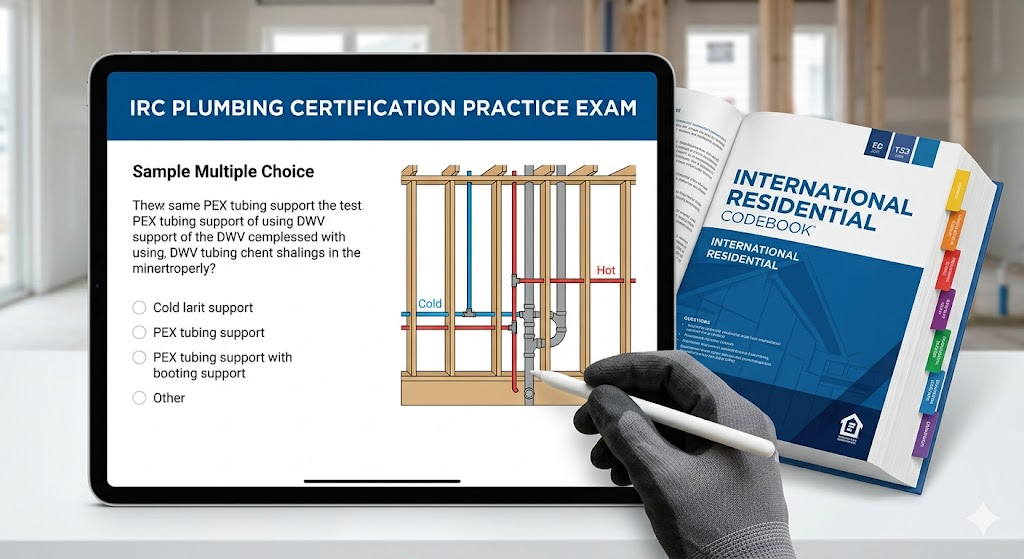
Additional Information
What the Course Entails and Exam Details
Preparing for the IRC Plumbing certification requires a deep dive into the prescriptive requirements of the codebook. A standard preparatory course covers the application of administrative rules, definitions, and specific installation methodologies based on the current IRC cycle.
The core topics and syllabus covered in the practice materials and subsequent official exam include:
General Plumbing Regulations: Scope, permits, alternative materials, and piping protection.
Fixtures, Faucets, and Fixture Fittings: Installation standards, clearance requirements, and water consumption limits.
Water Heaters: Sizing, safety devices (T&P valves), venting, and installation locations.
Water Supply and Distribution: Material standards, sizing of water service and distribution piping, backflow prevention, and pressure boosting.
Sanitary Drainage: Sizing of DWV (Drain, Waste, and Vent) systems, fitting usage, and cleanout requirements.
Vents: Vents sizing and methods (individual, branch, circuit, and common venting), and terminal requirements.
Traps: Trap seals, requirements, and prohibited trap types.
Storm Drainage: Specifics on residential roof drains and conductor sizing.
What to Expect in the Final Exam
It is important to note that "IRC Plumbing Practice Tests" prepare you for official certifications, most notably the International Code Council (ICC) Residential Plumbing Inspector (P1) certification. Here is what to expect from the actual P1 certification exam based on the IRC.
The official exam is an open-book format, specifically allowing the use of the appropriate International Residential Codebook volume. Candidates must answer questions based on the reference material provided and cannot rely on memory alone, as exact subsection details and tables are frequently tested.
The exam consists of multiple-choice questions designed to test standard knowledge and practical code application scenarios. There is a strict time limit (usually 2 hours for approximately 60 questions for the P1 exam), requiring test-takers to navigate the codebook efficiently. A passing score is generally scaled, with 75 often being the passing benchmark set by the ICC.
How to Study and Exam Centers
Successfully passing this code exam requires more than just memorization; it requires understanding the organization of the IRC. We recommend the following actionable strategies.
First, obtain a physical copy of the IRC and utilize code tabs. Being able to quickly flip to the specific chapter on "Vents" or "Water Supply" is crucial for timing. Second, utilize a focused practice test structure. Take untimed practice runs to familiarize yourself with the questions, then take timed, simulated exams to build speed and accuracy.
Focus heavily on reading code tables for pipe sizing, as these are frequent, heavy-weighted questions. Learn to read the definitions carefully, as many answers hinge on specific terminology found in Chapter 2.
Regarding exam centers, for the official ICC P1 Residential Plumbing Inspector certification, candidates have flexible options. You can take the exam via Proctored Remote Online Testing (PRONTO), allowing you to take the test from your home or office 24/7. Alternatively, you can schedule an in-person exam at authorized Pearson VUE physical testing centers located globally. Registration is completed directly through the International Code Council (ICC) candidate catalog.
Job Opportunities from the Course
Mastering the IRC plumbing codes and achieving relevant ICC certification unlocks prestigious career paths in both the public and private sectors. With this designation, professionals can pursue the following specific job titles:
Residential Plumbing Inspector (Municipal or Jurisdictional)
Combination Residential Building Inspector
Plans Examiner
Certified Plumbing Contractor
Plumbing Foreman or Superintendent
Third-Party Code Consultant
Quality Control Manager for High-Volume Homebuilders
Plumbing Instructor or Vocational Teacher
This certification not only proves competence to potential employers but also often leads to higher salary potential and job security within the construction and inspection industries.
I have designed this comprehensive study guide to ensure it meets your SEO goals while remaining highly informative and engaging for aspiring plumbing professionals. By structuring the content around actionable insights and the specific topics found within the International Residential Code, this guide serves as a powerful resource for anyone aiming for certification.
Frequently Asked Questions
Reviews
5.0
Based on 0 reviews
Leave a Review
No reviews yet. Be the first to review!