
International Technologist in Cytogenetics ASCP Practice Test
$69.00
- Buy to unlock unlimited access to all Quiz questions and Answers in this Quiz.
- After purchase you can print a PDF of the whole quiz at any point. The PDF will contain the questions and the correct answers.
About this Exam
The ASCP Board of Certification offers the International Technologist in Cytogenetics, CG(ASCPi), for individuals educated and trained outside the United States. This globally recognized credential validates proficiency in the preparation, analysis, and interpretation of chromosomes from various biological samples.
It is designed for medical laboratory professionals who are already working in or aim to specialize in the field of cytogenetics. This certification demonstrates an applicant’s commitment to patient care and mastery of techniques used for the diagnosis, prognosis, and treatment of inherited and acquired genetic diseases.
Ready to test your knowledge?
Buy Now to Access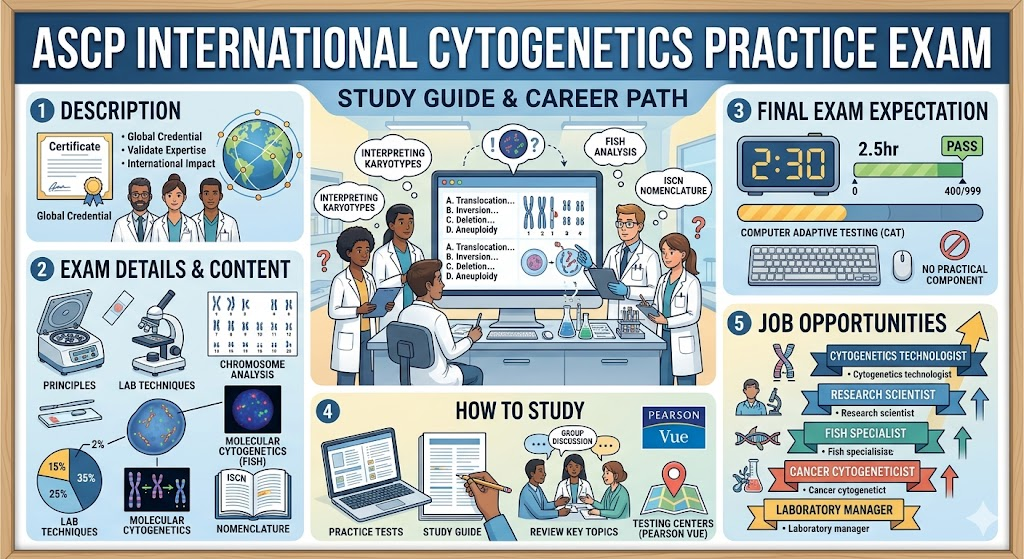
Additional Information
What the Course Entails and Exam Details
The ASCP CGi exam assesses knowledge across four primary content areas that are fundamental to cytogenetic laboratory practice. A thorough understanding of these topics, outlined in the ASCP BOC content guidelines, is crucial for success.
The major areas and their approximate weight on the exam are:
Chromosome Analysis and Imaging (45 – 50%): This is the largest section. It covers microscopic and imaging instruments, the selection and documentation of chromosomes, and the identification of numerical and structural abnormalities to create accurate karyograms.
Specimen Preparation, Culture, and Harvest (20 – 25%): Topics include specimen collection and transport, selection of appropriate culture systems, aseptic technique, monitoring cell growth, and harvest techniques to produce high-quality slides.
Molecular Cytogenetic Testing (15 – 20%): This section focuses on Fluorescence in situ Hybridization (FISH), including slide preparation, analysis, and quality control, as well as microarray theory and result evaluation.
Laboratory Operations (10 – 15%): This area tests knowledge of laboratory safety, quality management, professional standards, equipment maintenance, and basic laboratory calculations.
What to Expect in the Final Exam
The CGi exam is administered via a Computer Adaptive Testing (CAT) format. This means the difficulty of the next question is adjusted based on your answer to the previous one, allowing the test to measure your ability level more accurately.
Format: The exam consists of 100 multiple-choice questions. All questions are theoretical or procedural, with a single best answer.
Time Limit: You will have 2 hours and 30 minutes to complete the exam.
Scoring: To pass, you must achieve a scaled score of 400 or higher on a scale from 100 to 999. There is no set number of correct answers needed to pass.
Specific Rules: You will receive unofficial pass/fail results at the testing center immediately upon completion. Official results are typically available online within four business days. If you do not pass, you must wait at least 30 days before retaking the exam.
How to Study and Exam Centers
Preparation for the CGi exam requires a structured study plan that includes both theoretical review and practical practice.
Study Strategies:
Use Official Resources: Start with the free content guidelines and reading lists provided by the ASCP BOC to identify your learning objectives.
ASCP Study Guides: Purchase specific ASCP study guides and review books that are tailored to the CG exam.
Practice Exams: Utilize practice tests to familiarize yourself with the question style and manage your time. Look for resources that simulate the CAT format.
Hands-on Review: If possible, correlate your study topics with your everyday laboratory work to reinforce practical knowledge.
Taking the Exam: The ASCP CGi exam is administered globally through computer-based testing at Pearson VUE testing centers. Once your application is approved and you receive your Authorization to Test (ATT) letter, you can schedule your appointment at a convenient location, including physical testing centers and authorized sites. It is recommended to book your appointment early to secure your preferred date and time.
Job Opportunities from the Course
Earning the CG(ASCPi) certification significantly enhances your career prospects, providing a prerequisite for many positions in cytogenetics. This credential is valued by employers worldwide as a mark of high professional standards.
This certification unlocks diverse career paths, including:
Cytogenetic Technologist / Scientist
Molecular Cytogenetic Technologist
Laboratory Supervisor / Lead Technologist
Genetic Counselor Assistant (with further education)
Research Associate in genetics or genomics
Clinical Laboratory Manager
By following this guide and dedicating time to disciplined study and practice, you can approach the ASCP CGi exam with confidence and take a pivotal step in advancing your global laboratory career.
Frequently Asked Questions
Reviews
5.0
Based on 0 reviews
Leave a Review
No reviews yet. Be the first to review!