
International Trauma Life Support (ITLS) Practice Test
$69.00
- Buy to unlock unlimited access to all Quiz questions and Answers in this Quiz.
- After purchase you can print a PDF of the whole quiz at any point. The PDF will contain the questions and the correct answers.
About this Exam
The International Trauma Life Support (ITLS) certification is an intensive, two-day program that teaches a systematic, evidence-based approach to the rapid assessment and effective management of acute trauma patients. Originally designed as a method to improve pre-hospital trauma care, the course has evolved into a global standard recognized for its comprehensive curriculum. ITLS provides a framework for both basic and advanced providers to make critical, life-saving decisions under pressure, from the scene of an injury to ultimate definitive care. It is a mandatory requirement or highly recommended credential for a wide range of registered medical professionals, including paramedics, emergency medical technicians (EMTs), critical care nurses, emergency physicians, and search and rescue personnel, ensuring they possess the core skills to reduce mortality and morbidity from traumatic events.
Ready to test your knowledge?
Buy Now to Access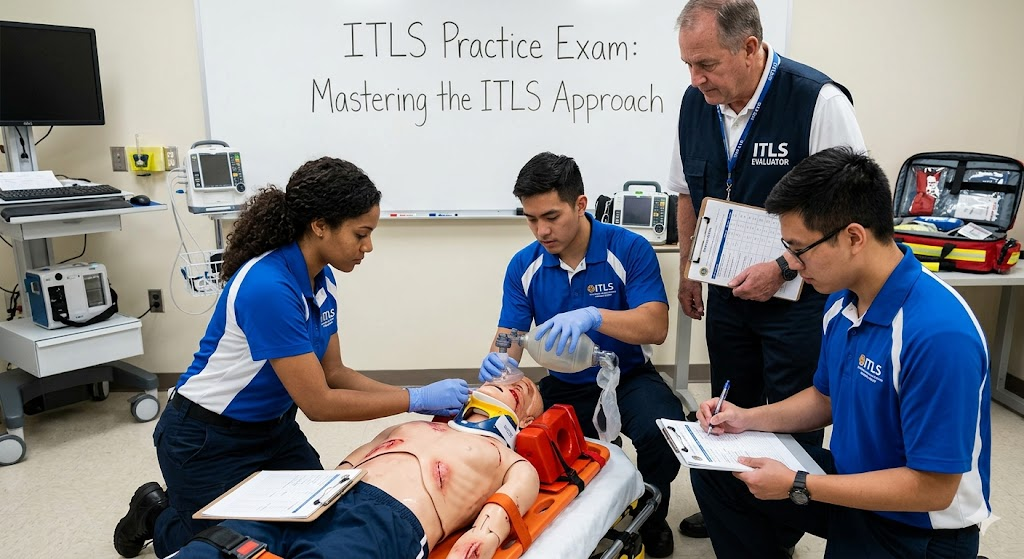
Additional Information
What the Course Entails and Exam Details
A successful ITLS certification requires pre-study of the comprehensive ITLS Provider manual and active participation in the two-day course. The course content is robust, combining interactive lectures with intensive hands-on skill stations and simulated patient scenarios. It is divided into basic and advanced levels, ensuring the training is appropriate for your specific licensure. The curriculum covers fundamental trauma concepts and the unique ITLS systematic patient assessment. Key modules include scene safety and triage, airway management in trauma, thoracic and abdominal trauma, shock and hemorrhage control, head and spinal trauma, extremity trauma, and trauma in special populations (pediatric, pregnant, and geriatric). In the skill stations, you will practice critical actions such as spinal motion restriction, extrication, hemorrhage control using tourniquets and hemostatic agents, and advanced airway techniques, all of which are essential components of the final assessment.
What to Expect in the Final Exam
The ITLS certification exam is comprehensive, demanding proficiency in both knowledge and application through two distinct components: a written examination and a practical scenario-based assessment. You must pass both to receive your card. The written exam is a one-hour test consisting of 50 multiple-choice questions that cover all the theoretical content, including algorithm pathways, pharmacological interventions, and clinical decision-making. The minimum passing score for the written exam is 74 percent. The second part is the practical exam, which is a Pass/Fail test. Candidates are evaluated on their ability to lead a team through a simulated trauma scenario. They are graded on their dynamic application of the ITLS systematic approach, the correct performance of critical medical skills, effective teamwork, and their ability to quickly recognize and treat life-threatening conditions while minimizing scene time.
How to Study and Exam Centers
Preparation for the ITLS course and final exam is paramount, as the two-day program is designed for review and practical application, not initial learning. You should begin by thoroughly reading the ITLS manual well in advance. Pay close attention to the algorithms, assessment flowcharts, and the logical rationale for the ITLS interventions. Take the required pre-test provided in your enrollment package to identify knowledge gaps and familiarize yourself with the question format. If possible, join a study group or work with a peer to practice the simulated practical scenarios, as verbalizing and physically performing the assessment are key to muscle memory. ITLS courses and exams are conducted globally through authorized ITLS Chapters and Training Centers. These locations range from hospitals and EMS agencies to accredited educational institutions. To find a certified provider and register for a course, you should use the official course finder on the ITLS International website.
Job Opportunities from the Course
An International Trauma Life Support (ITLS) certification is a powerful addition to your professional profile, unlocking numerous career paths in emergency medical services, critical care, and beyond. This globally recognized credential signals to employers that you have the skills to handle high-stakes traumatic situations. The specific job titles this certification can unlock or enhance include, but are not limited to, the following:
Emergency Medical Technician (EMT) - Basic and Advanced
Paramedic (ALS and Flight Paramedic)
Emergency Department (ER) Nurse
Critical Care Nurse (ICU/CCU)
Trauma Nurse
Emergency Room Physician (MD/DO)
Flight Nurse / Transport Medic
Search and Rescue Medic / Team Member
Military Combat Medic
Private Security Medical Specialist
Wilderness Emergency Medical Technician
International Relief and Development Medic
Ski Patrol / Mountain Rescue Medic
Firefighter with medical certifications
ITLS Instructor (requires advanced provider certification and achieving Instructor Potential designation)
Frequently Asked Questions
Reviews
5.0
Based on 0 reviews
Leave a Review
No reviews yet. Be the first to review!