
International Well Control Forum (IWCF) Practice Test
$69.00
- Buy to unlock unlimited access to all Quiz questions and Answers in this Quiz.
- After purchase you can print a PDF of the whole quiz at any point. The PDF will contain the questions and the correct answers.
About this Exam
The IWCF (International Well Control Forum) certification is the global gold standard for personnel involved in drilling, well completion, and well intervention operations.
It is designed to ensure that critical staff possess the essential knowledge and practical skills required to prevent well control incidents.
Furthermore, this certification aims to enhance safety and environmental protection within the oil and gas industry.
Utilizing an IWCF practice exam is a crucial step for candidates preparing to demonstrate their competency under rigorous testing conditions.
Ready to test your knowledge?
Buy Now to Access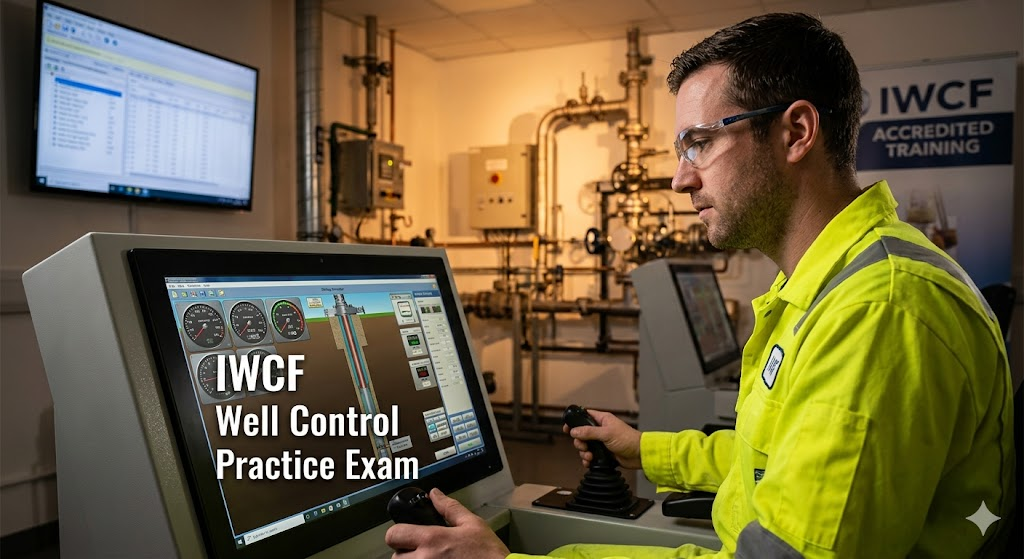
Additional Information
What the Course Entails and Exam Details
The IWCF training programs are structured around two main pillars: surface and subsea stack operations.
The curriculum is tailored to different responsibility levels, most notably the Driller Level (Level 3) and the Supervisor Level (Level 4).
The course covers a wide array of technical subjects critical to maintaining well safety.
Core topics include principles of formation pressure and primary well control.
Candidates must master methods for detecting kicks and establishing effective shut-in procedures.
Additionally, the syllabus covers various kill methods, such as the Driller’s Method and the Wait and Weight Method.
Finally, the course entails detailed studies of blowout preventer (BOP) equipment, control systems, and well control calculations.
What to Expect in the Final Exam
The formal IWCF examination process generally consists of two distinct components: a practical assessment and a series of theoretical written papers.
The practical assessment requires candidates to demonstrate their ability to manage a simulated well control scenario, including lining up the manifold and bringing a pump up to speed.
The theoretical component consists of multiple written exams covering "Principles and Procedures" and "Equipment."
Depending on the specific course, you may take exams focused on Surface, Subsea, or both.
The questions are primarily in a multiple-choice format, though some calculations are usually required for filling out a kill sheet.
To successfully obtain certification, candidates must achieve a passing score of at least 70% in every individual component of the exam.
Time limits vary by level but generally range from 1.5 to 2.5 hours per theoretical paper.
Strict adherence to international standards and regulatory guidelines is maintained throughout the examination process.
How to Study and Exam Centers
Preparation is vital, and the most effective study strategy involves using an IWCF practice exam to identify knowledge gaps.
Begin by thoroughly reviewing all course materials, including IWCF manuals, technical handouts, and relevant kill sheets.
Familiarize yourself with all necessary formulas; while some are provided, knowing how to apply them efficiently is critical.
Actively participate in simulator training sessions at your accredited facility to build confidence for the practical assessment.
Take multiple timed practice tests to become accustomed to the question phrasing and time pressure you will experience on exam day.
The final IWCF exam cannot be taken at general testing centers like Pearson VUE.
You must sit for the examination at an IWCF-accredited training provider or dedicated facility authorized by the International Well Control Forum.
Candidates must register for the course and the associated exam directly through one of these accredited centers worldwide.
Job Opportunities from the Course
Successfully gaining IWCF certification significantly boosts career prospects in the upstream oil and gas sector.
Below is a list of job opportunities and career paths this qualification unlocks:
Assistant Driller
Driller (Level 3 Certification usually required)
Toolpusher
Rig Manager
Drilling Supervisor (Level 4 Certification usually required)
Company Representative (Company Man)
Drilling Engineer
Well Intervention Supervisor
Completion Engineer
Frequently Asked Questions
Reviews
5.0
Based on 0 reviews
Leave a Review
No reviews yet. Be the first to review!