
Internet of Things (IoT) Practice Exam
$69.00
- Buy to unlock unlimited access to all Quiz questions and Answers in this Quiz.
- After purchase you can print a PDF of the whole quiz at any point. The PDF will contain the questions and the correct answers.
About this Exam
The fundamental Internet of Things (IoT) Practice Exam is a powerful preparatory tool expertly crafted for IT professionals, engineers, developers, students, and tech enthusiasts eager to solidify their knowledge and validate their skills in the diverse and evolving world of IoT. This comprehensive practice experience is designed to simulate the content, structure, and challenges you will encounter on leading IoT certification exams from various industry providers. It empowers you to assess your current readiness, identify critical knowledge gaps, build confidence, and refine your exam-taking strategies. Whether you are aiming to advance in your current role, embark on a new career path in IoT, or simply master the technologies connecting our world, this practice exam serves as a vital first step towards your goals.
Ready to test your knowledge?
Buy Now to Access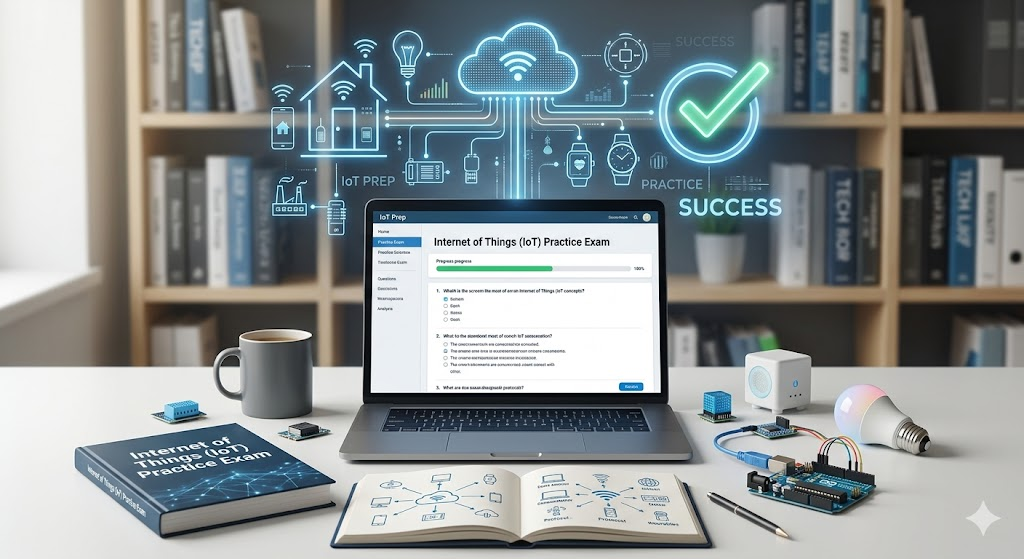
Additional Information
What the Course Entails and Exam Details
This practice exam meticulously reflects the broad spectrum of topics covered across comprehensive IoT certification pathways. While specific course details can vary depending on the target certification, you can expect robust practice coverage in the following areas:
IoT Ecosystem & Architectures: Understanding the fundamental layers, components, and interactions within complex IoT systems.
Device Connectivity & Sensors: Knowledge of sensor types, actuators, microcontrollers, gateways, and techniques for effective device management.
Communication Protocols: In-depth exploration of key IoT protocols such as MQTT, CoAP, Zigbee, BLE, Wi-Fi, and other critical networking standards.
Data Ingestion & Analytics: Techniques for efficiently collecting, processing, storing, and analyzing the massive data streams generated by IoT devices.
IoT Security & Privacy: Vital principles for securing devices, networks, and data, addressing unique vulnerabilities, and ensuring data privacy.
Cloud Integration: Understanding how to connect and integrate IoT solutions with leading cloud platforms (AWS IoT, Azure IoT, etc.).
A typical high-quality practice exam, such as this one, consists of a series of multiple-choice questions, scenario-based problems, and potentially practical, simulation-style questions that mirror the actual test environment. Most providers offer detailed explanations for correct and incorrect answers, timed exam simulations, and performance dashboards to track your progress and readiness across different domains.
What to Expect in the Final Exam
While this practice exam is an essential preparation tool, it is important to remember that the final, actual certification exams vary depending on the specific provider (AWS, Cisco, Microsoft, CompTIA, ISACA, etc.). However, you can generally expect:
Exam Format: Most IoT certification exams primarily utilize multiple-choice questions (single or multiple correct answers). Some might incorporate performance-based questions, labs, or scenario simulations set within a virtual environment.
Passing Score: Required passing scores fluctuate by provider and exam difficulty. Generally, you should aim for a score between 65% and 75% or higher to successfully certify. This practice exam is designed to help you achieve and exceed that required proficiency level.
Time Limits: Certification exams are typically timed, ranging from 90 to 120 minutes or more. Managing your time effectively during the actual test is crucial, a skill you will develop through timed practice sessions.
Rules and Proctoring: Final exams are almost always formally administered and proctored. This can take place online via authorized proctoring services (requiring a webcam, microphone, and secure environment) or in-person at specific testing centers. Rules regarding allowed materials, breaks, and conduct will be strictly enforced.
By thoroughly engaging with this practice exam, you will not only master the content but also become deeply familiar with the typical structures and pressure conditions, significantly increasing your chances of success in the final certification.
How to Study and Exam Centers
Preparation for your IoT certification should be a multi-faceted approach, with this practice exam serving as a critical cornerstone. Follow these proven study strategies:
Practice Regularly and Review Thoroughly: Treat every practice session seriously. Simulate real exam conditions (quiet space, timer), and most importantly, deeply review every single question—especially the incorrect ones—understanding the detailed explanations provided. Aim for consistently high scores well above the passing threshold across multiple practice test versions.
Supplement with diverse resources: Don’t rely solely on one practice test. Utilize official study guides from your chosen certification provider, online courses (Coursera, Udemy, LinkedIn Learning), hands-on projects (build your own small IoT setup!), relevant technical documentation, and authoritative blogs.
Get Hands-on Experience: The best way to learn IoT is by doing. Experiment with microcontrollers, connect sensors, send data to the cloud, and work with different communication protocols. Practical experience reinforces theoretical knowledge significantly.
Join Communities and Study Groups: Engage with online forums (like Stack Overflow, specific IoT subreddits, LinkedIn groups) and find local or virtual study partners. Discussing concepts, troubleshooting issues, and sharing resources can accelerate your learning and keep you motivated.
Exam Centers and Portals:
Practice Exams: You can access this practice exam primarily through dedicated online educational platforms, certification training websites, or specific practice test provider portals. They are typically taken remotely from your own computer at your convenience.
Final Certification Exams: The formal, proctored final exams are scheduled through authorized administrators or portals. The most prominent example is Pearson VUE, which has a vast global network of physical testing centers and also offers secure online proctoring for many certifications. Additionally, some certification bodies have their own direct online portals for remote proctoring or work with other specified testing delivery partners. You must register and pay for the final exam separately on these official platforms.
Job Opportunities from the Course
Successfully validating your IoT expertise through certification, supported by rigorous practice, opens doors to a multitude of exciting and high-demand career paths across diverse industries. The knowledge and validation gained empower you to pursue roles such as:
IoT Solutions Architect: Designing and overseeing the overall architecture of complex IoT systems.
Embedded Systems Engineer: Developing the firmware and software that runs directly on IoT devices.
IoT Platform Developer: Building and maintaining the backend platforms that process and analyze massive amounts of IoT data.
IoT Data Analyst: Extracting actionable insights from vast streams of sensor data.
IoT Cybersecurity Specialist: Securing devices, networks, and data in the vulnerable connected ecosystem.
IoT Network Engineer: Designing and managing the communication networks connecting IoT devices.
IoT Application Developer: Creating user-facing applications to interact with and control connected smart systems.
By investing in this practice exam and subsequently achieving your IoT certification, you are strategically positioning yourself at the forefront of technological innovation and unlocking exceptional career growth potential.
Frequently Asked Questions
Reviews
5.0
Based on 0 reviews
Leave a Review
No reviews yet. Be the first to review!