
Interpreter Certification Practice Exam
$69.00
- Buy to unlock unlimited access to all Quiz questions and Answers in this Quiz.
- After purchase you can print a PDF of the whole quiz at any point. The PDF will contain the questions and the correct answers.
About this Exam
The Interpreter Certification Practice Exam is a crucial preparation tool designed for bilingual individuals seeking official credentials as professional interpreters. This practice exam is tailored to help candidates assess their readiness for rigorous certification tests, which are the industry standard across various sectors.
The primary certification (though specializations exist in medical and legal fields) validates that an interpreter possesses the necessary cognitive abilities, language proficiency, and ethical grounding to facilitate accurate communication between parties who do not share a common language. Achieving certification signifies not only linguistic competence but also professionalism and adherence to national standards of practice, bridging vital communication gaps in highly sensitive scenarios.
Ready to test your knowledge?
Buy Now to Access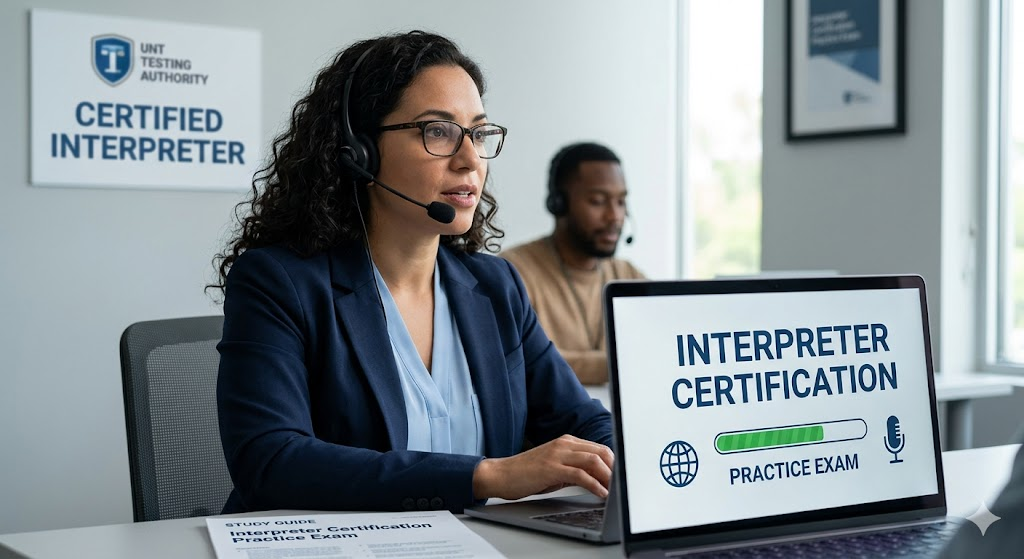
Additional Information
What the Course Entails and Exam Details
While the specific content of certification tests can vary by specialization (such as medical, legal, or community interpreting), the skills assessed are generally standard and robust. Candidates preparing for the final exam must demonstrate competence in the following core areas:
Language Proficiency: Near-native fluency in both English and the non-English language (LOTE - Language Other Than English), including precise terminology and nuanced vocabulary.
Interpreting Modes: Mastery of the three main modes of interpretation.
Consecutive Interpreting: Listening to a segment of speech and then interpreting it accurately after the speaker pauses.
Simultaneous Interpreting: Converting messages into the target language in real-time, while the speaker continues to talk (crucial for conference and sometimes legal settings).
Sight Translation: Reading a document in one language and orally translating it immediately into another.
Cultural Competence: The ability to recognize and navigate cultural differences that may impact communication and understanding between the speaker and listener.
Ethical Standards and Standards of Practice: Strict adherence to the professional code of ethics, focusing on accuracy, impartiality, confidentiality, and professional boundaries.
The practice exam mimics this structure, allowing candidates to refine their skills in these key areas and receive feedback on their performance under simulated test conditions.
What to Expect in the Final Exam
The final Interpreter Certification exam typically consists of two distinct parts: a written component and an oral performance assessment. Understanding this dual structure is essential for success.
The Written Examination: This section focuses primarily on the theoretical and ethical knowledge required of a professional interpreter. It is generally delivered in a multiple-choice format and is administered via computer. Key topics tested include language proficiency (both vocabulary and grammar in English), interpreting ethics, specialized terminology relevant to the field (e.g., basic medical or legal terms), and standards of practice. Candidates are usually allocated approximately 60 to 90 minutes to complete this section. A passing score must be achieved to proceed to the oral component.
The Oral Examination: This practical component is the most critical and challenging part of the certification process, as it directly evaluates the candidate’s ability to interpret in real-time. This exam is typically administered individually by trained evaluators or through a recorded proctoring system. It consists of multiple scenarios involving consecutive interpreting, simultaneous interpreting (if required by the specific certification), and sight translation. Evaluators score candidates on their accuracy, fluency, pronunciation, completeness of the message, and adherence to professional protocols. Unlike multiple-choice sections, the scoring is based on specific performance criteria and the successful delivery of predetermined 'scoring units' within the scenarios. Time limits are strictly enforced for each section of the oral exam.
How to Study and Exam Centers
Preparation for the final certification exam requires a rigorous and multi-faceted study approach. Simply being bilingual is rarely sufficient for professional certification. Candidates should integrate the following strategies into their study plan:
Practice with Feedback: The most critical part of preparation is engaging in deliberate practice. Use a dedicated [Interpreter Certification Practice Exam] to simulate the real testing experience. This helps with managing exam anxiety and understanding the timing. Critically, candidates must record themselves during interpreting practice and listen back to identify errors, omissions, or hesitations. Practice with peers or instructors who can provide constructive feedback is also essential for improvement.
Build Terminology and Knowledge: Continuously expand your vocabulary in both languages, focusing heavily on specialized domains if you are seeking a specific certification. Create glossaries for medical systems, legal procedures, or technical equipment. Review the Code of Ethics and Standards of Practice regularly, as these are foundational elements tested in both the written and oral exams.
Where to Take the Exam: The physical administration of the Interpreter Certification final exams depends entirely on the certifying body.
Written Exams: These are often administered globally through established computer-based testing centers. The specific vendor used will be defined by the organization overseeing the certification (e.g., CCHI for medical interpreting may use certain proctored networks). Candidates register online for a slot at an authorized center.
Oral Exams: These are sometimes conducted at the same testing centers as the written exams, but may also be held at specific university language departments, professional interpretation schools, or at specialized testing events organized by the certification board. Increasingly, virtual proctoring options are being used for the oral portion as well, allowing candidates to take the exam remotely under strict conditions. Always verify the current testing locations and modalities directly with your chosen certification authority.
Job Opportunities from the Course
Earning an interpreter certification unlocks numerous career paths across diverse sectors, providing competitive advantages in a growing market. The validation provided by the credential makes you a preferred candidate for employers who prioritize accurate communication and professional ethics.
Possible career opportunities unlocked by obtaining interpreter certification include:
Certified Medical Interpreter (Hospital and Clinic settings)
State-Certified Court Interpreter (Legal and Judiciary systems)
Federal Court Interpreter
Community Interpreter (Social Services, Education, Non-profits)
Conference Interpreter
Video Remote Interpreter (VRI)
Telephonic Interpreter
Immigration and Asylum Interpreter
Corporate/Diplomatic Interpreter
This credential is a prerequisite for many of the most stable, highest-paying, and most prestigious roles in the professional language services industry.
Frequently Asked Questions
Reviews
5.0
Based on 0 reviews
Leave a Review
No reviews yet. Be the first to review!