
Interservice Nonlethal Individual Weapons Instructor Course (INIWIC) 1 Practice Test
$69.00
- Buy to unlock unlimited access to all Quiz questions and Answers in this Quiz.
- After purchase you can print a PDF of the whole quiz at any point. The PDF will contain the questions and the correct answers.
About this Exam
The Interservice Nonlethal Individual Weapons Instructor Course (INIWIC) 1 is the foundational certification program designed to create expert instructors in the tactical employment of nonlethal capabilities. This elite course, an integral part of the Department of Defense Non-Lethal Weapons Program, prepares soldiers, sailors, airmen, Marines, and other DoD personnel to serve as primary trainers and specialized advisors within their units. Participants will gain the critical knowledge and practical skills necessary to train others in applying intermediate force options, bridging the gap between verbal warnings and lethal force. This certification is essential for personnel responsible for training, advising on, and executing mission profiles involving escalation of force and crowd control.
Ready to test your knowledge?
Buy Now to Access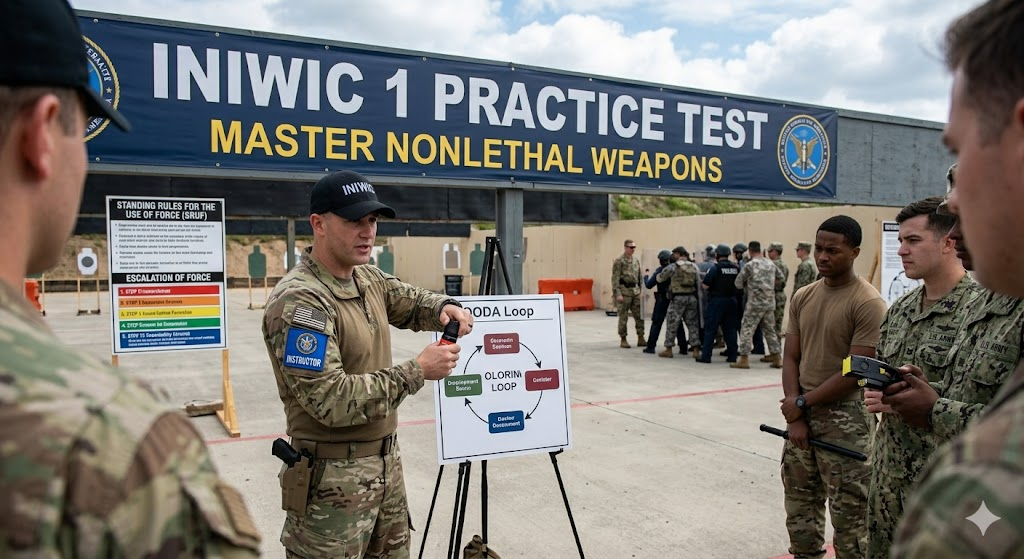
Additional Information
What the Course Entails and Exam Details
The INIWIC 1 course provides comprehensive training on both the technical aspects of nonlethal weapons and the crucial legal and policy frameworks surrounding their use. Students engage in intensive instruction covering the theoretical principles, operational procedures, and safety protocols for a wide array of individual nonlethal tools. The core curriculum focuses on:
Standing Rules of Engagement (SROE) and Standing Rules for the Use of Force (SRUF): Mastering the distinct legal guidelines governing the use of force in both international (SROE) and domestic/DoD installation (SRUF) environments.
Nonlethal Weapon Systems: In-depth technical proficiency and instructor-level qualification with specific devices, such as Oleoresin Capsicum (OC) spray, Electro-Muscular Incapacitation (EMI) devices (TASER), and expandable batons.
Human Effects and Safety: Understanding the physiological and psychological effects of various nonlethal munitions on targeted individuals, with a strong emphasis on medical considerations and safety procedures.
Tactical Employment: Developing skills in crowd dynamics, shield formulations, and individual and team tactics for the safe and effective application of nonlethal measures.
Instructor Methodology: Learning to effectively plan, conduct, and evaluate nonlethal weapons training, including the development of realistic scenarios and the assessment of student performance.
The examination details encompass multiple phases of assessment. Students must pass a rigorous written examination to demonstrate conceptual understanding, a series of practical skills evaluations to prove technical mastery, and an instructor evaluation to verify their ability to effectively teach the material.
What to Expect in the Final Exam
The INIWIC 1 final exam is a comprehensive assessment designed to simulate the demanding conditions an instructor will face. It is not merely a memory test but an evaluation of critical decision-making and instructional capability under pressure. The final assessment generally includes three primary components:
Written Examination: A timed, multiple-choice, and short-answer test focusing on the conceptual knowledge, ROE/SRUF application, technical specifications, and safety rules for nonlethal weapons. Expect a minimum passing score, often 80% or higher, reflecting the gravity of the subject matter.
Practical Application Test (PAT): A hands-on evaluation of the student's ability to safely and effectively operate and demonstrate all required nonlethal weapon systems. This includes weapon manipulation, immediate and remedial action, and applying the escalation of force continuum. Any safety violation can result in an automatic failure.
Instructor Evaluation (IE): The final and most critical component, where students must plan and lead a lesson, teach a block of instruction, or run a simulated nonlethal scenario, demonstrating their ability to control a range, provide corrective feedback, and certify others. This evaluation measures command presence, clarity, and safety adherence.
Rules during the exam are strict. Academic integrity is paramount, and practical exercises require adherence to dynamic range safety rules.
How to Study and Exam Centers
Preparation for the INIWIC 1 exam requires a dual approach: dedication to the academic material and intensive practical practice. Start your journey by thoroughly reviewing all provided student guides, technical manuals, and doctrinal publications (e.g., CJCSI 3121.01B for SROE/SRUF, DoDD 3000.03E). Leverage practice tests and study groups to solidify your legal and conceptual foundation. For the practical components, repetitive, correct practice of all drills is essential; seek feedback from current INIWIC instructors to refine your technique and instructional delivery.
INIWIC courses and their associated examinations are typically administered at specific, authorized physical training centers and military installations equipped with the necessary nonlethal ranges and simulation facilities. Primary locations include the US Army Military Police School at Fort Leonard Wood, Missouri, and other designated US Marine Corps and Navy centers, such as Marine Corps Base Quantico. These are not exams taken at external commercial testing centers like Pearson VUE. For the most accurate, up-to-date schedule and registration process, personnel must coordinate through their unit’s training NCO/Officer and access the official DoD Non-Lethal Weapons Program resources on military networks.
Job Opportunities from the Course
Successfully completing INIWIC 1 and earning the certified Nonlethal Individual Weapons Instructor qualification unlocks a diverse range of specialized roles and career paths within the DoD and beyond. This certification is highly valued, opening doors to positions such as:
Nonlethal Weapons Instructor
Unit Nonlethal Weapons Advisor
Security Forces Instructor
Force Protection Specialist
Law Enforcement Instructor
Master-at-Arms (Navy)
Military Police Instructor
Crowd Control and Civil Disturbance Trainer
Tactical Training Specialist
Specialized Unit Training Advisor
Scenario-Based Training Facilitator
Frequently Asked Questions
Reviews
5.0
Based on 0 reviews
Leave a Review
No reviews yet. Be the first to review!