
Interservice Nonlethal Individual Weapons Instructor Course (INIWIC) 2 Practice Test
$69.00
- Buy to unlock unlimited access to all Quiz questions and Answers in this Quiz.
- After purchase you can print a PDF of the whole quiz at any point. The PDF will contain the questions and the correct answers.
About this Exam
The Interservice Nonlethal Individual Weapons Instructor Course (INIWIC) 2 is the pinnacle of non-lethal capabilities training within the United States Department of Defense. This rigorous, joint-service program is specifically designed to certify exceptional non-commissioned officers, officers, and DoD civilians as elite subject matter experts and, most importantly, as instructors in the art and science of non-lethal force. Graduates of INIWIC 2 are not just end-users; they are the standard-bearers responsible for training their home units, advising commanders on the tactical employment of non-lethal assets, and bridging the critical gap between verbal warnings and deadly force. This course targets personnel from all military branches, typically E-5 and above (E-4 for Marines), who exhibit leadership potential and a mastery of tactical decision-making.
Ready to test your knowledge?
Buy Now to Access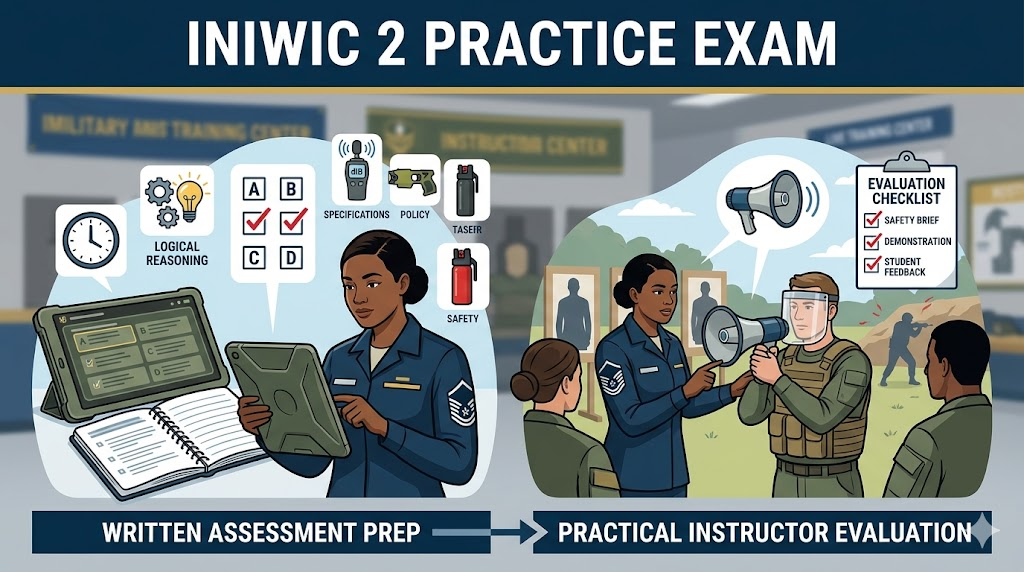
Additional Information
What the Course Entails and Exam Details
This comprehensive "train-the-trainer" course delivers a sophisticated blend of classroom instruction, legal doctrine, and high-intensity practical application. The INIWIC 2 curriculum focuses heavily on the joint "Nonlethal Capability Sets (NLCS)," ensuring instructors can teach the full spectrum of available technologies.
Key topics and skills covered in the course include:
Policies and Legal Framework: Deep dives into the Standing Rules of Engagement (SROE), Standing Rules for the Use of Force (SRUF), the "Objectively Reasonable" standard, and relevant international treaties.
The Non-Lethal Mindset: Mastering the force continuum and human dynamics to effectively escalate and de-escalate confrontations.
Acoustic Hailing Devices (AHD): Operation, safety, and instructional techniques for devices like the Long Range Acoustic Device (LRAD) and Sound Commander.
Conductive Energy Weapons (CEW): Certification to instruct on TASER systems (e.g., X26P, X23E), including technical specs, medical safety, and probe removal.
Oleoresin Capsicum (OC) Systems: Instruction on the use of various OC delivery methods, from individual Mark 4 sprays to the large-scale Mark 46 riot extinguishers, and managing contamination training.
Kinetic Energy Munitions and Launchers: Direct and indirect fire with a wide array of non-lethal rounds.
Civil Disturbance and Riot Control: Teaching formations, crowd dynamics, and shield techniques.
Instructional Methodology: How to deliver effective non-lethal weapons training, evaluate student performance, and run a safe, effective training range.
What to Expect in the Final Exam
The INIWIC 2 final assessment is a multifaceted evaluation designed to ensure you possess both the knowledge of a subject matter expert and the capability of a lead instructor.
The Written Examination
This segment of the final exam is a robust, time-limited assessment, typically consisting of multiple-choice and true/false questions. It is designed to test your comprehensive recall and understanding of technical specifications, safety protocols, legal standards, and device operation. You can expect questions detailing:
Technical Specifications: Decibel levels and maximum effective ranges of specific AHDs; weight, voltage, and power sources of CEWs; and minimum safe engagement distances for dynamic munitions and OC sprays.
Safety and Medical: Identifying fault indicators on advanced electronic devices, identifying medical risks, and outlining protocol for OC de-contamination.
Doctrine and Policy: Distinguishing between SROE and SRUF, and applying the "Objectively Reasonable" standard to hypothetical use-of-force scenarios.
The Practical Evaluation (Instructor Assessment)
Because this is an instructor course, the practical component is paramount. You will not simply demonstrate the use of the weapon; you will be evaluated on your ability to instruct others. This comprehensive practical assessment typically requires candidates to lead a lesson block, conduct a safety brief, manage a live-fire range, or coach a "student" through complex practical application of non-lethal tools, from close-range subject control to acoustic hailing.
To pass, you must demonstrate impeccable safety standards, clear communication, and technical mastery in every assessed area.
How to Study and Exam Centers
Preparation is critical. Since this exam focuses on your ability to teach, your study strategy must go beyond mere memorization.
Study Actionable Strategies:
Master the Manuals: Thoroughly review all course materials, including service-specific non-lethal capability documentation, Joint-Service (JNET-C) manuals, and technical specification sheets for every device.
Practice Public Speaking: Rehearse delivering complex technical information and safety briefs out loud to build clarity and confidence.
Form Study Groups: Collaborate with fellow students to practice teach-back sessions and quiz each other on technical specs and use-of-force scenarios.
Use Practice Tests: Leverage available INIWIC 2 practice exams to get a feel for the types of multiple-choice and scenario-based questions you will encounter on the written portion.
Exam Centers and Location: The INIWIC 2 course and its final certification exams are not conducted at public testing centers. Instead, they are administered only at authorized Department of Defense training locations. The primary instructional hub is the U.S. Marine Corps Detachment, MP/NBC Instruction Company, located at Fort Leonard Wood, Missouri. The course and exam are also facilitated globally by mobile training teams that dispatch to major military installations.
Job Opportunities from the Course
Earning your INIWIC 2 Instructor Certification is a major career milestone, transforming you into a vital asset. This qualification unlocks specialized roles within the military, federal government, and law enforcement sectors, focusing on your new designation as a lead trainer and subject matter advisor.
Graduates are highly sought after for the following career paths:
Unit Non-Lethal Weapons Instructor (NLW-I)
Service/Base Non-Lethal Weapons Senior Instructor (NLW-SI)
Military Police/Security Forces Non-Lethal Capabilities Advisor
Non-Lethal Force Development and Doctrine Specialist
Civil Disturbance and Riot Control Subject Matter Expert (SME)
Weapons and Tactics Instructor (WTI) within special operations command
Non-Lethal Weapons Training Contract Instructor (for DoD and Federal agencies)
Frequently Asked Questions
Reviews
5.0
Based on 0 reviews
Leave a Review
No reviews yet. Be the first to review!