
Interventional Radiology Registry Practice Exam
$69.00
- Buy to unlock unlimited access to all Quiz questions and Answers in this Quiz.
- After purchase you can print a PDF of the whole quiz at any point. The PDF will contain the questions and the correct answers.
About this Exam
The Interventional Radiology Registry exam is a prestigious certification assessment designed for radiologic technologists who wish to specialize in minimally invasive, image-guided procedures.
This highly respected credential validates your expertise in assisting with complex treatments that target the vascular system and other critical organs.
It is specifically tailored for dedicated healthcare professionals who want to elevate their careers from general radiography into a specialized, fast-paced clinical environment.
Earning this certification proves your mastery of advanced imaging technologies and exceptional patient care.
Ready to test your knowledge?
Buy Now to Access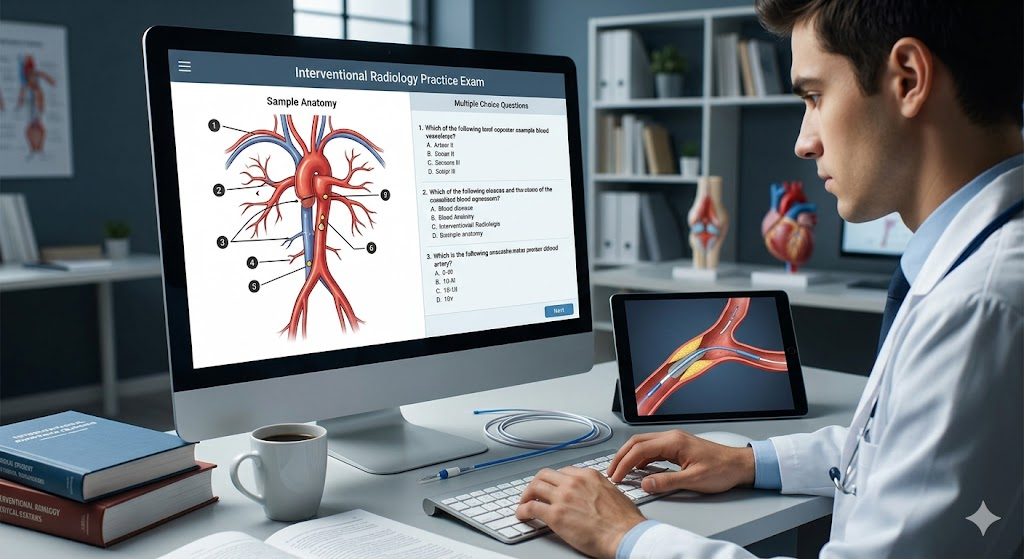
Additional Information
What the Course Entails and Exam Details
Preparing for this specialty exam requires a deep dive into several core clinical competencies.
Candidates must master intricate vascular and non-vascular anatomy, understanding how different systems interact during image-guided interventions.
The syllabus heavily emphasizes equipment and instrumentation, requiring you to understand the precise uses of catheters, guidewires, stents, and embolization materials.
You will also learn essential procedure protocols, covering everything from angiography and angioplasty to biliary and genitourinary interventions.
Furthermore, the curriculum entails rigorous training in pharmacology, safe contrast media administration, and advanced radiation protection to ensure the safety of both the patient and the medical team.
What to Expect in the Final Exam
The final registry exam is a comprehensive, computer-based test that demands focus and thorough preparation.
You can expect to face approximately 145 to 160 multiple-choice questions, depending on the specific credentialing body, such as the ARRT.
These questions are designed to test your critical thinking, blending clinical scenarios with technical knowledge and anatomy identification.
Candidates are generally given around three and a half hours to complete the examination, requiring excellent time management skills.
To pass, you must achieve a scaled score of 75 or higher, which demonstrates that you meet the rigorous national standards for competency in interventional radiography.
How to Study and Exam Centers
Success on this exam comes down to strategic, consistent, and active studying.
Start by taking a dedicated Interventional Radiology Registry Practice Exam to identify your baseline knowledge and pinpoint your weakest subjects.
Utilize spaced repetition flashcards for complex pharmacology terms and anatomy, and review visual case studies to familiarize yourself with real-world imaging scenarios.
When you are ready to test, the exam is typically administered in person at highly secure, authorized testing environments.
You will schedule and take your test at a local Pearson VUE testing center, which provides a quiet, monitored computer lab setting to ensure fairness and academic integrity.
Job Opportunities from the Course
Achieving your Interventional Radiology certification opens the door to a highly lucrative and dynamic career path.
Here are some of the rewarding job opportunities you can pursue:
Interventional Radiology Technologist
Vascular Interventional Radiographer
Cardiac Cath Lab Technologist
Neuro-Interventional Radiology Technologist
Lead IR Technologist
Radiology Clinical Instructor
Imaging Department Manager
Medical Device Clinical Specialist
Frequently Asked Questions
Reviews
5.0
Based on 0 reviews
Leave a Review
No reviews yet. Be the first to review!