
Intravenous (IV) Technician Certification Practice Exam
$69.00
- Buy to unlock unlimited access to all Quiz questions and Answers in this Quiz.
- After purchase you can print a PDF of the whole quiz at any point. The PDF will contain the questions and the correct answers.
About this Exam
The Intravenous (IV) Technician Certification is a vital credential that verifies your specialized knowledge and hands-on skills in the correct and safe administration of intravenous fluids and medications. Designed for healthcare professionals like licensed practical nurses (LPNs), medical assistants, and phlebotomists who wish to expand their scope of practice, this certification demonstrates a commitment to patient care and clinical excellence. Possessing this recognized qualification often opens doors to specialized roles within hospitals, clinics, and outpatient care centers, allowing you to play a critical role in patient treatment plans. The accompanying practice exam is a powerful study tool designed to gauge your readiness for the official certification, providing a clear picture of your strengths and areas for further focus.
Ready to test your knowledge?
Buy Now to Access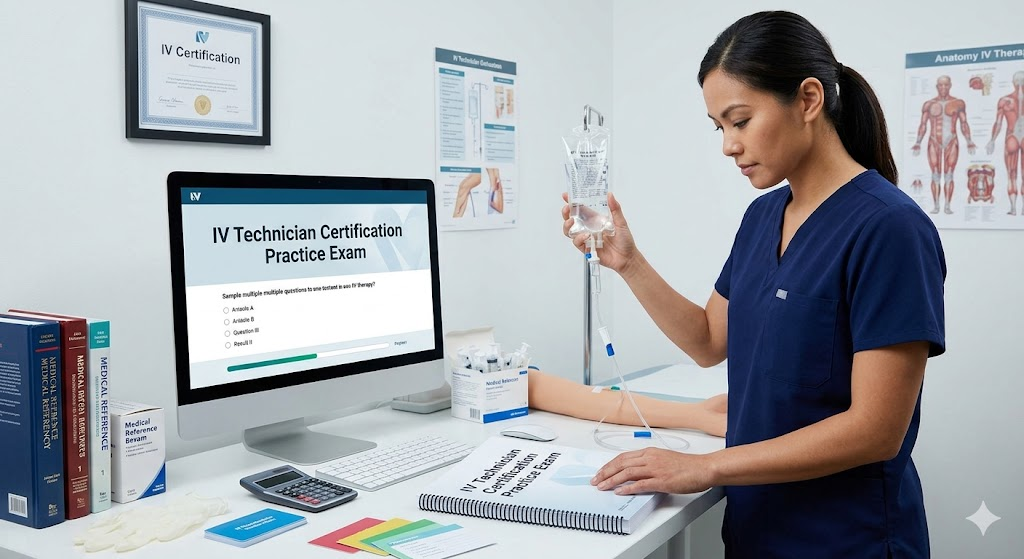
Additional Information
What the Course Entails and Exam Details
The training course for this certification covers a broad range of topics essential for safe IV therapy, often including in-depth modules on vascular anatomy and physiology, sterile compounding techniques, and the latest aseptic practices. You will learn about the vast array of IV equipment and supplies, from catheter selection and insertion techniques to monitoring infusion flow rates. Essential components typically include understanding different types of IV solutions and their indications, meticulous dosage calculations, and identifying and managing potential complications like infiltration or phlebitis. The official certification exam details will vary by the certifying body, but typical exams consist of 50 to 80 multiple-choice questions, covering the core subject matter outlined above, and must be completed within a specific time limit, such as 1.5 to 2 hours. Common passing scores range between 70% and 80%, so diligent study is paramount for success.
What to Expect in the Final Exam
When you take the final certification exam, you can expect a mix of knowledge-based and clinical scenario-based multiple-choice questions. These questions will test not only your memorization of facts but also your critical thinking and ability to apply best practices in a real-world context. Be prepared to answer questions on proper patient preparation and site selection, identifying signs of infection or reaction, precise flow rate calculations, and adherence to safety protocols. A practical component involving hands-on demonstration of specific IV skills may also be required depending on the certifying organization. Understanding the specific testing format, whether entirely multiple-choice or a hybrid, is crucial, as is careful time management throughout the examination.
How to Study and Exam Centers
Maximizing your study efforts involves a multi-faceted approach. Utilize comprehensive study guides, review your coursework modules thoroughly, and leverage flashcards for essential terms and calculations. A critical component of effective preparation is the use of practice exams and quizzes to simulate the actual test environment, familiarizing yourself with question styles and time constraints. For the practical portion, seek hands-on practice, perhaps using a training arm or under supervision, to build confidence in your technique. Official certification exams are often administered through online proctoring systems provided by the certifying body, and may also be available at designated physical testing centers, such as Pearson VUE, or approved healthcare educational institutions and authorized schools where you completed your training.
Job Opportunities from the Course
Obtaining this certification can lead to exciting and fulfilling career opportunities in various healthcare settings. Potential job paths and specialized roles include:
Licensed Practical Nurse (LPN) with IV Certification
Medical Assistant with IV Specialization
Emergency Medical Technician (EMT) or Paramedic
Phlebotomist with advanced IV starting skills
Home Health Aide with specialized IV skills (depending on state regulations and certifications)
Dialysis Technician with IV therapy expertise
Hospital-based IV Team member (specific positions vary by hospital structure)
Frequently Asked Questions
Reviews
5.0
Based on 0 reviews
Leave a Review
No reviews yet. Be the first to review!