
Intravenous (IV) Therapy Practice Exam
$69.00
- Buy to unlock unlimited access to all Quiz questions and Answers in this Quiz.
- After purchase you can print a PDF of the whole quiz at any point. The PDF will contain the questions and the correct answers.
About this Exam
The Intravenous (IV) Therapy Certification Exam is a pivotal validation of essential nursing and healthcare skills. It ensures that healthcare professionals possess the standardized knowledge and proficiency required to safely and effectively initiate and manage peripheral intravenous lines. This certification is designed for various healthcare providers seeking to legally and competently expand their scope of practice, including Registered Nurses (RNs), Licensed Practical Nurses (LPNs) or Licensed Vocational Nurses (LVNs), Medical Assistants (MAs), and Paramedics. Achieving this certification demonstrates your dedication to patient safety and complex care, making you a highly valuable asset to medical teams.
Ready to test your knowledge?
Buy Now to Access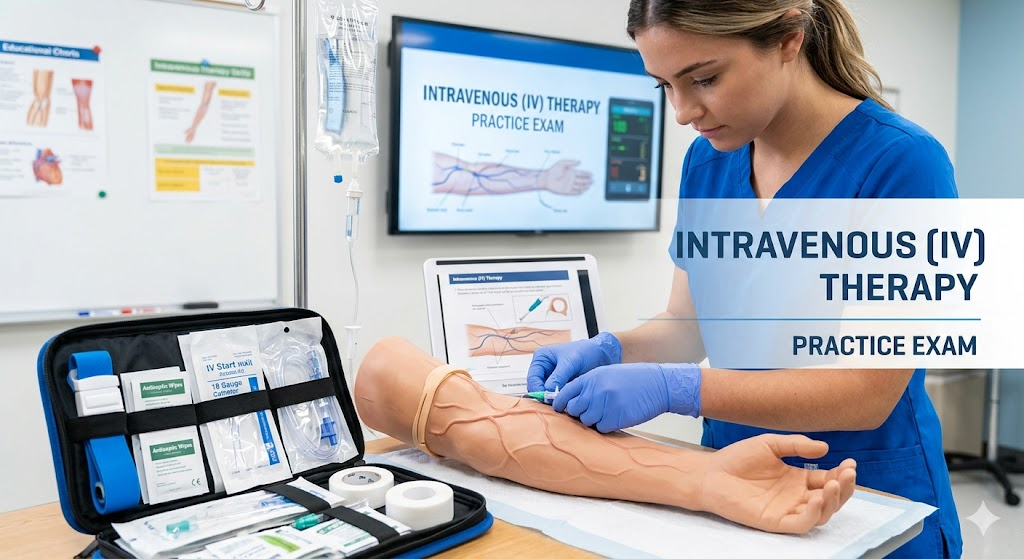
Additional Information
What the Course Entails and Exam Details
This practice exam serves as a direct mirror to the comprehensive curriculum covered in reputable IV therapy certification programs. It assesses a wide range of critical topics essential for successful practice. Core subjects tested in this study guide include:
Anatomy and Physiology: Detailed knowledge of the vascular system, vein selection, and peripheral nerve pathways.
Principles of IV Therapy: Understanding indications, fluid and electrolyte balance, and the different types of infusates.
Infection Control and Aseptic Technique: Maintaining sterile conditions and minimizing risks of Central Line-Associated Bloodstream Infections (CLABSIs).
Vein Selection and Site Preparation: Identifying suitable veins, proper skin antisepsis, and considerations for specific patient populations.
IV Equipment and Technology: Correct use and maintenance of peripheral catheters, tubing, infusion pumps, and securement devices.
Insertion Techniques: Proficiency in the steps of standard peripheral venipuncture.
Complications Management: Identifying and managing common issues like infiltration, phlebitis, occlusion, and nerve damage.
Medication Administration: Safely administering fluids, pigments, and medications via the intravenous route, including dosage calculations and compatibility.
Legal and Ethical Considerations: Documentation requirements, scope of practice regulations, and informed consent.
What to Expect in the Final Exam
While the exact structure can vary depending on the certifying body, an IV therapy certification exam typically includes two major components to ensure competency.
First, you will complete a written, standardized examination, often in a multiple-choice format. This section typically consists of 50 to 100 questions covering the theoretical knowledge detailed above. Expect a time limit ranging from 1 to 2 hours for this part. Achieving a passing score, which commonly falls between 75% and 85%, is mandatory.
Second, a practical skills demonstration is almost universally required. In this component, you will be observed by an evaluator to ensure you can perform key procedures correctly and safely. Tasks typically include preparing the equipment, successfully establishing an IV line on a lifelike simulation arm or model, securing the site, and trouble-shooting a potential complication, all while adhering to aseptic protocol. Both sections must be passed to earn your certification.
How to Study and Exam Centers
Preparing effectively is essential for success. Here are actionable study strategies:
Maximize Practice Exams: Take numerous practice tests, like the ones provided in this guide, to simulate the actual test environment. Analyze your performance to identify weak areas.
Utilize Study Guides and Textbooks: Consult the specific curriculum or recommended textbooks from your certifying body. Review key terminology, dosages, and procedural steps.
Simulate Practical Skills: Seek opportunities for hands-on practice, whether in a dedicated skills lab, through an authorized training program, or by using educational models. Familiarity with the feel of inserting a catheter is crucial.
Review Infection Control: Dedicate focused study time to aseptic technique and complication identification. This knowledge is paramount for patient safety.
Regarding exam locations, certifications are administered through various channels. Common methods include:
Authorized Training Schools: Many institutions, like community colleges and private healthcare schools, offer both the course and the final exam on site.
Hospitals and Healthcare Facilities: Some employers host certification courses for their staff or partners.
Online Proctoring: For the written exam, some national certifying organizations utilize secure online testing platforms that allow you to take the test from home with a remote proctor.
Dedicated Testing Centers: In some cases, examinations might be scheduled at physical testing facilities used for professional certifications. Always check with your specific governing body (e.g., the Infusion Nurses Society or a state board) to find approved testing locations and dates.
Job Opportunities from the Course
Obtaining an IV Therapy Certification significantly enhances your employ-ability and opens doors to a variety of specialized roles. Here is a list of job opportunities this certification can unlock or support:
Registered Nurse (RN) with IV Certification
Licensed Practical Nurse (LPN) or Licensed Vocational Nurse (LVN) with IV Certification
Certified IV Therapist
Infusion Nurse
Vascular Access Team Nurse
Emergency Room (ER) Nurse
Critical Care/Intensive Care Unit (ICU) Nurse
Outpatient Clinic Nurse (e.g., dialysis centers, oncology clinics)
Home Health Nurse
Travel Nurse (many assignments require IV proficiency)
Paramedic (advanced scope)
Medical Assistant (with state-specific allowance and supervision)
Frequently Asked Questions
Reviews
5.0
Based on 0 reviews
Leave a Review
No reviews yet. Be the first to review!