
Intro to ESP Training Pre-Class Practice Test
$69.00
- Buy to unlock unlimited access to all Quiz questions and Answers in this Quiz.
- After purchase you can print a PDF of the whole quiz at any point. The PDF will contain the questions and the correct answers.
About this Exam
Welcome to your comprehensive study guide for the Intro to ESP Training Pre-Class Practice Test. This resource is designed to help you understand the purpose, structure, and expectations of this foundational assessment.
The introductory training course aims to equip English language learners and professionals with the initial knowledge required to effectively teach English for Specific Purposes (ESP). This specialization focuses on delivering English instruction tailored to the unique communication and vocabulary needs of learners within specific industries. For instance, this could involve preparing individuals for fields such as medicine, law, hospitality, or technical sectors. The Intro to ESP Training course provides the core principles and strategies to design, deliver, and assess such tailored language programs.
This pre-class practice test is a vital component. It's designed to gauge your current understanding of the basic concepts of ESP, course structure, and essential terminology before you officially begin your in-depth studies. Think of it as a diagnostic tool that highlights your strengths and areas where you should focus your initial learning efforts.
Ready to test your knowledge?
Buy Now to Access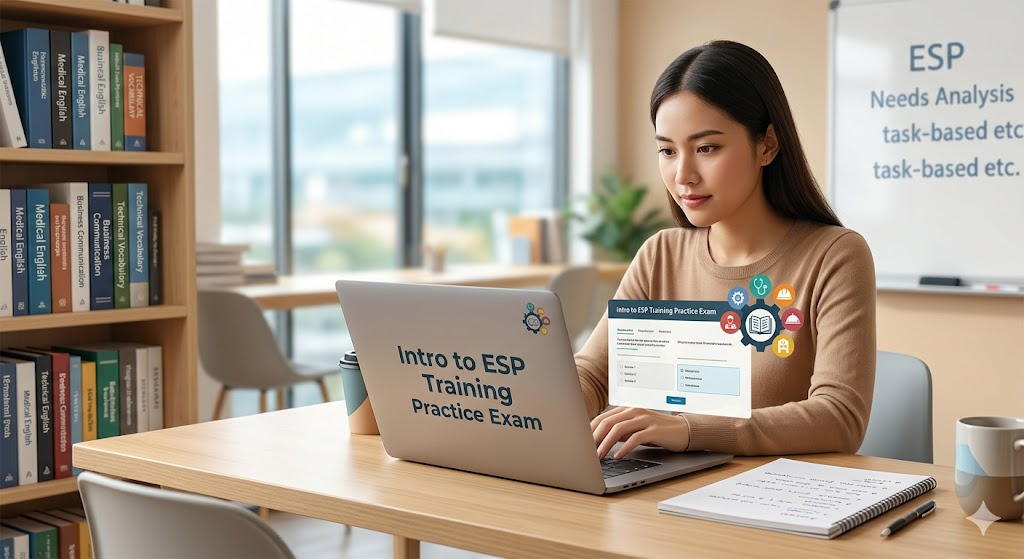
Additional Information
What the Course Entails and Exam Details
A foundational Intro to ESP Training course typically covers several core modules, which this pre-class practice test begins to touch upon.
Understanding ESP Principles: The course introduces the definition, history, and key differences between General English and ESP. You’ll learn how ESP focuses on communication within specific genres and registers relevant to the target context.
Needs Analysis: This is a cornerstone of ESP. The course explains how to conduct a needs analysis, which involves identifying the target learner group, their current language level, and, most crucially, the specific communicative tasks they will perform in English in their professional or academic lives.
Syllabus and Materials Development: You will explore different approaches to designing an ESP syllabus (e.g., structural, functional, task-based) and learn about the importance of authentic materials relevant to the learners' field.
Teaching Methods: The training outlines effective teaching strategies for ESP learners, often emphasizing task-based learning and simulation to prepare students for real-world scenarios.
Assessment and Evaluation: You'll learn how to develop and implement assessments that measure not just general language proficiency but, more importantly, the student's ability to communicate effectively in their specific discipline.
The Pre-Class Practice Test typically includes questions that cover these introductory topics. It may feature various formats, though multiple-choice is most common at this level, and is often delivered through a secure online platform provided by the course administrators.
What to Expect in the Final Exam
Upon completion of the full Intro to ESP Training course, you will typically be required to pass a final, more comprehensive exam to receive your certification. While this practice test gives you a taste, the final exam will be more detailed and potentially include a wider range of question types and practical application tasks.
Format: You can usually expect a mix of question formats, including multiple-choice, short-answer, case study analyses, and potentially a practical component like designing a sample lesson plan or needs analysis outline for a specified scenario. Online exams are increasingly common, but physical centers might be an option depending on the provider.
Passing Score: Requirements vary by course provider and certification body, but a common benchmark for passing such professional qualifications is often between 70% and 80%. Be sure to check the specific details provided for your chosen course.
Time Limit: Final exams are usually timed, typically ranging from one to three hours depending on the depth and structure. You should learn to manage your time efficiently across the different sections.
Rules: Expect standard exam protocols, including strict anti-cheating measures (like online proctoring for remote exams), specific guidelines on using resources (usually closed-book), and instructions on how to submit your work.
How to Study and Exam Centers
Preparation is key to success, both for this practice test and the subsequent final exam.
Review All Intro Material: Thoroughly review the initial course description, pre-class readings, and any introductory materials provided. Even though this is a pre-class practice test, having a solid grasp of the foundational concepts is essential.
Practice with Similar Questions: The more practice you get, the more comfortable you will be with the style of questioning. Utilize the pre-class practice test to identify areas where your understanding is weak. Seek out any additional example questions if available.
Focus on Key Terms: Create flashcards for important terms and definitions (e.g., ESP, Needs Analysis, Genre, Register, authentic materials, task-based learning).
Apply Concepts: Try to think of real-world scenarios for each concept you learn. Imagine you are designing a course for a group of airline pilots. How would you conduct a needs analysis? What kind of vocabulary would be critical? What would their typical communication tasks be?
Identify Your Learning Gaps: After taking this practice test, carefully review your answers and any feedback provided. Use this to create a focused study plan for the official course content.
As for where to take the exam, these details depend entirely on the course you are enrolled in.
Online Portals: Many Intro to ESP Training courses and their associated exams are offered fully online through dedicated learning management systems or professional development portals. The exact process for registration, testing, and certification will be detailed by the course provider.
Authorized Schools: If you are taking the course through a language school or professional institute, they will administer the exam directly, potentially either in a classroom setting or via an online proctoring service.
Physical Testing Centers: For certain globally recognized certifications, final exams might be delivered through specialized physical testing centers (like those in a network such as Pearson VUE) but this is less common for introductory training, which is typically more localized or online.
Check your course materials and communicate with your course administrator for precise details on how and where you will take both this practice test and the final certification exam.
Job Opportunities from the Course
Successfully completing this introductory training and the subsequent final exam can open several exciting career paths or enhance your existing professional capabilities, especially within the global context of teaching English as a foreign or second language. An ESP qualification, even at the foundational level, indicates a capability for specialized instruction, which is highly sought-after.
A career in ESP can take you across various fields and specializations, generally increasing your value to educational institutions and corporate training programs. Here are some of the potential job roles and career advancement opportunities this course can contribute to:
ESP Teacher / Instructor in specialized language schools, community colleges, and universities.
Corporate English Trainer, developing and delivering in-house communication training for multi-national companies in diverse sectors like finance, technology, and manufacturing.
Curriculum Developer / Syllabus Designer for language institutions, creating specialized course materials.
Material Developer focusing on creating relevant, task-based learning materials and authentic content for ESP programs.
English Language Coach / Mentor for professionals, offering personalized ESP training to advance their careers and communication skills in their field.
Educational Content Writer / Blogger specializing in English language learning and teaching methodologies, with a particular focus on specialized areas.
Assessment Specialist for language testing, contributing to the development of field-specific language assessments.
ESL/EFL Program Coordinator with a specific mandate to expand and manage specialized English programs.
Freelance ESP Specialist offering training and consulting services directly to individuals and businesses.
Many of these roles require further experience or advanced study, but this introductory qualification serves as an essential first step. For current ESL/EFL teachers, it can be a significant professional development milestone that allows for branching out and increasing employability.
Remember, the pre-class practice test is the first step in your exciting journey into the specialized and rewarding world of English for Specific Purposes. Approach your studies with curiosity, dedication, and a clear goal, and you'll be well on your way to success!
Frequently Asked Questions
Reviews
5.0
Based on 0 reviews
Leave a Review
No reviews yet. Be the first to review!