
Intro to Wildland Fire Behavior (S-190) Practice Test
$69.00
- Buy to unlock unlimited access to all Quiz questions and Answers in this Quiz.
- After purchase you can print a PDF of the whole quiz at any point. The PDF will contain the questions and the correct answers.
About this Exam
The "Intro to Wildland Fire Behavior (S-190)" course is the foundational standard for understanding how wildfire interacts with the environment. It is designed to introduce the basic concepts of wildland fire behavior to prospective firefighters, natural resource technicians, and emergency responders. This course provides the essential knowledge that every individual on a fireline must possess to maintain situational awareness and make safe, informed decisions.
Ready to test your knowledge?
Buy Now to Access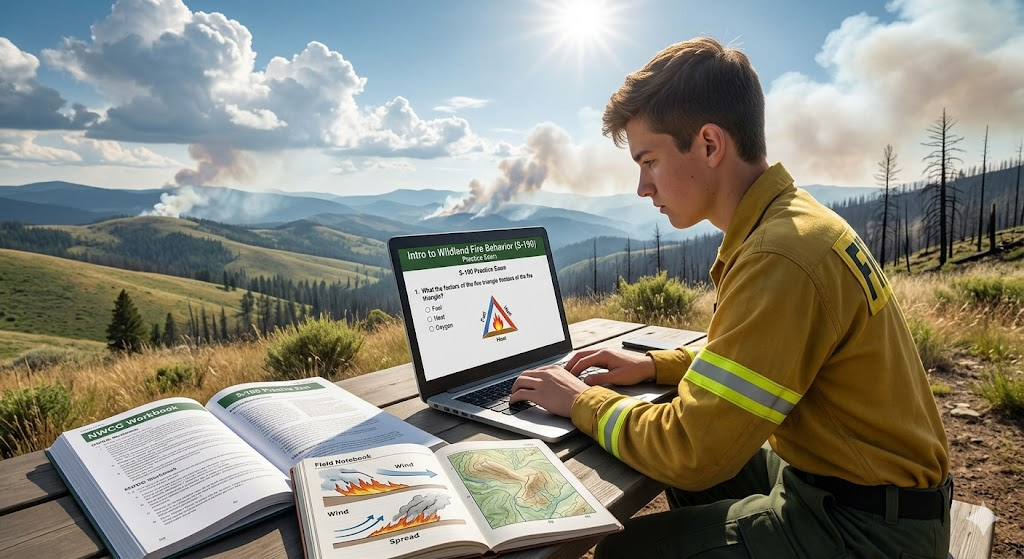
Additional Information
What the Course Entails and Exam Details
This course provides entry-level personnel with the skills necessary to recognize the factors that influence fire behavior. The comprehensive S-190 curriculum covers critical topics that dictate how a wildland fire will ignite, spread, and intensify.
Specifically, students will gain an understanding of:
The Fire Triangle: Mastery of the three elements required for combustion—fuel, heat, and oxygen.
The Fire Environment Triangle: Analysis of how topography, weather, and fuel types interact to dictate fire activity.
Topography Factors: The critical roles that slope, aspect, elevation, and terrain shapes play in fire spread.
Weather and Fire: Understanding temperature, relative humidity, wind velocity, atmospheric stability, and cloud formations as primary drivers of fire behavior.
Fuel Classifications: Recognizing how fuel moisture, size, arrangement, and continuity impact ignition and rate of spread.
Common Fire Behavior Terms: Learning standard terminology to effectively communicate fire conditions to colleagues and supervisors.
What to Expect in the Final Exam
The final S-190 exam is designed to validate your comprehension of fundamental fire science. It is typically administered as a multiple-choice assessment following the completion of the course material.
Here is what candidates should expect:
Format: A computer-based or paper-based test containing approximately 30 to 50 multiple-choice questions.
Passing Score: A standard minimum score of 70% is generally required to pass.
Time Limit: While the test is straightforward for those who have studied, it is usually timed (often 1–2 hours), demanding that candidates know the material well rather than relying heavily on notes.
Rules: For official certification, this is typically a "closed-book" exam proctored by an NWCG-certified instructor or taken through an official learning management system.
How to Study and Exam Centers
Effective preparation is key to succeeding on the S-190 exam. Utilizing the practice test included in this guide is an essential first step.
Study Strategies for Success:
Review Official NWCG Materials: Focus on the free student workbooks and course materials provided on the official NWCG website (nwcg.gov).
Create Flashcards: Make digital or physical flashcards for definitions of key weather terms (e.g., relative humidity, wind shear), the fire triangle, and topographical features (e.g., chimney, chute, ridge).
Visualize Scenarios: Practice linking terms. When you see "high temperature," visualize "lower relative humidity" and how that impacts "fuel moisture" and "fire intensity."
Take Multiple Practice Exams: Repeat this practice test several times, focusing on the reasons why a choice is correct rather than just memorizing the answer.
Study the IRPG: Review relevant sections of the Incident Response Pocket Guide (IRPG), which complements the S-190 curriculum.
Exam Centers and Location:
The final official examination is usually not taken at independent "testing centers" like Pearson VUE. Instead, it is administered as part of the formal S-190 course delivery. Courses and their associated exams are offered through:
Federal and State Agencies: The USDA Forest Service, BLM, NPS, and state forestry departments regularly host internal training.
Local Fire Departments: Structure fire departments often offer NWCG training to their members.
Community Colleges and Training Academies: Many colleges with fire science programs are authorized to offer NWCG courses.
Online Portals: Sections of S-190 are often available online via the NWCG’s Wildland Fire Learning Portal (WFLP), though the final may still require proctoring.
Job Opportunities from the Course
S-190 is not just a course; it is a mandatory prerequisite for several entry-level career paths in the wildland fire service. It is a critical component of earning the "Red Card" (Interagency Incident Qualification Card), which is required to work on federal, state, and many local wildfire incidents.
Earning this certification opens the door to the following specific positions and career paths:
Wildland Firefighter (FFT2): The standard entry-level position on any wildland crew (engine, hand crew, or helitack).
Forestry Technician: Federal (GS-03/04) positions that include fire suppression duties.
Natural Resource Technician/Specialist: Entry-level positions involving ecosystem management and prescribed burning.
Fuels Management Technician: Working on proactive hazardous fuel reduction projects, such as thinning and prescribed fires.
Structure Firefighter (with WUI capabilities): Many local fire departments require wildland certification for operations in the Wildland-Urban Interface.
Park Ranger: Entry-level ranger positions with fire management or emergency response responsibilities.
By mastering the concepts in S-190, you are not only taking the first step toward an exciting career but also demonstrating a commitment to the fundamental principles of fire safety.
Frequently Asked Questions
Reviews
5.0
Based on 0 reviews
Leave a Review
No reviews yet. Be the first to review!