
Introduction to Artificial Intelligence (AI) Practice Test
$69.00
- Buy to unlock unlimited access to all Quiz questions and Answers in this Quiz.
- After purchase you can print a PDF of the whole quiz at any point. The PDF will contain the questions and the correct answers.
About this Exam
Embarking on your journey into Artificial Intelligence (AI) is an exciting and potentially career-transforming decision. The "Introduction to Artificial Intelligence (AI)" realm is designed for students, technology enthusiasts, and professionals from all backgrounds who are looking to gain a foundational understanding of this groundbreaking field.
This practice test is a vital self-assessment tool, acting as a stepping stone. It is crafted to evaluate your comprehension of the core principles that underpin modern AI. Whether you're a absolute beginner just starting your first online course, a college student preparing for a class final, or a curious mind wanting to validate your knowledge, this practice material is for you.
It helps you identify strengths and pinpoint areas that require further study before attempting formal certification or more advanced coursework.
Ready to test your knowledge?
Buy Now to Access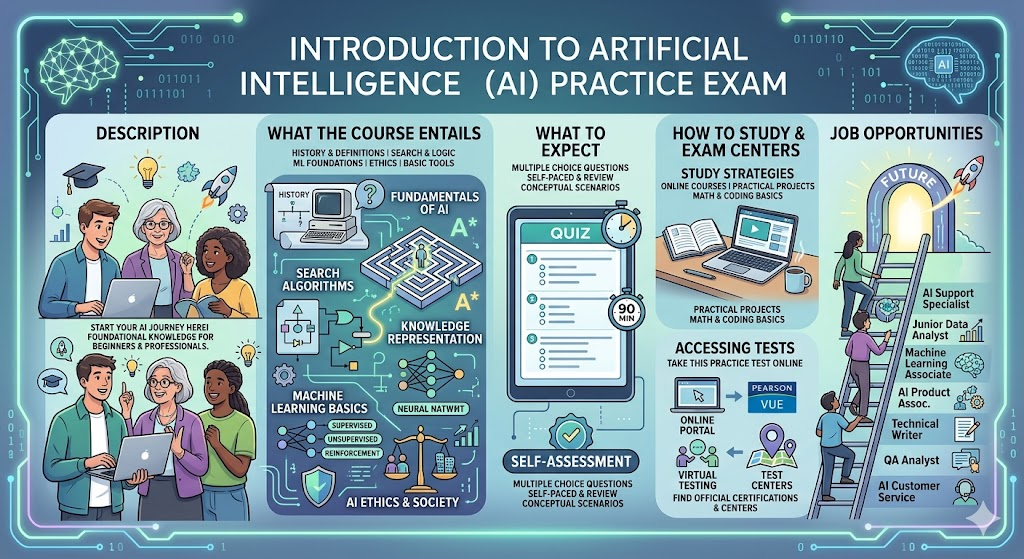
Additional Information
What the Course Entails and Exam Details
This comprehensive guide focuses on the typical knowledge domains you would encounter in an introductory AI course. The "Introduction to Artificial Intelligence (AI) Practice Test" specifically aims to validate your understanding across several key areas:
Fundamentals of AI: Expect questions on the history, definition, and core types of AI, including narrow, general, and potentially superintelligence, as well as common misconceptions.
Problem Solving and Search Algorithms: You will likely encounter concepts related to state space search, blind search (like BFS, DFS), and informed search (like A*, Hill Climbing).
Knowledge Representation and Reasoning: This section covers how knowledge is structured and utilized by AI systems, including propositional logic and first-order logic principles.
Machine Learning (ML) Basics: An intro test must cover the foundational concepts of ML, distinguishing between supervised, unsupervised, and reinforcement learning, and mentioning popular algorithms and their applications.
AI, Society, and Ethics: A critical area for all AI professionals, this section evaluates your understanding of ethical considerations, potential biases in AI systems, privacy concerns, and the societal impact of AI.
Basic Tools and Technologies: While not usually deeply technical at an introductory level, you should be familiar with common programming languages (like Python) and libraries often used in AI development.
What to Expect in the Final Exam
While the format of an actual "final" or formal certification can vary, this practice test generally mimics the typical entry-level assessment structure. For this specific "Introduction to Artificial Intelligence (AI) Practice Test" experience, you should anticipate:
Question Format: The vast majority of questions will be multiple-choice, which is efficient for assessing a wide breadth of fundamental knowledge. Some may also include multiple response options or basic conceptual scenarios.
Difficulty Level: The questions will range from direct recall of definitions to simple applications of key concepts. The level is suitable for verifying understanding, not in-depth technical execution.
Passing Score & Self-Assessment: This is a practice tool. It doesn’t have a universal formal passing score in the conventional sense. Instead, aim for a high score (e.g., 70% or more) as an indicator of solid comprehension. Treat incorrect answers as valuable learning opportunities, reviewing the associated material thoroughly.
Time Limit: Typical practice tests of this nature are not usually strictly timed but completing it within 60–90 minutes can simulate real exam pressure and assess your ability to recall information efficiently.
Environment: This test is designed to be taken in a self-paced, online environment, allowing you to learn from your mistakes. Ensure you have a quiet, distraction-free space for the best experience.
How to Study and Exam Centers
Effective preparation is key to success in any exam, even a practice one. Here are actionable strategies to help you master the foundational concepts of AI:
Engage in Comprehensive Learning: Enroll in and complete reputable online introductory AI courses on platforms like Coursera, edX, or Udacity.
Master the Prerequisite Knowledge: Don't neglect the fundamentals. A basic grasp of mathematics (especially probability, statistics, and linear algebra) and coding principles (particularly Python) is essential.
Explore Official Learning Paths: Many tech companies and professional bodies provide excellent introductory AI resources and learning paths for their specific platforms.
Practice with Projects: While this is a foundational test, working on small hands-on projects, like implementing simple search algorithms or building basic machine learning models, will solidify your understanding.
Focus on Ethics: Dedicate significant time to understanding the ethical and societal dimensions of AI. Read key guidelines and case studies.
Simulate and Review: Use this practice test as it's intended. Go through it without using notes, review your answers, understand the reasoning for both correct and incorrect choices, and focus your revision accordingly. Repeat this process as needed.
Regarding exam centers, for this specific practice material, you will typically access it through the online portal or platform that provided it. No physical exam centers are usually involved. However, if this practice leads you to seek formal introductory AI certifications, the exam process will vary by provider. These official tests are often available through:
Online Proctored Exams: Many certifications can be taken remotely, requiring a suitable computer, stable internet connection, and online proctoring.
Authorized Testing Centers: Large certification providers often partner with global networks of testing centers (e.g., Pearson VUE, Prometric). You would need to register through the official provider and schedule a time at a convenient center.
Specific Institutions: In some cases, educational institutions or large corporations offering specific certifications may host their own physical testing facilities.
Always check the official website of the certification you wish to pursue for the most accurate and current details on exam locations and procedures.
Job Opportunities from the Course
While completing this introductory level does not guarantee a specialized AI role immediately, it provides the essential foundational knowledge required for several relevant entry-level positions and sets the stage for further advancement. This level of understanding, combined with appropriate intermediate skills, opens doors to various career paths. (Job titles and descriptions are provided as a list below):
AI Support Specialist: In this role, you provide support to users of AI-driven tools or systems, troubleshooting common issues and explaining functionality based on your foundational understanding.
Junior Data Analyst (with AI focus): Analyze data to identify trends and insights, using simple AI and machine learning tools to support data interpretation and decision-making processes.
Machine Learning Intern / Associate: Work alongside more experienced ML engineers on projects, contributing to data preparation, model testing, and result analysis at an introductory level.
AI Product/Project Management Associate: Use your general understanding of AI concepts to effectively communicate with technical teams, manage introductory-level AI projects, or contribute to product development discussions.
Technical Content Writer (AI/ML): Combine writing skills with foundational AI knowledge to create technical documentation, user guides, or educational content in the AI space.
QA Analyst for AI Systems (Introductory Level): Participate in testing AI models and applications, identifying basic functionality issues or potential biases according to defined parameters.
Tech-Focused Customer Service (AI Products): Leverage your AI knowledge to provide superior technical support and guidance to customers using AI-related software or hardware.
By mastering the foundational concepts validated in this practice test, you are positioning yourself for these exciting, growing fields. Good luck with your study!
Frequently Asked Questions
Reviews
5.0
Based on 0 reviews
Leave a Review
No reviews yet. Be the first to review!