
Introduction to Epidemiology and Concepts of Infectious Disease Practice Test
$69.00
- Buy to unlock unlimited access to all Quiz questions and Answers in this Quiz.
- After purchase you can print a PDF of the whole quiz at any point. The PDF will contain the questions and the correct answers.
About this Exam
The [Introduction to Epidemiology and Concepts of Infectious Disease Practice Test] is your essential stepping stone towards mastering the foundational principles that underpin public health and disease control. This comprehensive practice resource is meticulously designed for students, aspiring public health professionals, healthcare workers, and anyone beginning their journey into the critical field of epidemiology. It offers a simulated exam experience that mirrors the content and rigor you can expect in the actual certification or end-of-course exam, allowing you to gauge your understanding and identify areas for further study. Whether you are aiming for a formal qualification or simply seeking to solidify your knowledge, this practice test will significantly enhance your preparation and confidence.
Ready to test your knowledge?
Buy Now to Access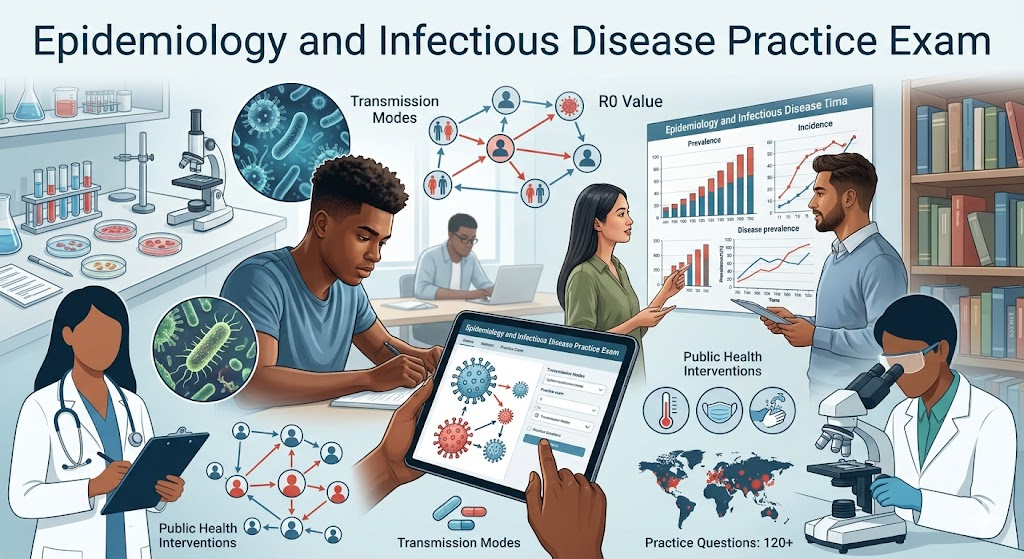
Additional Information
What the Course Entails and Exam Details
This foundational material covers a broad range of vital topics, ensuring a well-rounded understanding of how diseases arise, spread, and are controlled within populations. Key areas covered include:
Fundamental Principles of Epidemiology: Learning definitions, history, core functions, and the diverse applications of epidemiological studies in public health.
Concepts of Health and Disease: Understanding different models of disease causation, the spectrum of health, and how disease is defined and measured.
Measuring Disease Occurrence: Grasping key metrics like incidence, prevalence, morbidity, and mortality rates, including calculations and interpretation.
Disease Transmission and Dynamics: Delving into the mechanisms of infectious disease spread, different modes of transmission, vectors, reservoirs, and the concept of herd immunity.
Outbreak Investigation and Control: Learning the systematic steps involved in identifying, investigating, and managing disease outbreaks.
Epidemiological Study Designs: Exploring various research methods, including descriptive studies, observational studies (cohort, case-control), and experimental studies, alongside their strengths and limitations.
Screening and Diagnostic Tests: Understanding the concepts of validity (sensitivity, specificity) and reliability in testing for disease presence.
Basic Biostatistics for Epidemiology: Applying fundamental statistical concepts to analyze epidemiological data and interpret research findings.
What to Expect in the Final Exam
While specific formats can vary depending on the certifying body or institution administering the actual final exam for this introductory course, you can generally anticipate the following structure and requirements for the real certification:
Format: The exam typically consists of multiple-choice questions, true/false questions, and potentially some short answer or data interpretation scenarios. This diverse format aims to assess both knowledge recall and the ability to apply epidemiological concepts practically.
Time Limit: Expect a timed exam, usually ranging from 60 to 90 minutes. Strict adherence to time constraints is crucial, so regular practice with simulated conditions like this practice test is invaluable.
Number of Questions: The final exam may contain anywhere from 50 to 100 questions, designed to comprehensively test the breadth of the covered topics.
Passing Score: Requirements can vary, but a passing score typically falls within the 70% to 80% range. Be sure to check the specific guidelines for your particular program or examination.
Rules and Conduct: Standard academic integrity and exam conditions apply, whether administered online (with proctoring) or in a physical testing center. No external resources or collaboration are allowed.
How to Study and Exam Centers
Effective preparation is key to success on both the practice test and the actual final exam. Follow these proven strategies:
Diligent Study: Review your course materials, textbooks, lecture notes, and any recommended resources thoroughly. Create clear summaries and flashcards for key terms and formulas.
Utilize Practice Resources: Engage deeply with practice materials. This [Introduction to Epidemiology and Concepts of Infectious Disease Practice Test] is specifically designed for this purpose, providing a realistic assessment of your progress and illuminating areas that require more focus. Repeat the test multiple times, focusing not just on correct answers but on understanding the underlying rationale.
Focus on Understanding, Not just Memorization: While key terms are important, prioritize grasping the why and how of epidemiological concepts, especially calculating and interpreting rates, understanding transmission dynamics, and evaluating study designs.
Time Management Practice: When taking practice tests, simulate real exam conditions by timing yourself strictly to build speed and accuracy.
Clarify Doubts: Don't hesitate to seek clarification from instructors, tutors, or peers if you encounter challenging topics. Active discussion can significantly solidify understanding.
Where and How to Take the Final Exam:
Educational Institutions: If you are taking this as part of a formal course, the final exam will likely be administered directly by your university, college, or training provider, either online through their learning platform or in an invigilated classroom setting.
Online Proctored Exams: Some certifications allow for online exams that are monitored by a remote proctor. This offers convenience but requires suitable technology and a quiet, compliant environment.
Authorized Testing Centers: Specific certifications might require you to schedule and take your exam at designated testing facilities, such as Pearson VUE centers, where standard testing protocols are strictly followed. You would typically register online and select a convenient location. Always confirm the exact exam administration process and location details with your specific program or certifying body.
Job Opportunities from the Course
Upon completing this course and potentially earning a certification, numerous career paths and job opportunities in the vital field of public health and beyond open up for you, including roles such as:
Public Health Associate: Assisting with community health assessments, data collection, and program implementation.
Infection Control Coordinator: Working within healthcare settings to monitor and prevent the spread of healthcare-associated infections.
Epidemiology Research Assistant: Supporting research projects by managing data, conducting basic analyses, and assisting with studies on disease patterns.
Disease Intervention Specialist: Working in public health departments to track, investigate, and help control infectious disease outbreaks (e.g., STI tracing, tuberculosis cases).
Public Health Data Analyst (Entry Level): Utilizing basic epidemiological and statistical knowledge to clean, organize, and visualize health data.
Healthcare Administrator (with focus on Population Health): Leveraging understanding of disease trends to manage healthcare resources and improve community health outcomes.
Environmental Health Technician: Contributing to public health by monitoring environmental factors that influence disease transmission.
Clinical Research Coordinator (with basic epidemiological knowledge): Assisting in the management and data collection of clinical trials.
Global Health Support Staff: Working on international health initiatives that address infectious diseases.
Get ready to make a tangible impact on global health by mastering the principles of epidemiology and infectious disease. Your journey begins with solid preparation!
Frequently Asked Questions
Reviews
5.0
Based on 0 reviews
Leave a Review
No reviews yet. Be the first to review!