
Introduction to Java Programming Practice Test
$69.00
- Buy to unlock unlimited access to all Quiz questions and Answers in this Quiz.
- After purchase you can print a PDF of the whole quiz at any point. The PDF will contain the questions and the correct answers.
About this Exam
Navigating the world of software development requires a strong foundation, and few languages offer a better starting point than Java.
The Introduction to Java Programming exam is a pivotal assessment designed to validate an individual's fundamental understanding of one of the world's most popular and enduring programming languages.
This test serves as the crucial first step for aspiring software developers, university computer science students, and IT professionals looking to transition into a coding-focused role.
It is specifically engineered for beginners who need to prove their proficiency in core programming concepts before moving on to advanced development or specialized Java certifications.
Achieving a passing score on this practice test demonstrates that you have grasped the essential logic and syntax required to begin building functional applications.
Ready to test your knowledge?
Buy Now to Access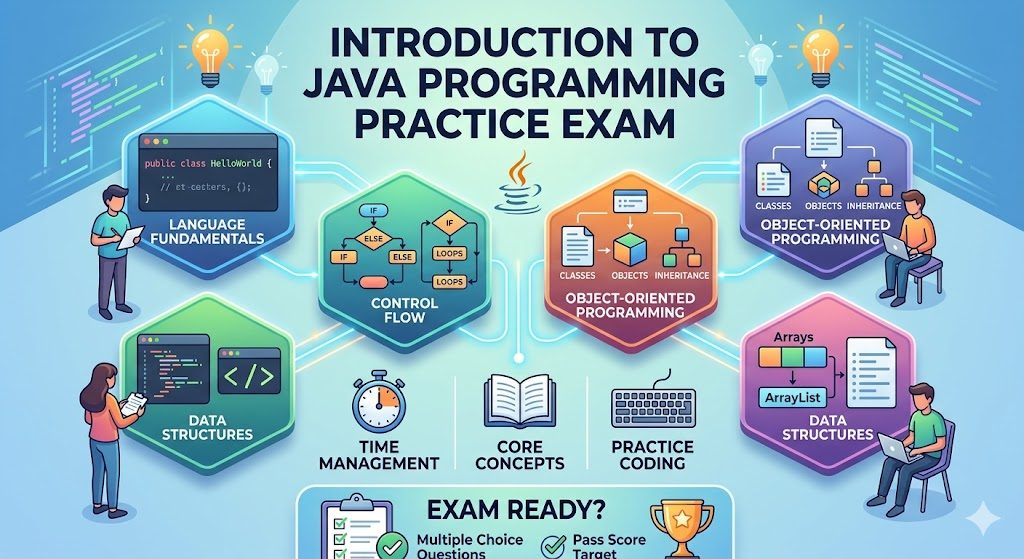
Additional Information
What the Course Entails and Exam Details
This comprehensive practice test covers the core pillars of procedural and Object-Oriented Programming (OOP) using the Java language.
The curriculum ensures you are equipped with the knowledge necessary to write, compile, and debug simple Java applications.
Key competency areas assessed within this exam include:
Java Fundamentals: Understanding the Java Virtual Machine (JVM), Java Development Kit (JDK), and standard language syntax.
Data Types and Variables: Working with primitive types (int, double, boolean), reference types (String), declaration, and initialization.
Operators and Expressions: Applying arithmetic, relational, and logical operators to manipulate data.
Control Flow Statements: Mastering decision-making structures (if-else, switch) and looping mechanisms (for, while, do-while).
Methods: Defining, calling, and structuring methods, including parameter passing and return types.
Object-Oriented Programming Concepts: Implementing the core concepts of classes, objects, inheritance, and polymorphism.
Arrays and Collections: Creating, iterating, and managing single and multi-dimensional arrays, as well as basic ArrayList usage.
Exception Handling: Utilizing try-catch blocks to build resilient, error-resistant code.
What to Expect in the Final Exam
Preparing for the Introduction to Java Programming Practice Test requires understanding the assessment environment and constraints.
While exact details can vary based on the certifying body (such as Oracle or specific academic institutions), this exam generally follows a standardized professional format.
Format: The exam predominantly consists of multiple-choice and multiple-select questions that require you to analyze code snippets and predict their output or correct syntactical errors.
You may also encounter drag-and-drop programming scenarios or "fill-in-the-blank" coding challenges designed to test logical sequencing and syntax accuracy.
Time Limit: Candidates are typically given between 90 and 120 minutes to complete the test, demanding both accuracy and efficient time management.
Question Count: Expect to answer approximately 50 to 70 questions covering the diverse topic areas listed in section two.
Passing Score: A passing score is usually set between 65% and 75%; however, as this is a practice exam, your goal should be to exceed this threshold consistently before attempting the official certification.
This assessment is typically administered as a "closed-book" exam, meaning you will not have access to external resources, IDEs, or documentation.
How to Study and Exam Centers
Successfully preparing for this exam requires a balanced approach that combines theoretical knowledge with rigorous practical application.
Effective Study Strategies:
Write Code Daily: Do not just read about Java syntax; actively write code. Use a simple text editor or a powerful IDE like IntelliJ IDEA or Eclipse to build small programs that implement the concepts you are studying.
Analyze Code Snippets: A large portion of the exam involves reading code, not writing it. Practice looking at unfamiliar code and manually tracking variable changes and output (known as "desk-checking").
Utilize Practice Tests: This is crucial. Repeatedly taking practice exams helps you become familiar with the questioning style, identify your weak areas, and manage your time effectively under pressure.
Focus on "What Happens When": Java has strict rules. Understand exactly what happens during edge cases, such as integer division, operator precedence, and loop termination conditions.
Exam Center Information:
The official Java fundamental certifications are usually administered through major global testing providers, most notably Pearson VUE.
These exams can be taken at their authorized physical testing centers worldwide, which offer a controlled and secure environment.
Alternatively, many students now opt for online proctored exams, allowing you to take the test from the comfort of your home or office while being monitored remotely.
University students taking this as a final exam will typically complete it within their institution's designated computer labs.
Job Opportunities from the Course
Mastering introduction to Java is the gateway to a lucrative and diverse career in technology. While often considered the "first step," proficiency at this level qualifies you for several essential starting roles.
Potential job opportunities and career paths unlocked by this foundational knowledge include:
Junior Java Developer
Associate Software Engineer
Quality Assurance (QA) Engineer (specifically focusing on automated testing using Java)
Application Support Analyst
Java Web Developer Trainee
Back-End Developer (Entry-Level)
Technical Support Specialist (supporting Java-based enterprise applications)
Systems Analyst Intern
Frequently Asked Questions
Reviews
5.0
Based on 0 reviews
Leave a Review
No reviews yet. Be the first to review!