
Introduction to Laboratory and Diagnostic Medicine Practice Test
$69.00
- Buy to unlock unlimited access to all Quiz questions and Answers in this Quiz.
- After purchase you can print a PDF of the whole quiz at any point. The PDF will contain the questions and the correct answers.
About this Exam
This Introduction to Laboratory and Diagnostic Medicine Practice Exam serves as a vital tool for individuals taking their first steps towards a career in the dynamic field of medical diagnostics. It is designed to evaluate and reinforce understanding of core concepts for students in entry-level health programs, prospective laboratory assistants, phlebotomists, and medical support staff. By completing this practice test, candidates can build confidence, identify knowledge gaps, and familiarize themselves with the style and scope of the actual foundational assessment in this critical domain. It is an essential component of a successful study strategy for anyone aiming to validate their knowledge at an introductory level and ensure compliance with essential safety and practice standards.
Ready to test your knowledge?
Buy Now to Access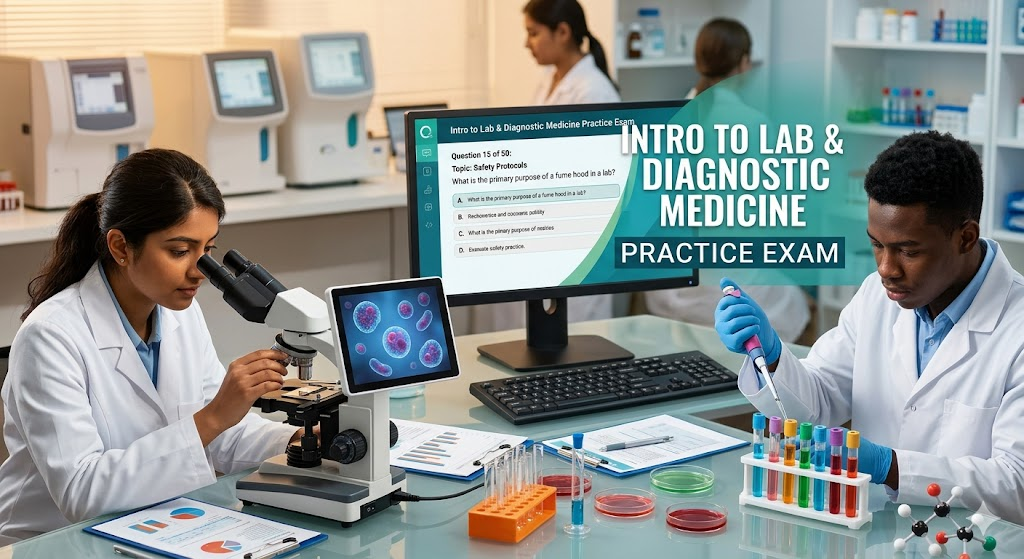
Additional Information
What the Course Entails and Exam Details
The Introduction to Laboratory and Diagnostic Medicine course and its associated exam provide a foundational understanding of the principles, procedures, and safety protocols essential for effective practice in a medical laboratory or diagnostic environment. Key areas typically covered include:
Laboratory Safety and Regulations: Strict adherence to safety guidelines, handling hazardous materials, understanding biohazard symbols, and general regulatory requirements (e.g., OSHA in the US).
Basic Laboratory Equipment and Techniques: Identification and correct usage of common laboratory tools like microscopes, centrifuges, pipettes, and analytical instruments, as well as basic sterile techniques.
Medical Terminology: Mastery of common prefixes, suffixes, root words, and specific terminology relevant to laboratory tests and medical conditions.
Specimen Collection, Handling, and Transport: Procedures for collecting various types of samples (blood, urine, tissue, etc.), ensuring proper labeling, storage, and safe transport to maintain sample integrity. This often includes an overview of phlebotomy fundamentals.
Data Recording and Quality Assurance: Understanding the importance of accurate data entry, quality control procedures, and basic statistical concepts used to ensure the reliability of test results.
Overview of Common Diagnostic Areas: A basic introduction to key disciplines such as hematology (blood study), clinical chemistry, microbiology (study of microorganisms), and immunology, including common tests and their clinical significance.
Laboratory Mathematics: Fundamental calculations and unit conversions required for solution preparation, dilutions, and basic test interpretation.
What to Expect in the Final Exam
While specific exam details vary by institution or certification body, this practice exam reflects the common format of introductory, foundational assessments. You should generally expect:
Multiple-Choice Format: The vast majority of questions are likely multiple-choice, testing your ability to recall definitions, apply concepts, and select the correct answer among plausible options.
Question Count: A typical introductory exam could contain between 50 and 150 questions.
Time Limit: Expect a time limit ranging from 1 to 2.5 hours. Time management will be crucial.
Passing Score: Requirements often range from 70% to 80%, reflecting a need for a solid grasp of the material. Crucially, these ranges are examples and you must check with your specific exam provider for the exact score needed.
Rules and Regulations: Expect standard exam protocols. These typically include the requirement for valid, government-issued photo identification. Prohibited items, such as smartphones, smartwatches, calculators (unless explicitly permitted), and study materials, are strictly disallowed in the testing area. Online proctored exams may have specific system requirements and environment guidelines (e.g., a quiet room, clear desk). Some exams might include a simple calculator built into the software, but you should not assume.
Practical Component (Potential): While this practice exam focuses on the written/theoretical component, be aware that some certification pathways or institutional programs may require a separate practical skills assessment (e.g., for phlebotomy or basic lab techniques). However, the foundational written test is generally the initial requirement.
How to Study and Exam Centers
Effective study and selection of an appropriate exam delivery method are key to success:
Actionable Study Strategies:
Official Resources First: Always prioritize textbooks, course notes, and study guides provided or recommended by your specific institution or exam board.
Utilize This Practice Test: Take the Intro to Lab & Diagnostic Medicine Practice Exam multiple times. Treat each attempt as a real test to improve speed and identify weak areas. Review incorrect answers thoroughly.
Active Learning: Create flashcards for medical terms, equipment functions, and safety symbols. Explain concepts to a study partner or even out loud to yourself. Work through lab math problems regularly.
Iterative Review: Space your studying out rather than cramming. Consistent, shorter study sessions are often more effective for long-term retention.
Join Study Groups: Interacting with peers can provide new insights, clarification, and moral support.
Exam Centers:
Online Proctoring: Many modern introductory exams are available online. This involves a secure browser and live or recorded proctoring via your computer's camera and microphone, offering flexibility.
Physical Testing Centers: Larger, established exams are often hosted by dedicated testing network providers. Check the specific exam guidelines for authorized networks, potentially including well-known organizations such as Pearson VUE or Prometric, if they offer this specific foundational exam. Note: You must verify with the precise body administering your exam for current delivery partners.
Authorized Educational Institutions: Many colleges, universities, and technical schools are authorized to administer introductory exams to their own students or sometimes to the public. Contact the testing center or health sciences department of local institutions to inquire.
Job Opportunities from the Course
A strong performance on an Introduction to Laboratory and Diagnostic Medicine exam, often in conjunction with specific practical training or educational prerequisites, can open doors to various entry-level positions in medical laboratories, hospitals, clinics, and research settings. These roles provide essential support and can serve as building blocks for a successful long-term career. Job opportunities include:
Laboratory Assistant / Aide
Phlebotomist (requires specific practical certification, which this knowledge supports)
Specimen Processor
Laboratory Receptionist
Clinical Support Worker (in a diagnostic setting)
Research Assistant I (entry-level lab support in a research context)
Diagnostic Imaging Assistant (support roles within imaging departments)
These positions offer valuable experience and can be a stepping stone towards more advanced roles, such as Medical Laboratory Technician (MLT) or Medical Laboratory Scientist (MLS), which typically require further education and separate, more advanced certification.
Frequently Asked Questions
Reviews
5.0
Based on 0 reviews
Leave a Review
No reviews yet. Be the first to review!