
Introduction to Laboratory Medicine Practice Test
$69.00
- Buy to unlock unlimited access to all Quiz questions and Answers in this Quiz.
- After purchase you can print a PDF of the whole quiz at any point. The PDF will contain the questions and the correct answers.
About this Exam
The Introduction to Laboratory Medicine course is designed for aspiring healthcare professionals—including Medical Laboratory Technicians (MLT), Clinical Laboratory Scientists (CLS), and medical students—who need a rock-solid foundation in the critical world of diagnostic testing. This course unlocks the essential concepts that drive patient care behind the scenes. The Introduction to Laboratory Medicine Practice Test is your pivotal tool to gauge your understanding, identify knowledge gaps, and build the unshakable confidence required to excel on your final, accredited examination. Think of it as your simulated gateway to a vital and rewarding career in healthcare science.
Ready to test your knowledge?
Buy Now to Access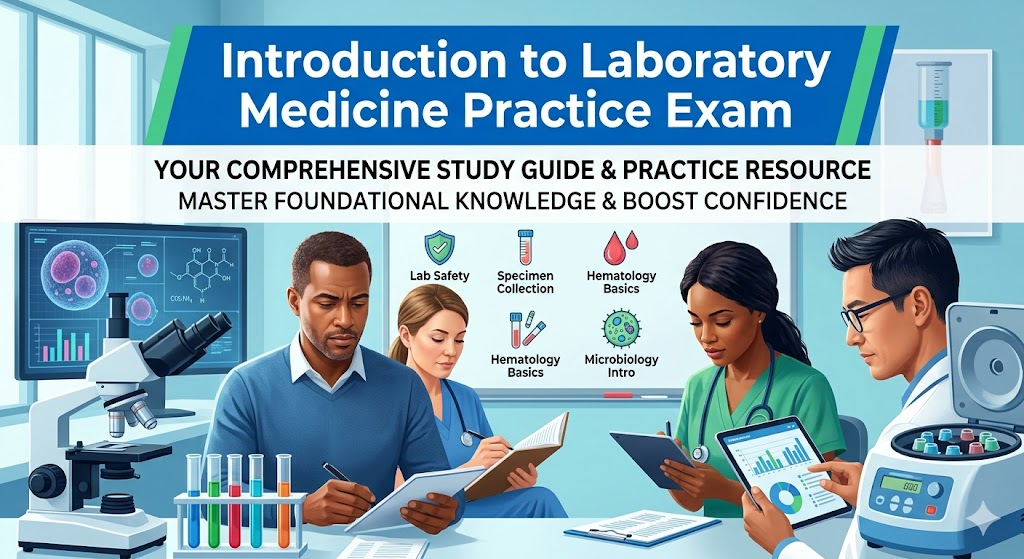
Additional Information
What the Course Entails and Exam Details
This foundational course is a prerequisite for more advanced, specialized training in clinical laboratory science. It covers a broad range of critical topics that every lab professional must master. The curriculum provides a comprehensive introduction to:
Laboratory Safety and Regulation: Understanding OSHA standards, bloodborne pathogens, proper personal protective equipment (PPE), and chemical hygiene.
Quality Control and Assurance: Learning how to validate test results and maintain the highest standards of accuracy and precision.
Specimen Collection and Processing: Techniques for phlebotomy, urine collection, and proper handling of other biological samples.
Microscopy and Instrumentation: Hands-on experience and theoretical knowledge of basic lab tools, including compound microscopes.
Foundational Hematology: Understanding cell types, basics of complete blood counts (CBC), and blood coagulation principles.
Urinalysis and Body Fluids: Introduction to physical, chemical, and microscopic analysis of urine and other specimens.
Basic Clinical Chemistry: An introduction to analyzing chemical components in blood and other fluids.
Microscopy Basics: Techniques for visualizing microorganisms, fungi, and cellular structures.
What to Expect in the Final Exam
While the practice test helps you prepare, the final Introductory Laboratory Medicine Course Exam is a formal evaluation administered by your educational institution or accredited body. You should expect:
Format: The exam typically consists of 70 to 100 multiple-choice questions (MCQs). Some tests may include simple case study scenarios or data interpretation questions.
Time Limit: You will generally have 90 to 120 minutes to complete the exam.
Content: Questions are derived directly from the syllabus topics mentioned in Section 2, demanding both recall of facts and application of introductory concepts.
Passing Score: Requirements vary, but a score of 70% or higher is commonly required to pass. The passing standard is designed to ensure you possess the base knowledge needed to advance safely in your clinical education.
How to Study and Exam Centers
Preparation is paramount. To master this introduction, you need a targeted strategy:
Leverage Multiple Practice Tests: Take several variations of the Introduction to Laboratory Medicine Practice Test. This is the single best way to familiarize yourself with question formats and identify weak areas.
Focus on Flashcards: Use digital tools like Anki or physical cards to memorize definitions, safety protocols, normal ranges for basic tests, and key equipment functions.
Review Your Textbooks and Lectures: Don’t just memorize answers; understand the why behind the procedures and concepts presented in your course materials.
Form Study Groups: Explaining concepts to peers is a powerful reinforcement technique.
Where to Take the Exam:
Because this is an introductory course exam, it is typically taken:
Through Your College or University: Most often, students take this exam directly through their degree or certificate program, either in a physical testing center on campus or via the university's secure online learning management system (like Canvas or Blackboard).
Authorized Training Schools: Accredited vocational or technical schools offering lab tech programs will administer their own introductory exams.
Please note: National certification exams (like those from ASCP or AMT) are taken after complete program completion and are administered at separate, authorized centers like Pearson VUE. The exam described here is the precursor course exam.
Job Opportunities from the Course
Successfully completing this introductory course is the necessary first step on several rewarding career paths. While this course alone doesn't provide certification, the knowledge you gain is essential for securing positions such as:
Medical Laboratory Technician (MLT) – (Upon completing full training program)
Clinical Laboratory Assistant (CLA)
Medical Laboratory Assistant (MLA)
Phlebotomist
Research Assistant (in clinical research or biomedical settings)
Biomedical Laboratory Support Specialist
Quality Control Analyst Trainee (in relevant industries)
Frequently Asked Questions
Reviews
5.0
Based on 0 reviews
Leave a Review
No reviews yet. Be the first to review!