
Introduction to Lifetime Fitness Practice Exam
$69.00
- Buy to unlock unlimited access to all Quiz questions and Answers in this Quiz.
- After purchase you can print a PDF of the whole quiz at any point. The PDF will contain the questions and the correct answers.
About this Exam
The Introduction to Lifetime Fitness course, and this corresponding practice exam, provides a comprehensive introduction to the principles of long-term health and wellness. This program is typically designed for individuals who are enthusiastic about fitness and want to develop a foundational understanding. It is also an excellent starting point for aspiring personal trainers, group fitness instructors, corporate wellness coordinators, or anyone aiming to promote healthy lifestyles in themselves and others. The exam assesses a foundational level of knowledge about exercise science, nutrition, behavior change, and program design. Completing this process successfully demonstrates a commitment to understanding the core tenets of making fitness a sustainable, life-long journey.
Ready to test your knowledge?
Buy Now to Access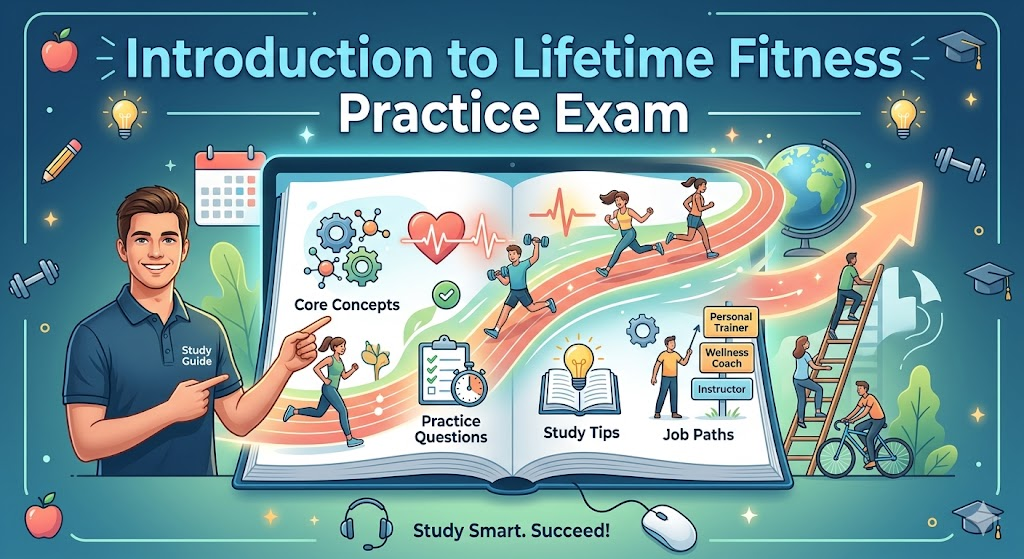
Additional Information
What the Course Entails and Exam Details
The Introduction to Lifetime Fitness course covers a diverse range of foundational topics essential for promoting and maintaining overall wellness. Students can expect a thorough syllabus exploring concepts like:
Principles of Exercise Science: Understanding biomechanics, muscle physiology, and standard movement patterns.
Health and Wellness Foundations: Defining total fitness, understanding the relationship between physical activity and longevity, and identifying lifestyle factors.
Nutrition and Weight Management: Basic dietary guidelines, the role of macro and micronutrients, and effective, healthy weight management strategies.
Exercise Program Design: Crafting safe, effective workout plans tailored to various needs and goals, understanding the FITT formula.
Behavior Change and Motivation: Strategies for developing sustainable healthy habits and encouraging long-term engagement in physical activity.
Health Assessments and Goal Setting: Learning to evaluate fitness levels and set appropriate, achievable goals for clients or oneself.
Safety and Injury Prevention: Understanding proper form, common injuries, and risk management in fitness settings.
The exam itself is a rigorous assessment, likely featuring a structure with a high percentage of multiple-choice questions designed to test knowledge retention and practical application. It might also include scenario-based questions, short answers, or possibly a practical component where you demonstrate key movements or coaching skills. Specific duration and rules will vary depending on the exact certification or institution issuing the practice exam.
What to Expect in the Final Exam
When you move from practice to the actual final exam, you should anticipate a structured assessment.
Format: The exam will typically be primarily multiple-choice. There may be true/false questions, matching, or potentially short-answer and essay questions designed for deeper critical thinking. Some comprehensive programs might incorporate a proctored practical examination as well.
Passing Score: Requirements can vary widely. Most commonly, a passing score falls within the range of 70% to 80% or a specific equivalent point value. Be sure to confirm the exact passing standard of your target program.
Time Limit: Expect a strict time limit. This could typically range from 1.5 hours to 3 hours, giving you a reasonable but defined window to complete all sections.
Specific Rules: Online exams might require a live proctor through your webcam, government-issued photo ID verification, and restrictions against using notes or external aids. Physical testing centers will have similar ID and security protocols, ensuring a standardized testing environment.
It is always crucial to check the specific details provided by your exam administrator well in advance.
How to Study and Exam Centers
Preparation is paramount for success on any exam. Consider these effective study strategies:
Utilize Course Materials Thoroughly: Dedicate time to reviewing all textbooks, online modules, lecture notes, and provided resources.
Create Structured Notes and Flashcards: Actively engage with the material by summarizing key points and using flashcards for terms and definitions.
Take Multiple Practice Exams: Use this practice exam and seek out other high-quality practice resources. Analyze your results, focus on areas where you are weak, and simulate exam conditions with time limits.
Apply Concepts Practically: If possible, practice key movements, coaching cues, or program design with a study partner to solidify understanding.
Focus on Core Areas: Pay extra attention to high-weight topics like exercise science and program design.
Study Groups: Collaborate with peers to discuss complex concepts and share different perspectives.
Rest and Review: Do not cram all at once. Study consistently, get adequate rest, and review the most critical information as the exam date approaches.
Exam Centers: The location and method of your exam will depend on the offering institution.
Online Portals: Many certifications offer flexible online proctoring, allowing you to take the exam from a quiet space at home. This often requires specific software and a proctoring service.
Physical Testing Centers: You may need to visit a designated location, such as a college campus, training school, or authorized third-party testing center like Pearson VUE or Prometric. These centers provide a secure and standard testing environment.
Authorized Schools/Institutions: If the exam is part of a specific school or organization's program, it may be held on-site at that facility.
Confirm your chosen method and location early in your study process to avoid any last-minute issues.
Job Opportunities from the Course
Earning a foundational understanding and certification in lifetime fitness, even starting with an introduction and practice exam, can unlock a variety of exciting job opportunities in the health and wellness industry. Here is a list of specific job titles and career paths this knowledge can contribute to:
Personal Trainer: Work directly with clients to assess their fitness levels, design personalized exercise plans, and provide motivation.
Group Fitness Instructor: Lead dynamic classes like cycle, yoga, cardio dance, or strength training for multiple participants.
Wellness Coordinator: Develop and manage wellness programs for corporations, community centers, or residential communities.
Health Coach: Guide and support individuals in making healthy lifestyle choices, from diet to stress management.
Fitness Center Manager: Oversee the daily operations, staff, and programming of a gym or fitness facility.
Recreation Leader/Director: Plan and lead recreational and sports activities for parks, community organizations, or youth groups.
Youth Fitness Coach: Specialize in designing safe and engaging fitness programs for children and adolescents.
Corporate Wellness Trainer: Deliver on-site fitness training and wellness workshops for employees.
Community Health Worker: Focus on promoting public health initiatives and wellness in specific community settings.
Sales Representative for Fitness Products: Use your knowledge to represent and sell fitness equipment, apparel, or technology.
This introduction can also be a vital first step for those who wish to pursue further specialized certifications or advanced education in fields like physical therapy, kinesiology, or sports medicine.
We hope this study guide proves useful on your journey toward mastering lifetime fitness principles. Stay focused, believe in yourself, and know that each hour of preparation is an investment in your success. Good luck with your studies and with the exam. You can do it!# Introduction to Lifetime Fitness Practice Exam Guide
Frequently Asked Questions
Reviews
5.0
Based on 0 reviews
Leave a Review
No reviews yet. Be the first to review!