
Introduction to Mobile Cranes Practice Test
$69.00
- Buy to unlock unlimited access to all Quiz questions and Answers in this Quiz.
- After purchase you can print a PDF of the whole quiz at any point. The PDF will contain the questions and the correct answers.
About this Exam
The Introduction to Mobile Cranes Practice Test is designed for aspiring crane operators, construction personnel, and heavy equipment enthusiasts seeking to enter the lifting and hoisting industry.
This introductory exam assesses foundational knowledge necessary to operate mobile cranes safely and effectively.
It provides a crucial first step for beginners before they move on to more advanced, hands-on certifications required by occupational safety and health organizations.
Successfully completing this test demonstrates that a candidate possesses a core understanding of the equipment’s mechanics and the safety protocols fundamental to lifting operations.
It is an ideal starting point for anyone looking to build a career in this high-demand field.
Ready to test your knowledge?
Buy Now to Access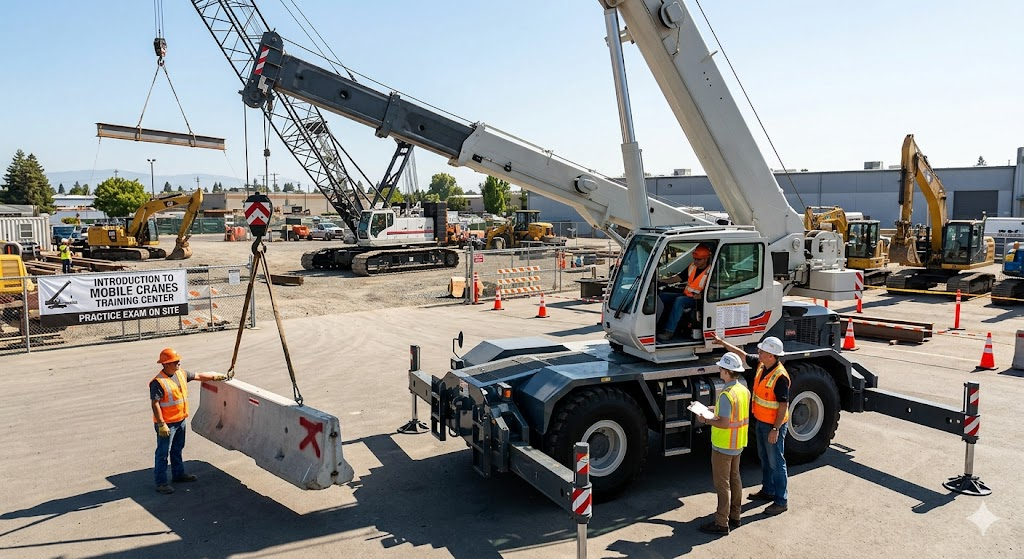
Additional Information
What the Course Entails and Exam Details
This introduction covers the essential vocabulary and concepts related to mobile crane operation.
Students will learn to distinguish between different types of mobile cranes, such as all-terrain, rough-terrain, crawler, and truck-mounted units.
A major component involves understanding the basic physics of lifting, including stability factors and the importance of the center of gravity.
Furthermore, the curriculum introduces the crucial skill of interpreting general load charts, although comprehensive chart mastery is often reserved for advanced certifications.
Basic crane setup, inspection procedures, and fundamental safety regulations are also central to the syllabus.
The exam typically focuses on validating theoretical understanding rather than practical operation.
What to Expect in the Final Exam
The Introduction to Mobile Cranes examination generally consists of a multiple-choice format, designed to test theoretical knowledge rather than practical skill.
Depending on the administering body, the exam typically features between 50 and 100 questions.
Candidates are usually allocated a fixed time limit, often ranging from 90 minutes to two hours, to complete the test.
A passing score is frequently set at around 70% or higher, emphasizing the need for thorough preparation.
It is essential to check the specific guidelines of your testing provider, as rules regarding calculator use, scratch paper, or breaks can vary.
The exam focuses heavily on safety protocols, terminology, and foundational math needed for load chart calculations.
How to Study and Exam Centers
Effective study strategies include utilizing a structured study guide that aligns with the exam’s core topics.
Creating flashcards for key definitions and crane terminology is highly beneficial for retention.
One of the most effective methods for preparation is taking multiple practice tests to build confidence and familiarize yourself with the question formatting and time constraints.
These introduction exams are often available through online educational portals or specialized trade schools.
For official testing, candidates often visit Pearson VUE test centers, authorized trade schools, or utilize secure, online proctored testing portals.
Always verify the approved testing centers with your certification body.
Job Opportunities from the Course
While an introductory certification is usually a stepping stone to full licensure, it opens several career paths and entry-level positions in the construction and logistics sectors.
Crane Operator Apprentice or Trainee
Crane Rigger and Signaler
Heavy Equipment Operator Assistant
Safety Inspector Assistant
Yard Person or Equipment Dispatcher
Construction Laborer specializing in lifting support
Entry-Level Position in Crane Maintenance and Mechanics
Frequently Asked Questions
Reviews
5.0
Based on 0 reviews
Leave a Review
No reviews yet. Be the first to review!