
Introduction to Physical Geology Practice Exam
$69.00
- Buy to unlock unlimited access to all Quiz questions and Answers in this Quiz.
- After purchase you can print a PDF of the whole quiz at any point. The PDF will contain the questions and the correct answers.
About this Exam
The Introduction to Physical Geology exam is a foundational assessment for students, enthusiasts, and anyone exploring the fascinating science of Earth’s processes, materials, and history. This exam typically serves as a key component of introductory college-level geology courses, evaluating your understanding of fundamental concepts before moving on to more advanced geological studies. It is designed to gauge your grasp of dynamic Earth systems, from the formation of rocks to the movement of tectonic plates. By taking this practice exam, you can identify your strengths and weaknesses, build confidence, and effectively prepare for the academic final that often follows such a course. Whether you aim for a career in geosciences, environmental science, or simply want a deeper understanding of the planet you inhabit, mastering this introduction is the first essential step.
Ready to test your knowledge?
Buy Now to Access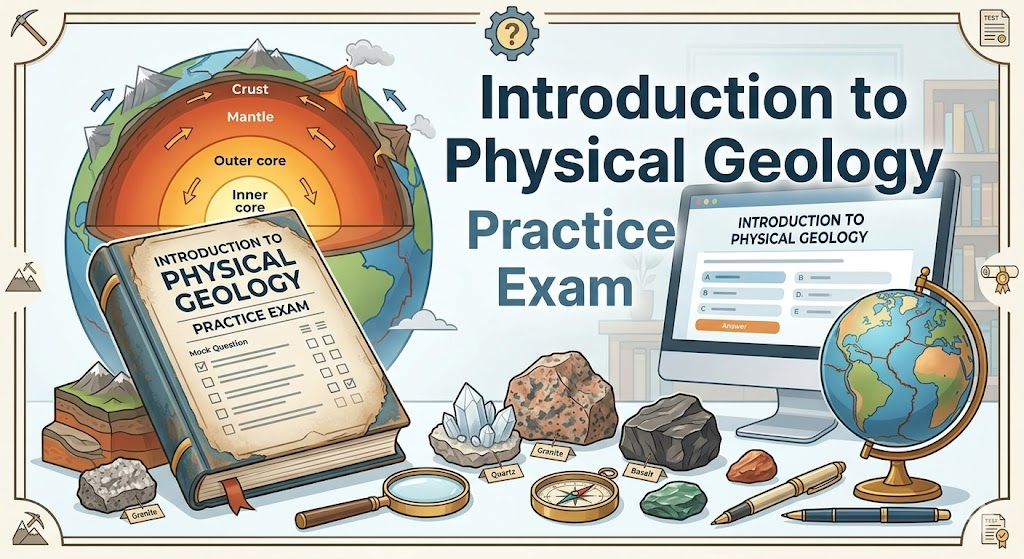
Additional Information
What the Course Entails and Exam Details
An introductory physical geology course provides a comprehensive look at the mechanisms that shape our planet. Core topics and skills covered usually include:
Earth Materials: Identification and classification of common minerals and the three major rock types: igneous, sedimentary, and metamorphic.
Plate Tectonics: The unifying theory explaining the movement of Earth’s lithospheric plates, the formation of mountains, ocean basins, and the distribution of earthquakes and volcanoes.
Geologic Time: Understanding the vast scale of Earth’s history, relative and absolute dating techniques, and the geologic time scale.
Surface Processes: The study of weathering, erosion, rivers, glaciers, groundwater, winds, and coastal processes that carve the landscape.
Internal Processes: An overview of earthquakes, volcanoes, magma formation, and the structural deformation of rocks.
Earth’s Structure: Understanding the composition and characteristics of Earth’s layers—crust, mantle, and core.
Geological Resources & Hazards: An introduction to energy and mineral resources, as well as natural hazards and their impacts.
The accompanying introductory course typically involves lectures, textbooks, laboratory exercises (often including rock and mineral identification), and sometimes field trips. A practice exam will mirror the breadth and level of detail of this foundational material.
What to Expect in the Final Exam
While the exact structure can vary significantly between universities and individual instructors, a typical Introduction to Physical Geology final exam often features:
Multiple Choice Questions: These are very common, testing a wide range of factual knowledge, conceptual understanding, and problem-solving scenarios.
Diagram Identification: You might need to label parts of a diagram (e.g., plate boundary types, the rock cycle, cross-sections of a volcano).
Calculation/Application Problems: You could encounter basic problems related to radioactive dating, seismic wave travel times, or contour map interpretation.
Brief Essay/Short Answer Questions: Some exams may require you to explain a geological process, define a key concept, or synthesize information.
Passing Score: A passing score is determined by the specific institution or instructor, often aligning with typical university grading scales (e.g., a letter grade of C or D, or a numerical score around 60-70%).
Time Limit: Expect a time limit that can range from 1 to 3 hours, reflecting the typical duration of a final examination.
Rules & Format: The exam is generally closed-book, though students are sometimes permitted certain scientific calculators or reference sheets, depending on the instructor’s policy. Practice exams are usually flexible and do not have official proctoring rules, designed primarily for self-assessment and learning.
It is crucial to remember that this study guide and practice exam are preparation resources. The actual final exam will be governed by the regulations of your specific academic program.
How to Study and Exam Centers
Effective preparation is key to success on any geology exam. Actionable strategies include:
Consistent Review: Don't cram. Review your notes, textbook chapters, and laboratory materials regularly.
Active Learning: Create flashcards for rock and mineral identification and key terms. Draw and label diagrams for geological processes like the rock cycle or tectonic boundaries.
Practice Questions: The "Introduction to Physical Geology Practice Exam" is your most valuable resource here. Take it multiple times. Identify the questions you get wrong and thoroughly review those specific topics in your course materials.
Utilize Study Groups: Discussing concepts and quiz questions with peers can enhance understanding and recall.
Consult Instructor Resources: Review any study guides, past exams, or practice materials provided by your instructor or department.
Review Labs: Laboratory exercises are crucial for practical skills like identifying materials and reading geologic maps. Re-examine your lab work and the materials used.
Exam Centers:
For this "Introduction to Physical Geology Practice Exam," the "exam center" is typically your own computer, tablet, or smartphone. These resources are most commonly provided through:
Online Platforms: Educational websites, learning management systems (like Canvas, Blackboard, or Moodle used by your institution), or specific testing portals might offer such practice tests. They are designed to be accessible anytime and anywhere with an internet connection, allowing for self-paced study.
University Internal Systems: Your university department or individual professor might provide a specific practice exam directly through an online course page or academic resource center.
Note on the Final Exam: The actual final examination for an "Introduction to Physical Geology" course is administered by your university or college. This typically takes place in a physical classroom or computer lab on your campus or is conducted through the institution's official, proctored online testing system, and the schedule and rules are set by your school. This practice exam is not an official, proctored certification but a learning aid.
Job Opportunities from the Course
A strong understanding of Introduction to Physical Geology, combined with further study in the geosciences, can open doors to diverse and rewarding career paths. Consider these job titles and sectors:
Geologist
Environmental Scientist
Geophysicist
Hydrologist
Engineering Geologist
Petroleum Geologist
Mining/Economic Geologist
Paleontologist
Stratigrapher
Sedimentologist
Science Educator (K-12 and university levels)
Natural Resource Manager
Geographic Information System (GIS) Specialist
Research Scientist with government agencies (like the USGS, state surveys)
Consultant in environmental, geotechnical, or energy firms
While this course is an introduction, it builds the essential foundation for advanced study in any of these areas, unlocking a world of exploration and professional growth in Earth sciences and related fields. Embrace the opportunity to learn, prepare diligently with this practice exam, and pave your way towards a successful academic journey in geology!
Frequently Asked Questions
Reviews
5.0
Based on 0 reviews
Leave a Review
No reviews yet. Be the first to review!