
Introduction to Radiographic Equipment Practice Test
$69.00
- Buy to unlock unlimited access to all Quiz questions and Answers in this Quiz.
- After purchase you can print a PDF of the whole quiz at any point. The PDF will contain the questions and the correct answers.
About this Exam
Welcome to your essential guide for the Introduction to Radiographic Equipment Practice Test. This practice exam is a crucial step for individuals aiming to enter the dynamic field of medical imaging. It is primarily designed for students enrolled in introductory radiologic technology courses, limited x-ray machine operator programs, or those preparing for entry-level certification assessments, such as the limited scope exams offered by the American Registry of Radiologic Technologists (ARRT) or various state licensing boards. By simulating the atmosphere of the actual exam, this practice test provides a low-stakes environment to assess your understanding of fundamental radiographic concepts, equipment operation, and safety protocols. Whether you are a dedicated student or a healthcare professional expanding your skill set, this practice exam is an invaluable tool to identify your strengths, pinpoint areas needing further study, and build the confidence necessary to succeed on your final certification day.
Ready to test your knowledge?
Buy Now to Access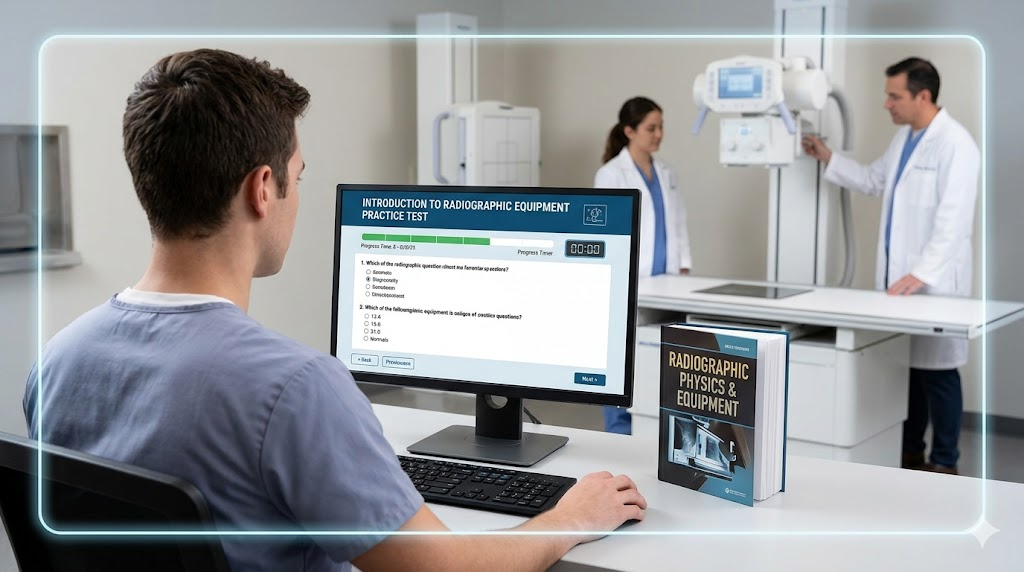
Additional Information
What the Course Entails and Exam Details
The "Introduction to Radiographic Equipment" course provides the foundational knowledge required to safely and effectively operate x-ray generating equipment. The curriculum is a blend of physics, technical theory, and practical application. Core topics covered typically include:
Principles of X-ray Production: Understanding how x-rays are generated within the x-ray tube, including the roles of the cathode, anode, and the process of thermionic emission.
Radiographic Equipment Components: Detailed study of the primary components of x-ray systems, including the control panel, high-voltage generator, x-ray tube, collimator, and table/bucky assembly.
Circuitry and Electronics: Basic understanding of the electrical circuits and rectifiers that power the x-ray tube and manage exposure factors.
Image Reception and Acquisition: Introduction to different types of image receptors, including conventional film-screen, computed radiography (CR) phosphor plates, and direct digital radiography (DR) flat-panel detectors.
Primary Exposure Factors: Master class on managing Kilovoltage peak (kVp), Milliampere-seconds (mAs), and time to control image contrast, density, and patient dose.
Beam Restriction and Filtration: Techniques and devices used to shape the x-ray beam and remove low-energy radiation to improve image quality and reduce patient exposure.
Basic Radiation Safety: Fundamental principles of time, distance, and shielding to protect patients, self, and others from unnecessary radiation.
What to Expect in the Final Exam
While the exact format can vary depending on the specific certifying body (e.g., ARRT limited scope versus a specific state exam), the final certification exam for Introduction to Radiographic Equipment generally follows a standardized structure. You can typically expect the following:
Exam Format: The vast majority of these exams are computer-based, consisting of multiple-choice questions. Some exams may incorporate enhanced question types, such as drag-and-drop, hot-spot identification, or short-answer, but multiple-choice remains the primary format.
Number of Questions: For a standard limited-scope or introductory equipment exam, the number of scored questions usually ranges from 100 to 150. There may also be a small number of unscored "pilot" questions used for future test development.
Time Limit: You will typically be allocated between 90 minutes and 3 hours to complete the exam, providing ample time to carefully read and answer each question.
Passing Score: A passing score is often established as a scaled score of 75. This is not a straight percentage but a scaled representation of your performance relative to the exam’s difficulty.
Specific Rules: Strict testing protocols are enforced. You will need to present two forms of valid identification, and personal belongings, including cell phones and watches, will likely be restricted from the testing room. Passing this exam often fulfills the core classroom requirement for licensing as a limited x-ray machine operator.
How to Study and Exam Centers
Preparation is key to conquering this exam. An effective study strategy should include a mix of theoretical review and practical application:
Leverage Comprehensive Resources: Utilize your course textbooks, lecture notes, and any study guides provided. Focus on key terminology, diagrams of equipment, and formulas.
Active Recall and Spaced Repetition: Instead of passive reading, test yourself frequently using flashcards for definitions, key components, and exposure factor relationships. Space out your study sessions to improve long-term retention.
Practice, Practice, Practice: Engage deeply with practice tests like this one. After completing a practice exam, do not just check your score. Analyze every incorrect answer to understand why the correct choice was right and why your choice was wrong.
Simulate Test Day: Once you feel confident, take a full-length practice test under timed conditions in a quiet, distraction-free environment. This helps build your testing stamina and reduces anxiety.
Exam Centers: To take the final certification exam, you will likely need to register through an authorized organization. For ARRT exams, candidates typically test at Pearson VUE professional testing centers, which are located globally. If you are taking a state-specific exam, it may be administered at Pearson VUE, other third-party centers, or authorized state facilities. Your course instructor will provide specific instructions on how and where to register for your final exam.
Job Opportunities from the Course
Successfully passing the Introduction to Radiographic Equipment exam opens doors to several rewarding entry-level and specialized careers within medical imaging, particularly in outpatient settings. Potential job titles include:
Limited X-Ray Machine Operator (LXMO)
Medical Assistant with Radiographic Authorization
Basic X-Ray Technician
Limited Scope Radiographer
Orthopedic Digital Imager
Podiatric Radiologic Technician
Chiropractic Radiologic Technician
Clinic Radiographer Assistant
Bone Densitometry Operator
This certification is often the fastest route to begin working in medical imaging, offering a direct path into physician offices, urgent care centers, orthopedic clinics, and other specialized healthcare facilities. For many, it also serves as a robust stepping stone toward becoming a fully Registered Radiologic Technologist (RT).
Frequently Asked Questions
Reviews
5.0
Based on 0 reviews
Leave a Review
No reviews yet. Be the first to review!