
Introductory Psychology CLEP Prep Practice Exam
$69.00
- Buy to unlock unlimited access to all Quiz questions and Answers in this Quiz.
- After purchase you can print a PDF of the whole quiz at any point. The PDF will contain the questions and the correct answers.
About this Exam
The College-Level Examination Program (CLEP) Introductory Psychology exam offers students a streamlined path to earn valuable college credit without enrolling in a full-semester course.
This exam is designed for diverse learners, including high school students seeking advanced standing, college students looking to save on tuition, and adult learners returning to education.
It assesses knowledge typically taught in a one-semester undergraduate introductory psychology course, validating your understanding of fundamental psychological principles, theories, and methodologies.
Mastering this material not only saves time and money but also provides a foundational understanding of human behavior beneficial for numerous academic and professional paths.
Ready to test your knowledge?
Buy Now to Access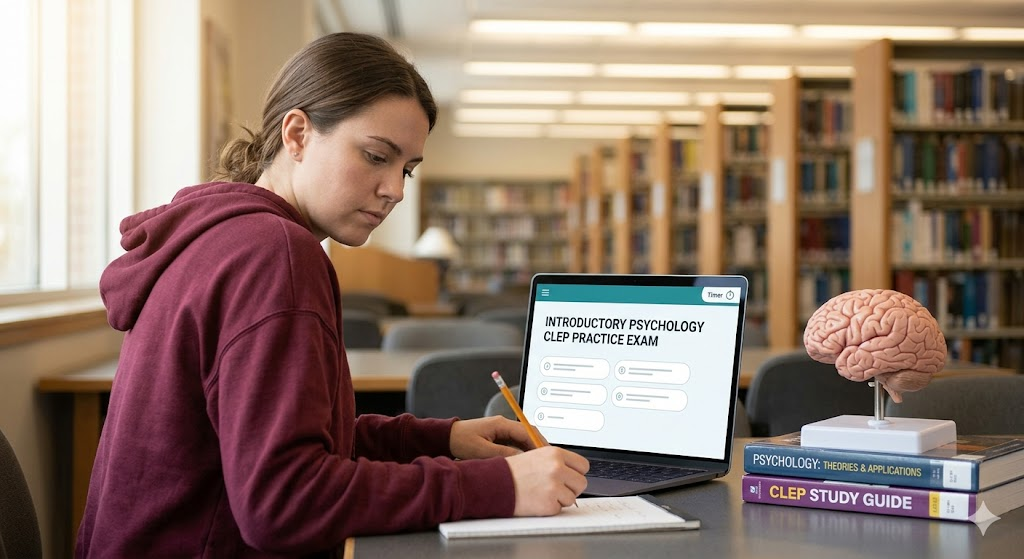
Additional Information
What the Course Entails and Exam Details
To succeed on this exam, you must demonstrate a comprehensive grip on the breadth of psychology.
While the exam is “introductory,” it requires deep knowledge of terminology, principles, and key figures within the following thirteen core areas:
History, Approaches, and Methods (8–9%): Origins of psychology, major perspectives (behavioral, cognitive, humanistic, psychodynamic), and research designs (experimental, correlational).
Biological Bases of Behavior (8–9%): Neuroanatomy, the nervous system, endocrine system, genetics, and physiological techniques.
Sensation and Perception (7–8%): How we process sensory information through vision, hearing, touch, taste, and smell, including perceptual organization.
States of Consciousness (5–6%): Sleep, dreams, hypnosis, meditation, and the effects of psychoactive drugs.
Learning (10–11%): Classical conditioning, operant conditioning, observational learning, and cognitive processes in learning.
Cognition (8–9%): Memory systems, problem-solving, language development, intelligence, and creativity.
Motivation and Emotion (7–8%): Theories of motivation (drive-reduction, arousal), hunger, thirst, social motivation, and theories of emotion.
Developmental Psychology (8–9%): Physical, cognitive, social, and moral development across the lifespan from infancy to old age.
Personality (7–8%): Major theories (psychoanalytic, trait, social-cognitive, humanistic) and assessment techniques.
Psychological Disorders and Health (8–9%): Types of disorders (anxiety, mood, schizophrenia, personality), their symptoms, and models of abnormality.
Treatment of Psychological Disorders (7–8%): Psychotherapy approaches (behavioral, cognitive, psychodynamic) and biological treatments (drug therapy).
Social Psychology (7–8%): Group dynamics, attribution theory, conformity, obedience, attitudes, prejudice, and aggression.
Statistics, Tests, and Measurement (3–4%): Descriptive statistics, inferential statistics, reliability, validity, and types of tests.
What to Expect in the Final Exam
The Introductory Psychology CLEP exam is a computer-based test that is both comprehensive and timed.
You will have a total of 90 minutes to answer approximately 95 multiple-choice questions.
It is important to note that a small number of these questions are pretest questions that do not count toward your final score.
CLEP exams are scored on a scaled range from 20 to 80.
The American Council on Education (ACE) recommends a passing score of 50, which usually corresponds to a grade of ‘C’ in the equivalent college course.
However, individual colleges and universities set their own credit-granting policies, so you must confirm the required passing score and credit award with your specific institution.
There is no penalty for guessing; your raw score is based solely on the number of correct answers, so you should attempt every question.
How to Study and Exam Centers
Preparation is critical to achieving a passing score on this rigorous exam.
Study Strategies:
Take a Diagnostic Test: Begin with a full-length Introductory Psychology CLEP Prep Practice Exam to identify your current strengths and weaknesses.
Use Comprehensive Study Guides: Utilize official College Board resources and respected third-party CLEP prep books that align specifically with the exam breakdown.
Focus on Vocabulary: Psychology is heavy on terminology; create flashcards for key terms, definitions, and the major theories associated with famous psychologists.
Take Multiple Practice Exams: The best way to build stamina and familiarity with the question format is through repeated practice. Review the explanations for every answer, both correct and incorrect.
Exam Centers and Logistics:
You cannot take the official CLEP exam at home without specific remote proctoring arrangements; you must register to take it at an authorized center.
There are over 1,800 CLEP testing centers located at colleges, universities, and military bases worldwide.
To take the exam, you must first register and pay the exam fee through the College Board’s "My Account" portal.
Once registered, you must contact your preferred testing center directly to schedule your appointment and pay any additional administrative fees they may charge.
On test day, you will be required to present your registration ticket and valid government-issued identification.
Job Opportunities from the Course
While clearing the CLEP Introductory Psychology exam itself does not grant a professional certification, the college credit it provides is a significant stepping stone toward degrees required for human-centric careers.
Successfully testing out of this introductory course accelerates your progress toward bachelor’s, master’s, or doctoral degrees in psychology, counseling, social work, or human resources.
Here are specific job titles and career paths unlocked by the degrees this credit supports:
Human Resources Assistant
Social Work Assistant
Psychiatric Technician
Market Research Analyst
Probation Officer
Preschool or Childcare Teacher
Addiction Counselor (Requires varying levels of licensure)
Mental Health Counselor (Requires Master's degree and licensure)
Licensed Clinical Social Worker (Requires Master's degree and licensure)
Industrial-Organizational Psychologist (Requires Master’s or Ph.D.)
Clinical Psychologist (Requires Ph.D. or Psy.D.)
Neuropsychologist (Requires Ph.D. or Psy.D.)
Preparing diligently for this exam validates your knowledge and sets a strong foundation for your future academic and professional success in the fascinating field of psychology.
Frequently Asked Questions
Reviews
5.0
Based on 0 reviews
Leave a Review
No reviews yet. Be the first to review!