
Introductory Psychology Practice Test 2026 | Exam Prep Questions and Answers
$69.00
- Buy to unlock unlimited access to all Quiz questions and Answers in this Quiz.
- After purchase you can print a PDF of the whole quiz at any point. The PDF will contain the questions and the correct answers.
About this Exam
The Introductory Psychology Practice Exam 2026 is an essential preparation tool designed to help students and aspiring psychology enthusiasts assess their understanding of the fundamental concepts, theories, and historical milestones in the captivating field of psychology. Designed as a rigorous practice assessment, this exam mimics the structure and content typically found in final introductory psychology courses at the college level or as part of foundational certification assessments. It is perfect for individuals currently enrolled in an introductory course, self-taught learners aiming to test their knowledge, or anyone looking to establish a solid grounding in psychological principles before further study. This practice test focuses on foundational knowledge that underpins more advanced psychology courses and careers.
Ready to test your knowledge?
Buy Now to Access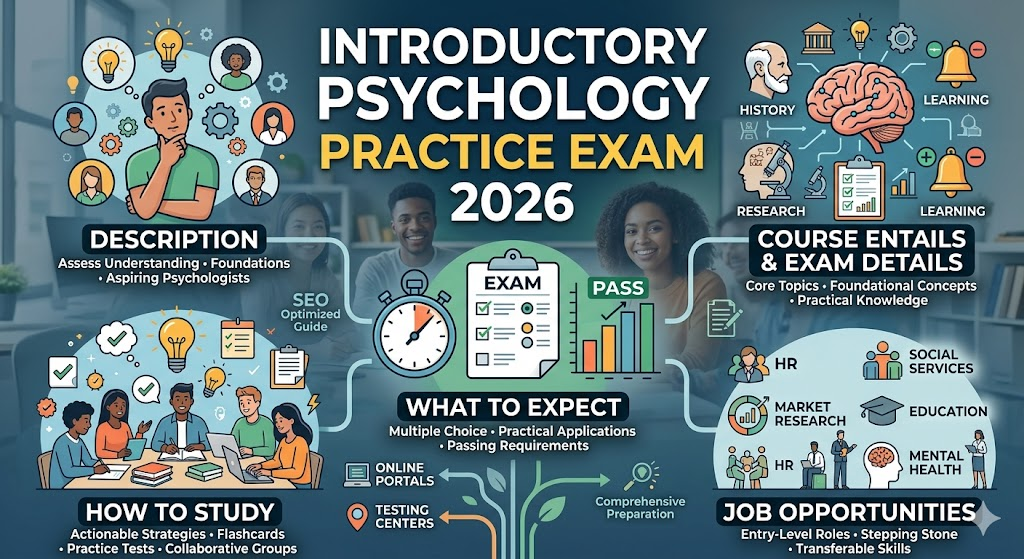
Additional Information
What the Course Entails and Exam Details
This practice exam serves as a comprehensive checkpoint for the knowledge gained throughout a standard introductory psychology curriculum. The exam details are illustrative of the kind of comprehensive assessment students should prepare for. Core topics and areas of assessment often include:
Foundations & History: Understanding the evolution of psychology, key figures like Freud, James, and Skinner, and the foundational perspectives of behavioral, cognitive, humanistic, and psychodynamic psychology.
Research Methods: Comprehending scientific inquiry in psychology, including experimental design, correlational studies, case studies, and fundamental ethical guidelines for research.
Biological Bases of Behavior: Knowledge of the brain's structure and function, neurotransmission, the endocrine system, and the influence of genetics on behavior.
Sensation & Perception: Examining how humans gather information from the world through their senses and process it into meaningful experiences.
Learning & Memory: Studying key principles of classical and operant conditioning, observational learning, and the stages, processes, and potential failures of human memory.
Cognition & Consciousness: Exploring processes like thinking, problem-solving, language development, and different states of consciousness such as sleep and hypnosis.
Development Across the Lifespan: Understanding physical, cognitive, social, and emotional development from infancy through adulthood.
Personality & Social Psychology: Analyzing the theories of personality and the influence of the social environment on attitudes, conformity, and group dynamics.
Psychological Disorders & Therapies: A foundational overview of major psychological conditions and the primary treatment approaches.
The specific "Introductory Psychology Practice Exam 2026" is a structured collection of diverse practice questions based on these common introductory syllabus topics, aimed at reinforcing learning and improving exam performance.
What to Expect in the Final Exam
While "Introductory Psychology Practice Exam 2026" is a preparation resource, it is designed to reflect the standards and formats commonly employed in final course exams or certification tests. When taking the final introductory psychology exam that this test prepares you for, students can typically expect:
Format: Primarily a comprehensive set of multiple-choice questions, which may include matching and short answer questions to thoroughly test recall and application of knowledge.
Practical/Application Questions: Questions that go beyond simple definition and require students to apply psychological concepts to real-world scenarios.
Passing Score: Requirements can vary, but standard expectations are typically a minimum percentage (e.g., 60-70%) or a passing score defined by the specific educational institution or testing body.
Time Limit: Final exams are generally timed, encouraging efficient recall and focus, typically ranging from 90 to 180 minutes.
Rules & Restrictions: Strictly enforced rules regarding proctoring, a closed-book environment, and integrity standards are typical for final assessments. This practice test helps students experience a mock version of these conditions.
How to Study and Exam Centers
Effective preparation is key to succeeding in any assessment, including the final exam your practice test is based on. Actionable study strategies include:
Active Recall & Review: Utilize flashcards for key terms and concepts, and actively quiz yourself on different psychology topics.
Take Multiple Practice Tests: Engage with the "Introductory Psychology Practice Exam 2026" and other practice resources repeatedly to build confidence, identify weak areas, and improve time management. Mimic exam conditions whenever possible.
Review Detailed Explanations: After taking practice tests, meticulously study the provided explanations for both correct and incorrect answers to understand the underlying logic.
Utilize Textbooks and Lecture Notes: Reinforce foundational knowledge by reviewing your core introductory psychology textbook, lecture materials, and reliable online educational resources.
Study Group Collaboration: Discuss complex theories and study key figures with peers to deepen understanding through dialogue and peer explanation.
For taking the practice test itself, "Introductory Psychology Practice Exam 2026" is often available through various online learning portals, university study centers, or authorized educational platforms. The final introductory psychology exam you prepare for might be administered through various methods, illustrative examples of which include:
Authorized School/College Testing Centers: Many university and college introductory psychology courses will have their final exams in a controlled environment within the institution.
Online Proctoring Services: Certain programs or standardized tests (like CLEP for psychology credit) may offer online proctoring that can be taken at home.
Testing Centers like Pearson VUE: If the practice test is associated with a specific standardized certification, the final exam may be scheduled through official, secure test centers. Always verify the specific rules and registration details for the official test you plan to take.
Job Opportunities from the Course
A strong foundation in introductory psychology, reinforced by thorough practice, can be beneficial in numerous professional pathways. While often a stepping stone, it unlocks entry-level roles and serves as a vital first step for those pursuing more advanced degrees. Job opportunities and career areas include:
Human Resources Assistant/Specialist
Social Services Assistant
Customer Service/Relations Representative
Market Research Assistant
Mental Health Technician
Educational Aide/Tutor
Public Relations Coordinator
Youth Counselor (with potential additional certifications)
Rehabilitation Aide
Frequently Asked Questions
Reviews
5.0
Based on 0 reviews
Leave a Review
No reviews yet. Be the first to review!