
Introductory Sociology CLEP Prep Practice Exam
$69.00
- Buy to unlock unlimited access to all Quiz questions and Answers in this Quiz.
- After purchase you can print a PDF of the whole quiz at any point. The PDF will contain the questions and the correct answers.
About this Exam
The Introductory Sociology CLEP exam offers students a streamlined pathway to earn college credit by demonstrating mastery of fundamental sociological concepts. This computer-based test is designed for individuals who possess a strong grasp of the material typically covered in a one-semester introductory college course. It is an ideal option for highly motivated high school students seeking advanced placement, adult learners returning to education, or current college students looking to accelerate their degree progress and save on tuition costs. By successfully passing this exam, candidates can showcase their understanding of human social behavior, social institutions, and the complex dynamics of society without enrolling in a traditional classroom course.
Ready to test your knowledge?
Buy Now to Access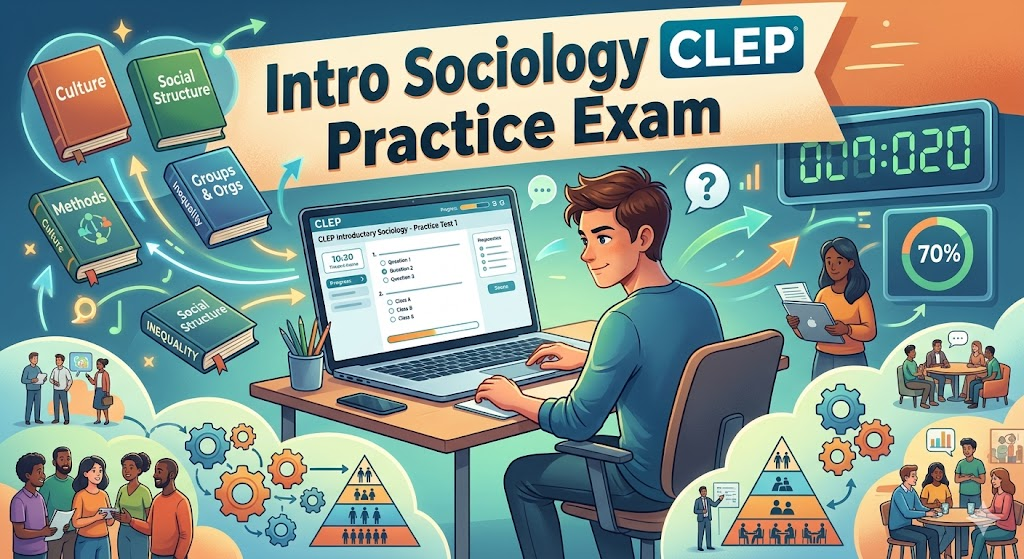
Additional Information
What the Course Entails and Exam Details
To excel on the Introductory Sociology CLEP exam, candidates must demonstrate a comprehensive understanding of diverse sociological principles. The exam content is rigorously structured to cover several core areas, ensuring a well-rounded assessment.
A significant portion of the exam focuses on Social Stratification, Social Change, and Social Institutions. Candidates must be prepared to answer questions regarding the complexities of social class, poverty, and wealth distribution. It also delves into the dynamics of social change, modernization, and globalization. Understanding major social institutions, such as the family, education systems, religion, and the economy, is crucial, as is knowledge of political structures and power dynamics within society.
Another critical area is Social Processes and Individual Development. This section examines the intricate ways individuals are socialized into their cultures, exploring the agents of socialization like family, peers, and media. Candidates must understand the concepts of conformity and deviance, social control, and the processes of social interaction and group dynamics. This includes a grasp of how identity is formed and the impact of social structure on individual lives.
The exam also places considerable emphasis on Sociological Perspective, Methods, and Theory. It is not enough to know facts; candidates must understand the very foundation of sociology as a discipline. This includes familiarity with the prominent sociological theories that shape our understanding of society, such as functionalism, conflict theory, and symbolic interactionism. A working knowledge of research methods—including surveys, experiments, and qualitative approaches—and the ethical considerations inherent in sociological research is also evaluated.
Finally, questions on Culture, Society, and Social Organization test knowledge of cultural norms, values, beliefs, and the concept of cultural relativism. Candidates are expected to differentiate between various types of societies and social groups, and understand the basic principles of social organization. This broad scope ensures that a passing score genuinely reflects a foundational competence in introductory sociology.
What to Expect in the Final Exam
The Introductory Sociology CLEP exam is a computer-administered test consisting of approximately 100 multiple-choice questions. These questions are designed to be completed within a 90-minute time limit, requiring test-takers to maintain a steady pace and manage their time effectively.
The questions vary in difficulty and format. Some may ask for straightforward definitions of sociological terms, while others will present scenarios requiring the application of sociological theories to real-world situations. Some questions might also require interpreting data from charts or graphs related to sociological research.
The CLEP exams are scored on a scaled system, ranging from 20 to 80. While the College Board recommends a credit-granting score of 50, which is roughly equivalent to a grade of 'C' in a comparable college course, it is important to remember that individual colleges and universities set their own credit-granting policies. Students must verify the required passing score and the number of credits awarded with their target institution’s registrar or academic advising office before taking the exam.
There are no penalties for guessing, so it is in the student's best interest to answer every question, even if uncertain. The exam environment is standardized, and specific rules regarding permissible items (typically very few, with no calculators or personal electronics allowed) will be strictly enforced by test center administrators.
How to Study and Exam Centers
Effective preparation is key to succeeding on the CLEP exam. A multi-faceted approach is highly recommended. Start by obtaining the official CLEP study guide from the College Board, which includes a comprehensive breakdown of topics and sample questions.
Systematic study using a standard introductory sociology textbook is essential for building a strong foundation. Supplement this by taking numerous practice exams under timed conditions. Reviewing both correct and incorrect answers from these practice sessions helps identify knowledge gaps and refine test-taking strategies. Online resources, educational videos, and flashcards can also reinforce key concepts and terminology.
When ready, students can take the exam at one of the thousands of CLEP test centers located worldwide. These centers are often situated on college and university campuses, in high schools, or at military bases. Candidates must register for the exam through the College Board website, where they can also locate convenient testing centers.
After registration and payment, students will receive a registration ticket, which they must present on exam day along with valid, government-issued photo identification. It is vital to contact the chosen testing center directly to schedule a specific appointment and to understand any additional administrative fees they may charge.
Job Opportunities from the Course
While the CLEP exam itself provides academic credit rather than a direct professional license, the knowledge gained in introductory sociology is invaluable across a wide spectrum of career paths. A foundational understanding of social dynamics, cultural competence, and analytical thinking can significantly enhance employability in diverse fields.
Here are specific job titles and career paths where a background in sociology is highly beneficial:
Social Worker
Human Resources Specialist
Market Research Analyst
Community Outreach Coordinator
Probation Officer or Correctional Treatment Specialist
Public Relations Specialist
Survey Researcher
Nonprofit Program Manager
Urban or Regional Planner
Diversity and Inclusion Coordinator
Customer Service Representative
Data Analyst (within social science contexts)
Paralegal or Legal Assistant
Earning credit through the CLEP Introductory Sociology exam can be a powerful first step toward these rewarding careers by accelerating your degree and demonstrating proactive dedication to your education.
Frequently Asked Questions
Reviews
5.0
Based on 0 reviews
Leave a Review
No reviews yet. Be the first to review!