
Introductory Sociology Practice Test 2026 | Exam Prep Questions and Answers
$69.00
- Buy to unlock unlimited access to all Quiz questions and Answers in this Quiz.
- After purchase you can print a PDF of the whole quiz at any point. The PDF will contain the questions and the correct answers.
About this Exam
Looking to ace your first major sociology assessment? This comprehensive Introductory Sociology Practice Exam is specifically designed to help students, prospective college attendees, or anyone curious about foundational social science principles. It provides a simulated testing environment, complete with relevant questions and detailed answers. This resource targets learners seeking to validate their knowledge or prepare effectively for official introductory sociology exams, perhaps for credit-by-exam programs like CLEP or as course finals.
Ready to test your knowledge?
Buy Now to Access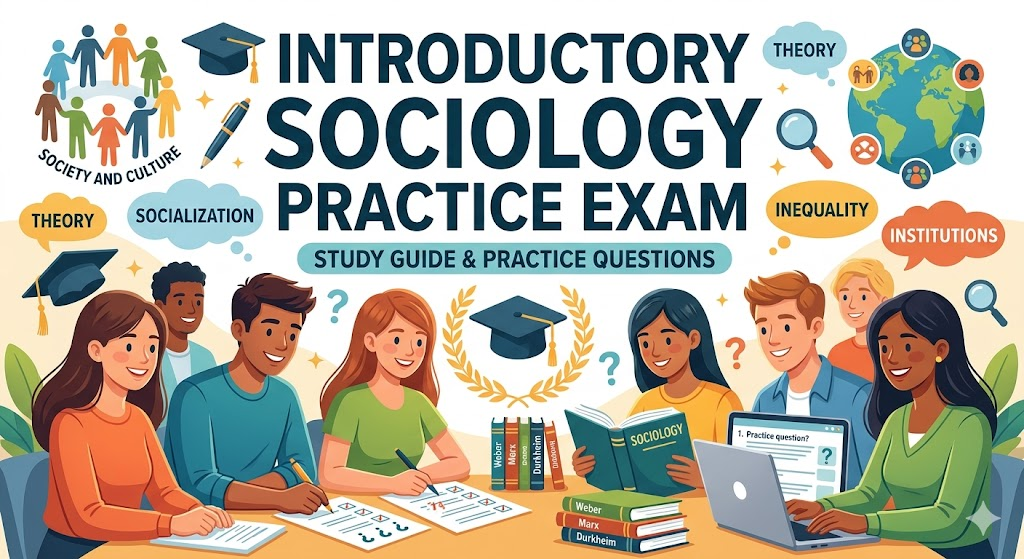
Additional Information
What the Course Entails and Exam Details
An introductory sociology curriculum typically covers a wide range of fundamental concepts. Expect questions on sociological theory, including perspectives like functionalism, conflict theory, and symbolic interactionism. You will likely encounter material on culture, socialization, and the process of defining identity. Social structure, social stratification, race, ethnicity, gender, and social inequality are key pillars. The exam will also dive into social institutions, such as the family, education, religion, and the economy. Finally, social change, deviance, and research methods in the social sciences will be included.
What to Expect in the Final Exam
Most final exams or standardized introductory sociology tests, like the ones this practice exam mirrors, are structured around multiple-choice questions. Prepare yourself to tackle numerous questions that assess your understanding of definitions, theories, researchers, and practical applications of sociological concepts. Passing score requirements and time limits can vary depending on the specific institution or standardized test provider. For instance, a CLEP introductory sociology exam generally gives you 90 minutes to complete approximately 100 questions, and score scales range, with a typical passing score set around 50 (on a 20-80 scale). Expect restrictions, such as not being allowed to use external resources or mobile devices. Knowing these structural details beforehand helps manage time and expectations effectively.
How to Study and Exam Centers
Consistent, active study is key to success. Start by thoroughly reviewing your course textbook or reliable sociology resources. Make use of flashcards for key terms, theories, and sociological figures. Actively engage with the material: try to apply sociological concepts to real-world examples in your daily life or in the news. Crucially, leverage practice exams like this one! Go beyond just answering – deeply analyze the explanations provided for both correct and incorrect answers to understand the why behind each question. Consider forming study groups to discuss complex topics and challenge each other.
The actual formal examination location depends heavily on the specific test you are taking. For college courses, your physical campus or an authorized online portal will be the venue. However, if you are pursuing credit-by-exam through programs like CLEP, you must typically register and schedule testing through an official College Board testing center. Many colleges and universities are authorized CLEP test centers. Specific standardized test administrators often partner with global networks like Pearson VUE or Prometric, offering hundreds of secure, proctored locations worldwide, alongside some online proctoring options. Be sure to check the specific requirements and scheduling details for your intended exam.
Job Opportunities from the Course
While "Introductory Sociology" itself is a foundational course rather than a terminal qualification, it is an essential step on paths leading to diverse and fulfilling careers. Successful completion demonstrates critical thinking and understanding of social dynamics valuable in many fields. Career possibilities for individuals with sociology backgrounds (often combined with further study or relevant experience) include:
Social Worker (typically requires specialized degree/licensure)
Human Resources Specialist / Recruiter
Market Research Analyst
Public Relations Specialist
Community Outreach Coordinator
Probation Officer / Correctional Treatment Specialist
Nongovernmental Organization (NGO) Program Manager
Data Analyst (often with statistical skills)
Legislative Aide / Policy Analyst
Urban Planner
Diversity, Equity, and Inclusion (DEI) Consultant
School Counselor or Academic Advisor (with relevant certification)
Law Enforcement Officer
Journalist or Writer
Frequently Asked Questions
Reviews
5.0
Based on 0 reviews
Leave a Review
No reviews yet. Be the first to review!