
Iowa Barber Practice Exam
$69.00
- Buy to unlock unlimited access to all Quiz questions and Answers in this Quiz.
- After purchase you can print a PDF of the whole quiz at any point. The PDF will contain the questions and the correct answers.
About this Exam
Embarking on a career in barbering in Iowa is an exciting journey, but it culminates in the critical step of passing the official state licensing examination. This study guide and practice resource are specifically designed for students who have completed their required training hours and are now preparing to transition from the classroom to a professional setting. The goal of this resource is to familiarize candidates with the structure, content, and intensity of both the theory and practical portions of the exam. By utilizing a practice exam, aspiring Iowa barbers can build their testing stamina, reduce anxiety, and pinpoint specific areas that require further review before the actual test day, ensuring they meet the high standards set by the state.
Ready to test your knowledge?
Buy Now to Access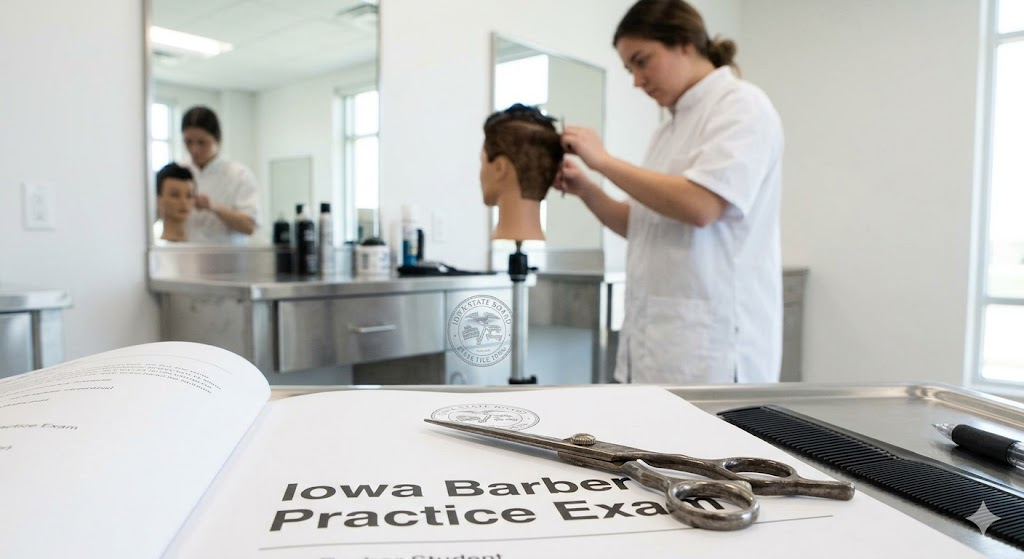
Additional Information
What the Course Entails and Exam Details
Preparing for licensure requires a deep understanding of the core pillars of barbering. In Iowa, to be eligible for the exam, you must first complete the mandatory training hours at an accredited barber school. The training curriculum, which this practice exam mirrors, is comprehensive. You must master concepts such as safe and effective sanitation protocols, sterilization, and the laws and rules specific to the Iowa Board of Barbering.
Beyond safety regulations, you will cover the history of barbering, professional image, and basic anatomy and physiology related to skin and hair. The physical skills training includes hair cutting (tapering, blending, shear work), shaving (with a straight razor), mustache and beard trimming, hairstyling, chemical services (permanent waving, coloring), and basic facials. This practice exam is structured to test your retention across all these essential domains.
What to Expect in the Final Exam
The actual Iowa barber licensing exam is typically divided into two distinct parts: a written theory section and a practical (hands-on) demonstration. You must pass both sections individually to be eligible for licensure.
The Theory Exam: This is a computer-based examination consisting of multiple-choice questions. It is administered in a controlled testing center. Candidates are given a specific amount of time (usually between 90 minutes and 2 hours) to complete this section. Questions focus heavily on safe practices, chemical safety, anatomy, and state regulations.
The Practical Exam: In this hands-on test, you are required to perform various barbering services on either a mannequin or a live model. Examiners watch to ensure you adhere to strict safety and sanitation protocols while performing tasks like a client setup, haircut, shave, and possibly a chemical preparation. Each task must be completed within a strict, set timeframe. Points are lost for safety violations as much as technical flaws. The passing score for both exam sections is generally a minimum of 75 percent.
How to Study and Exam Centers
Effective studying is about strategy as much as it is effort. The best way to utilize a practice exam is to simulate the testing environment as closely as possible. Set a timer, clear your workspace, and avoid checking your notes to get an accurate assessment of your current knowledge.
After completing a practice run, carefully review the explanations for any questions you missed. This will help you identify weak points in your theory or application. For the practical portion, practice your skills on a mannequin repeatedly, ensuring every setup and teardown procedure is committed to memory to save valuable time during the actual exam.
Regarding logistics, the written theory exam is usually administered at computerized testing centers. Iowa often utilizes third-party testing services like PSI, which have multiple testing locations across the state (e.g., Des Moines, Cedar Rapids). The practical exam is often held on specific dates at authorized barber schools or at a designated central state location. You will receive specific information on where and when to schedule your exams after your barber school verifies your completed hours with the state licensing board.
Job Opportunities from the Course
Passing the Iowa barber exam and obtaining your state license opens the door to a secure and creative career path in the booming grooming industry. A licensed Iowa barber is not limited to just one setting. This credential allows you to pursue many different professional avenues across the state:
Professional Barbershop Barber (Booth Rent or Commission)
Barbershop Manager or Lead Educator
Owner of your own independent Barbershop
Men’s Grooming Specialist in high-end Salons or Spas
Grooming Consultant for film, television, or photography
Platform Artist or Brand Ambassador for hair product companies
Barber Instructor (usually requires additional experience and certification)
Product Sales Representative in the professional beauty industry
Frequently Asked Questions
Reviews
5.0
Based on 0 reviews
Leave a Review
No reviews yet. Be the first to review!