
Iowa Pesticide Core Chemical Practice Exam
$69.00
- Buy to unlock unlimited access to all Quiz questions and Answers in this Quiz.
- After purchase you can print a PDF of the whole quiz at any point. The PDF will contain the questions and the correct answers.
About this Exam
The Iowa Pesticide Core Exam is a foundational certification test required for professionals and agricultural workers handling chemicals in the state.
It is specifically designed for commercial, public, and private pesticide applicators who need to prove their competency in safe chemical handling.
Earning this certification ensures that you understand the environmental, legal, and safety standards mandated by the Iowa Department of Agriculture and Land Stewardship.
Whether you are starting a new career in agriculture or upgrading your current credentials, this exam is your first step toward safe and regulated pesticide application.
Sample Questions
Explanation:
Explanation:
Explanation:
Explanation:
Explanation:
Ready to test your knowledge?
Buy Now to Access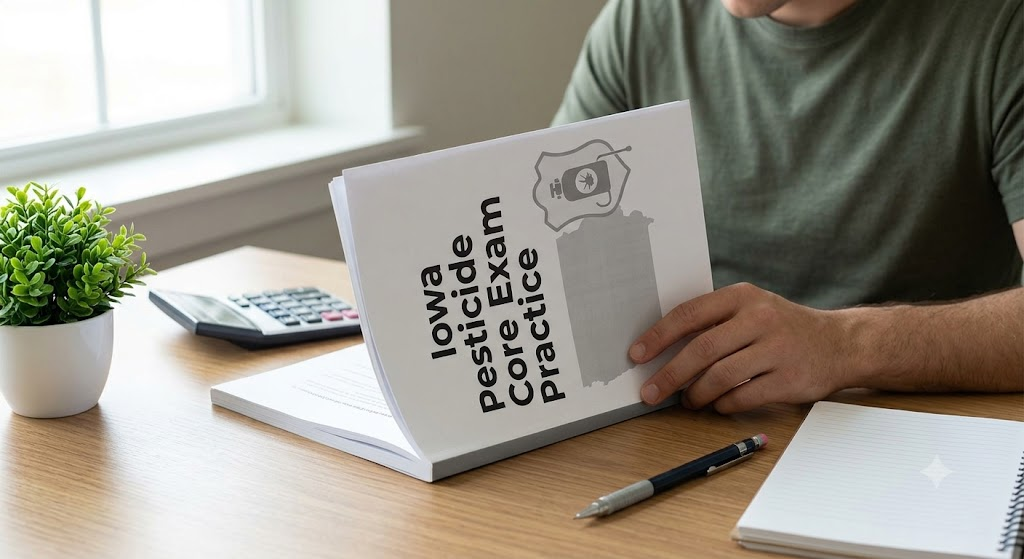
Additional Information
What the Course Entails and Exam Details
The core curriculum provides a comprehensive overview of integrated pest management and safe pesticide application techniques.
You will learn how to read and interpret complex pesticide labels, which is a critical skill for legal compliance and safe usage.
The syllabus deeply covers essential safety topics, including the proper use of personal protective equipment (PPE), handling accidental spills, and mitigating environmental hazards.
Furthermore, students will master the mathematics of pesticide formulation, including proper mixing, loading, disposal, and precise equipment calibration.
What to Expect in the Final Exam
The final exam is a closed-book, multiple-choice test designed to evaluate your practical knowledge of the state's core manual.
Test takers must achieve a minimum passing score, which is typically 80%, to successfully earn their state applicator certification.
You will have a strict time limit to complete the test, usually around one to two hours, making it crucial to pace yourself and read each question carefully.
Strict security rules apply at all testing centers, meaning absolutely no outside notes, mobile devices, or unapproved calculators are permitted in the examination room.
How to Study and Exam Centers
Your primary study tool should be the official Iowa Core Manual, as all official exam questions are drawn directly from this text.
Taking a timed practice exam is one of the most effective strategies to familiarize yourself with the question formats and identify any weak areas before test day.
You should also consider creating flashcards for common terminology, label warning signs, and calculation formulas to reinforce your memory.
Exams are primarily administered in person at approved locations, such as Des Moines Area Community College (DMACC) testing centers and other authorized community colleges across the state.
You can easily register for your preferred testing date and location through the Iowa Department of Agriculture's online portal.
Job Opportunities from the Course
Passing this exam opens the door to numerous high-demand agricultural, commercial, and environmental careers.
You can work as a Commercial Pesticide Applicator, managing pest control and crop health for large farming operations.
It also qualifies you for roles such as an Agricultural Science Technician, where you will assist in optimizing crop yields and maintaining field health.
Other popular and lucrative career paths include Landscape and Groundskeeping Manager, Residential Pest Control Operator, and Golf Course Turf Specialist.
Finally, government and municipal roles, such as Public Works Applicators who manage vegetation along highways and public parks, heavily rely on professionals with this vital credential.
Frequently Asked Questions
Reviews
5.0
Based on 0 reviews
Leave a Review
No reviews yet. Be the first to review!