
Iowa Property & Casualty Practice Exam
$69.00
- Buy to unlock unlimited access to all Quiz questions and Answers in this Quiz.
- After purchase you can print a PDF of the whole quiz at any point. The PDF will contain the questions and the correct answers.
About this Exam
The Iowa Property and Casualty insurance license is the mandatory credential for anyone looking to sell, solicit, or negotiate property and casualty insurance products within the state.
Designed for aspiring insurance agents, brokers, and agency staff, this certification ensures you understand the fundamental principles of risk management, policy provisions, and state-specific insurance laws.
With the insurance industry rapidly evolving, preparing for the updated 2026 exam cycle is essential for launching a successful and compliant career in the Iowa insurance market.
Passing this exam proves your competence to protect clients' homes, vehicles, and businesses against unexpected financial losses.
Ready to test your knowledge?
Buy Now to Access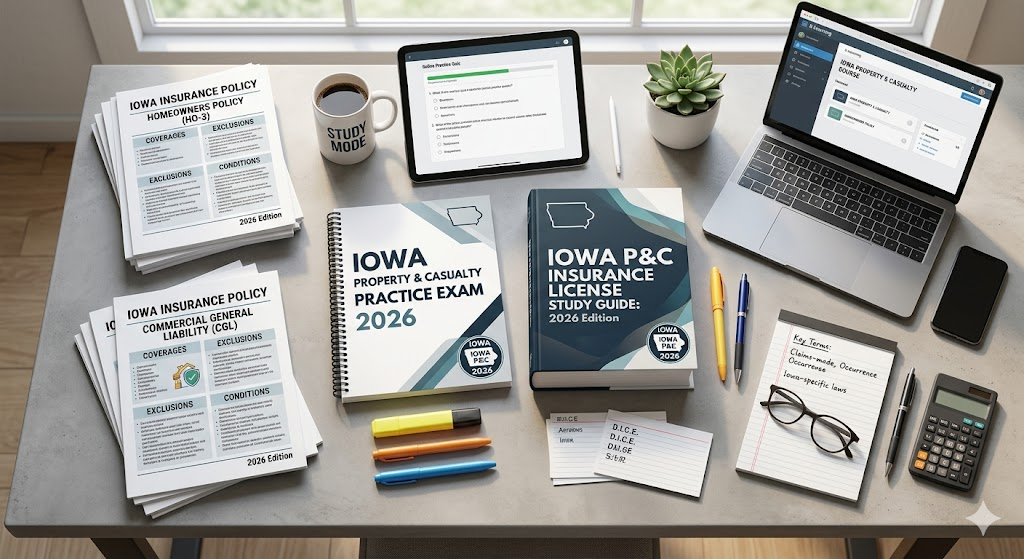
Additional Information
What the Course Entails and Exam Details
Preparing for this exam requires a deep dive into both national insurance concepts and Iowa-specific regulations.
The core syllabus is divided into two primary disciplines: Property Insurance and Casualty Insurance.
Under the Property Insurance section, you will study concepts such as types of policies, property insurance terms, policy provisions, contract law, and covered perils like fire, theft, and natural disasters.
The Casualty Insurance section focuses on liability concepts, including negligence, bodily injury, property damage, workers' compensation, and commercial general liability.
You will also need to master the Iowa state-specific rules, which cover the Department of Insurance regulations, licensing requirements, unfair trade practices, and consumer privacy laws.
What to Expect in the Final Exam
The Iowa Property and Casualty examinations are strictly multiple-choice tests administered by Pearson VUE.
If you take the exams separately, the Property exam consists of 98 total questions (83 scored and 15 pretest questions), while the Casualty exam consists of 97 total questions (82 scored and 15 pretest questions).
You are given a time limit of exactly two hours to complete each exam.
To earn your license, you must achieve a minimum passing score of 70% on each exam.
Keep in mind that the unscored pretest questions are mixed seamlessly into the test, so you must answer every question to the best of your ability as you will not know which ones count toward your final grade.
Strict rules apply on exam day: no personal items, mobile phones, or study materials are allowed in the testing area, and you must present a valid, government-issued photo ID that exactly matches your registration name.
How to Study and Exam Centers
Strategic preparation is critical for passing on your first attempt.
Start by utilizing comprehensive online prep courses, reading the official Iowa Insurance Division Candidate Handbook, and taking full-length, timed multiple-choice practice exams to build your test-taking endurance.
Focus heavily on memorizing terminology, dollar amount limits, and specific day requirements (such as the number of days to report an address change or a claim), as these data points frequently appear on the test.
When you are ready to test, you have two convenient options through Pearson VUE.
You can schedule an in-person exam at a physical Pearson VUE testing center located throughout Iowa and the surrounding region.
Alternatively, you can take advantage of OnVUE online proctoring, which allows you to take the exam from your home or office, provided you have a private, cleared desk space, a reliable internet connection, and a webcam for the live proctor to monitor you.
Job Opportunities from the Course
Earning your property and casualty license unlocks a variety of lucrative and stable career paths across the financial sector.
Captive Insurance Agent: Work exclusively for one major insurance carrier, selling their specific home, auto, and commercial policies to local clients.
Independent Insurance Broker: Operate independently to represent multiple insurance companies, allowing you to shop around and find the best coverage and rates for your clients.
Commercial Lines Account Manager: Specialize in business insurance by managing complex accounts, renewing corporate policies, and advising business owners on liability risks.
Claims Adjuster: Investigate property damage and liability claims, evaluate coverage limits, and negotiate fair settlements between the insurance company and the policyholder.
Underwriting Assistant: Support senior underwriters by reviewing insurance applications, assessing risk profiles, and helping to determine policy premiums.
Licensed Customer Service Representative (CSR): Act as the frontline contact for an insurance agency, helping existing policyholders update their coverage, process payments, and file initial claims.
Frequently Asked Questions
Reviews
5.0
Based on 0 reviews
Leave a Review
No reviews yet. Be the first to review!