
Iowa Right-of-Way Herbicide Category 6 Practice Exam
$69.00
- Buy to unlock unlimited access to all Quiz questions and Answers in this Quiz.
- After purchase you can print a PDF of the whole quiz at any point. The PDF will contain the questions and the correct answers.
About this Exam
The Iowa Right-of-Way Herbicide Category 6 certification is a professional credential managed by the Iowa Department of Agriculture and Land Stewardship (IDALS).
This certification is designed specifically for commercial, public, and noncommercial pesticide applicators who manage vegetation along public and private rights-of-way.
If your job involves managing weeds, brush, and invasive plants along roadsides, railways, utility pipelines, power line corridors, or bike paths, this credential is a legal requirement in the state of Iowa.
Earning this certification proves you have the specialized knowledge to control target vegetation safely and legally while preserving Iowa's natural habitats, prairie remants, and surrounding agricultural lands.
Ready to test your knowledge?
Buy Now to Access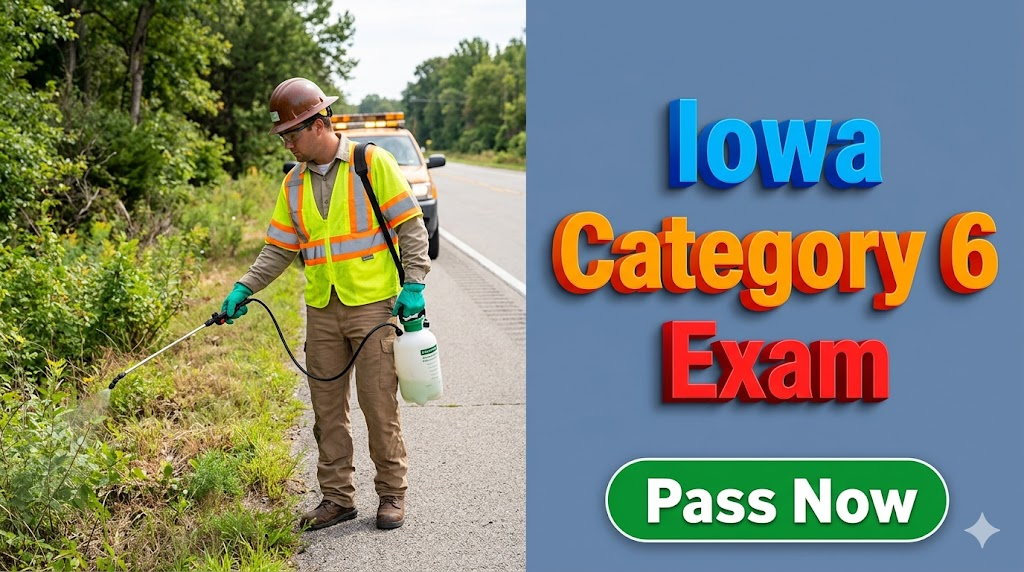
Additional Information
What the Course Entails and Exam Details
To master the material for the Category 6 exam, you must study the Iowa Right-of-Way Commercial Pesticide Applicator Manual (Extension publication CS 0018) in tandem with the Iowa Core Manual.
The syllabus covers a blend of environmental science, chemistry, and equipment logistics, focusing heavily on integrated vegetation management (IVM).
Weed and Plant Identification: Recognizing noxious weeds, perennial brush, annual broadleaf weeds, and native prairie plants common to Iowa rights-of-way.
Herbicide Modes of Action: Understanding how different chemicals work, including growth regulators (like 2,4-D and dicamba) and ALS-inhibitors (like chlorsulfuron).
Application Techniques: Mastering foliar sprays, basal bark treatments, frill and cut-surface methods, and total vegetation control practices.
Environmental Stewardship: Minimizing pesticide drift, runoff, and groundwater contamination while preventing non-target exposure to nearby crops or residential zones.
Equipment Calibration: Calculating precise mix ratios, nozzle outputs, and travel speeds to ensure accurate field applications.
What to Expect in the Final Exam
The final certification testing process is strictly regulated, digital, and closed-book.
To become fully certified as a commercial applicator, you must pass two distinct tests: the general Core Exam and the specific Category 6 Right-of-Way Exam.
Exam Format: Both tests consist entirely of multiple-choice questions administered via a secure computer interface.
Question Count: The general Core Exam features 50 questions, while the Category 6 specific exam contains 35 questions.
Passing Score: The minimum passing score for all Iowa commercial applicator exams is 80%. This means you must get at least 40 correct answers on the Core test and 28 correct answers on the Category 6 test.
Testing Conditions: The exams are closed-book, and no personal materials are allowed in the testing area. A single sheet of scratch paper and a basic calculator are provided by the testing center proctor.
Time Constraints: Exams must be completed in a single sitting. If you leave the testing room for any reason, your exam session will automatically conclude and your score will be submitted as-is.
How to Study and Exam Centers
Preparation requires a balanced approach of conceptual reading and active testing practice.
Actionable Study Strategies
Pair the Manuals: Do not study the Category 6 manual in isolation. Use the Iowa Core Manual to build your foundation on safety laws and calculations, then dive into the Right-of-Way manual for specific herbicide and plant data.
Focus on Timing and Phenology: Pay close attention to when specific weeds are most vulnerable. For example, memorize why annuals are easiest to control in early spring, whereas perennials are best targeted during early bloom or fall.
Utilize Practice Exams: Take timed, category-specific practice exams repeatedly. Focus heavily on practice questions that test your ability to read herbicide labels and perform calibration formulas, as these require active problem-solving rather than simple memorization.
Testing Center Locations
Pesticide applicator exams are administered across Iowa through partner community colleges and regional testing portals authorized by IDALS.
Community College Testing Facilities: Authorized locations include Iowa Western Community College (IWCC), North Iowa Area Community College (NIACC), and other regional community college campuses across the state.
Scheduling: Walk-ins are not permitted. You must schedule your test appointment in advance through the designated community college portal or the IDALS testing coordination network.
Fees and IDs: Expect a testing administration fee (typically around $20 to $25 per test session) paid directly to the testing center, and you must bring a valid, government-issued photo ID to the exam room.
Job Opportunities from the Course
Securing your Category 6 certification opens up stable, specialized career paths within both public infrastructure management and private environmental contracting.
County Roadside Manager: Overseeing vegetation control, native prairie restoration, and noxious weed eradication programs for Iowa county governments.
DOT Vegetation Specialist: Working directly with the Iowa Department of Transportation to maintain clear, safe sightlines and control brush along state highways and interstates.
Right-of-Way Utility Technician: Managing plant growth and clear zones beneath power lines, around substations, and along cross-country pipelines for utility companies.
Commercial Spray Contractor: Working for private agricultural and environmental service businesses that contract out large-scale weed control for railways and industrial sites.
Municipal Weed Commissioner: Serving local city governments to enforce public safety codes regarding invasive plants and managed green spaces.
Frequently Asked Questions
Reviews
5.0
Based on 0 reviews
Leave a Review
No reviews yet. Be the first to review!