
Iowa Security Guard Board Practice Exam
$69.00
- Buy to unlock unlimited access to all Quiz questions and Answers in this Quiz.
- After purchase you can print a PDF of the whole quiz at any point. The PDF will contain the questions and the correct answers.
About this Exam
The Iowa Security Guard Certified Training Course and its final exam are the gateway to a vital and growing career field in the state. Administered through various state-certified training providers, including community colleges and private security schools, this program is designed for individuals seeking employment as private security agents, often referred to as unarmed or armed security guards. The course is a mandatory requirement set by the Iowa Department of Public Safety to ensure that all personnel have the fundamental skills, legal knowledge, and ethical foundation necessary to protect property and people safely and effectively. Whether you are aiming to be a uniformed presence on a commercial campus or a loss prevention specialist in a retail environment, this certification is your first essential step.
Ready to test your knowledge?
Buy Now to Access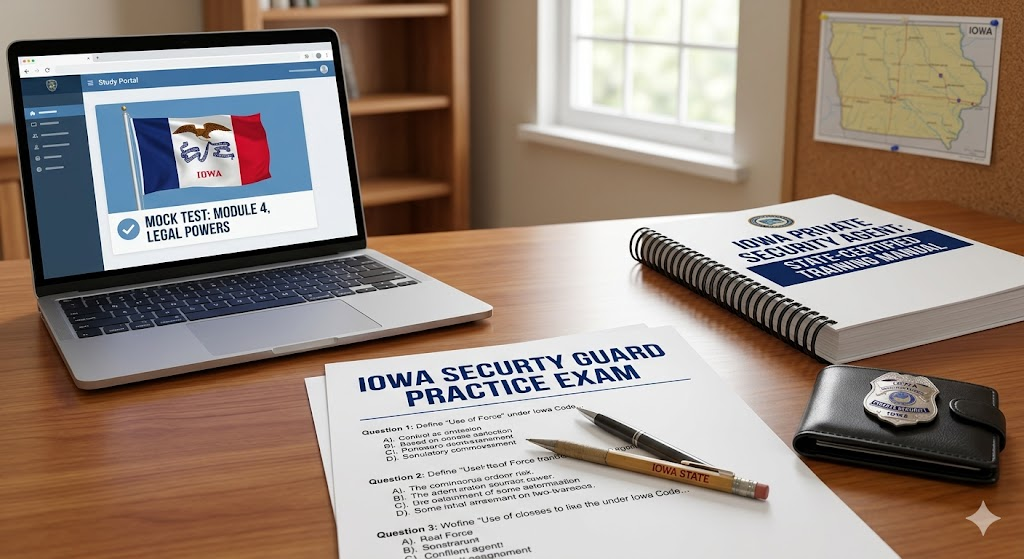
Additional Information
What the Course Entails and Exam Details
To successfully complete the state-certified training, candidates must engage in a comprehensive curriculum. In Iowa, the foundational training is often organized into a 40-hour program. This extensive syllabus covers a wide array of core topics.
Key areas of study include:
Introduction to the Security Industry: Understanding the role, history, and current landscape of private security in Iowa.
Legal Powers and Limitations: A critical section focusing on Iowa law, specifically regarding the authority to question, detain, search, seize, and arrest, as well as the important topic of "use of force" guidelines.
Professionalism and Ethics: Emphasizing the high standards of ethical conduct, honesty, and integrity required.
Report Writing: Mastering the art of creating clear, objective, and standardized written reports of occurrences, observations, and duties performed.
Emergency Response Preparation: Training on identifying emergency risks, protocols for fire safety, and coordinated responses.
Effective Communications and Sensitivity Training: Developing strong interpersonal skills for public interaction and adapting communication styles for diverse situations.
First Aid and Safety: Essential basic first-aid knowledge and understanding of workplace safety and health (OSHA) regulations.
Handling Information and Evidence: Learning how to collect, preserve, and present admissible evidence in court while preventing contamination.
What to Expect in the Final Exam
It is important to understand that while this practice guide is an invaluable tool, the official final exam is not administered directly by a central state board. Instead, the test you must pass to earn your certification is created and given by the state-certified training institution you attend at the conclusion of their program.
However, these training providers must adhere to the Department of Public Safety's strict curriculum standards. As a result, you can generally expect a standardized final written examination.
Exam Format: The test is almost universally a written, multiple-choice exam, designed to gauge your comprehension of the 40 hours of material.
Details:
Number of Questions: You can expect a test containing between 50 and 100 questions.
Passing Score: The typical passing requirement is 70% or higher, reflecting professional competency. Some rigorous programs may set the bar higher.
Time Limits: There will be a set time to complete the exam, often proportional to the number of questions, such as two hours for a 100-question test.
Rules: The exam will be proctored, and specific rules regarding forbidden materials will be strictly enforced. Candidates for armed security must complete additional, rigorous in-person hours and pass a specific firearms proficiency exam on a shooting range, in addition to this written test.
How to Study and Exam Centers
Preparation is paramount for success. Since the exam directly relates to the course content, your primary study tool must be the material provided by your state-certified training school.
Actionable Study Strategies:
Attend and Take Detailed Notes: Your in-class or online course hours are the source of all exam content. Pay close attention, especially to legal definitions, use-of-force continuums, and report writing templates.
Utilize Practice Exams: Leverage comprehensive practice tests, like this one, to familiarize yourself with the type of multiple-choice questions you will encounter. These tests help identify knowledge gaps.
Review the Core Syllabus: Structure your study sessions by the major sections of the course, such as "Legal," "Communication," and "Emergency Response."
Create Flashcards: Flashcards are highly effective for memorizing key legal terms, emergency codes, and report writing procedures.
Where to Take the Exam (Exam Centers):
In Iowa, your exam will take place at the state-certified facility where you complete your training. These can include:
Community Colleges: Many Iowa community colleges offer the certified 40-hour security training course.
Private Security Schools and Authorized Training Providers: A list of these can be obtained through the Iowa Department of Public Safety or by contacting local private security agencies.
Online Portals: Portions of the unarmed training may be available online through authorized platforms, which will also host the written test.
Job Opportunities from the Course
A state-certified security agent license in Iowa opens doors to diverse career paths across multiple sectors. This vital qualification makes you a desirable candidate for a wide array of roles that protect people and secure crucial infrastructure.
Career paths and specific job titles unlocked by this course include:
Commercial Security Officer: Providing safety for corporate headquarters, industrial sites, and high-rise office buildings.
Healthcare Security Specialist: Protecting patients, staff, and sensitive areas in hospitals and medical centers.
Retail Loss Prevention Agent: Focused on preventing theft, managing organized retail crime, and identifying safety hazards within retail environments.
Educational Institution Security: Maintaining a safe atmosphere for schools, community colleges, and universities.
Residential Security Guard: Securing gated communities, apartment complexes, and high-end residential areas.
Special Event Security: Providing crowd control, access point management, and general safety for concerts, sporting events, and large conferences.
Mobile Patrol Officer: Conducting vehicle-based patrols of multiple client sites to deter and detect criminal activity.
Transportation and Infrastructure Security: Securing key locations like airports, ports, and critical distribution centers.
Frequently Asked Questions
Reviews
5.0
Based on 0 reviews
Leave a Review
No reviews yet. Be the first to review!