
IPM Horticulture Practice Exam
$69.00
- Buy to unlock unlimited access to all Quiz questions and Answers in this Quiz.
- After purchase you can print a PDF of the whole quiz at any point. The PDF will contain the questions and the correct answers.
About this Exam
The Integrated Pest Management (IPM) in Horticulture qualification is a vital credential for professionals seeking to lead the way in sustainable and ecologically conscious plant care. This program and its associated exam are designed for a wide array of individuals in the green industry, including greenhouse and nursery managers, landscape professionals, agricultural extension agents, park supervisors, urban farmers, and aspiring pest control specialists with a focus on plant health. By achieving this certification, individuals demonstrate their proficiency in implementing a holistic, data-driven approach to managing pests, diseases, and weeds in diverse horticultural settings. The core goal of IPM is to maintain pest populations at acceptable levels while minimizing negative impacts on human health, beneficial organisms, and the environment. This exam validates that knowledge, making it a critical step for career advancement in the modern, eco-aware horticulture sector.
Ready to test your knowledge?
Buy Now to Access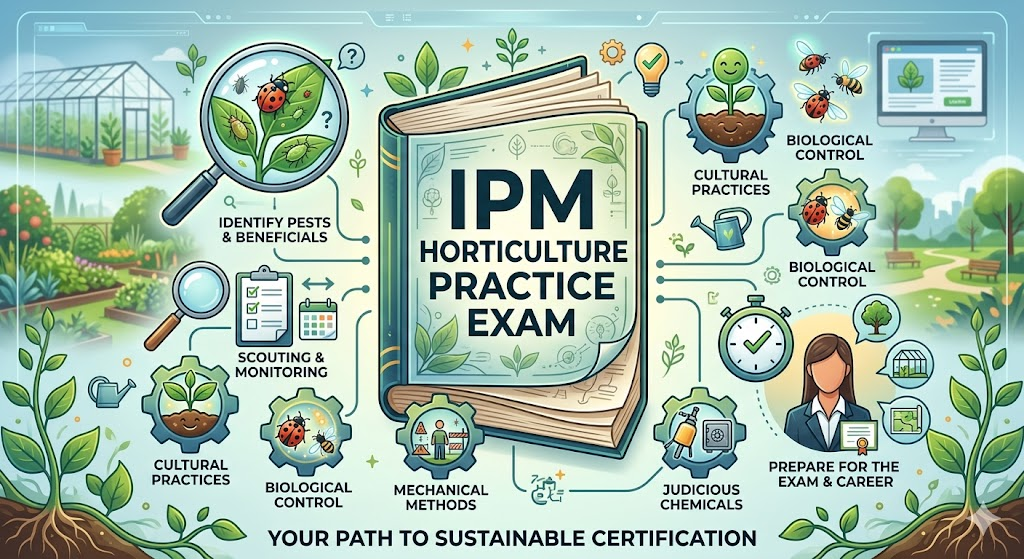
Additional Information
What the Course Entails and Exam Details
This examination covers the fundamental principles and practical applications of Integrated Pest Management specifically within horticultural contexts.
The core areas and skills typically assessed include:
IPM Principles and Philosophy: Understanding the holistic nature of IPM, its historical context, the distinction from purely chemical control, and the emphasis on prevention, monitoring, and diverse control methods.
Pest Identification and Biology: Accurately identifying a vast range of common horticultural pests, including insects, mites, plant pathogens (fungi, bacteria, viruses), weeds, and even significant abiotic factors affecting plant health. Crucial is an understanding of their life cycles, feeding behaviors, and environmental interactions.
Monitoring and Action Thresholds: Methods for effective field scouting, trapping techniques, and the critical concept of establishing economic and aesthetic thresholds—determining when intervention is necessary based on data.
IPM Control Strategies: In-depth knowledge and practical application of the four main categories of control:
Cultural Controls: Practices like resistant crop selection, sanitation, proper watering and fertilization, and crop rotation.
Biological Controls: Utilizing natural enemies, including predators, parasitoids, and microbial agents.
Mechanical and Physical Controls: Hand-picking, barriers, traps, and environmental modifications.
Chemical Controls: The judicious and targeted use of pesticides, with a strong focus on selecting the least-toxic options, proper application techniques, and resistance management.
Beneficial Organisms: Identification, preservation, and enhancement of beneficial insects and organisms that contribute to natural pest suppression.
Pesticide Safety, Regulations, and Stewardship: Comprehension of pesticide labels, personal protective equipment (PPE), safety protocols, environmental protection, and relevant local, state, and federal regulations regarding pesticide use in horticulture.
What to Expect in the Final Exam
The IPM Horticulture Practice Exam is typically designed to reflect the structure and rigor of the final certification test. However, it is essential to remember that specific details can vary significantly depending on the organization or state body offering the actual qualification.
Generally, you can expect:
Format: The exam predominantly consists of multiple-choice and true/false questions. Many testing bodies also incorporate more complex question types, such as matching, ordering, and detailed scenario- or case-study-based questions where you must apply IPM principles to solve a practical problem.
Passing Score Requirements: Passing scores vary but often require achieving between 70% and 75% or higher on the total exam. Practice exams may offer detailed score breakdowns to help you identify weak areas.
Time Limits: A final exam will likely have a specific time limit (e.g., 1 to 2 hours), and practice exams will help you develop your pace and manage your time effectively.
Rules and Proctoring: Official exams are often proctored, whether in-person or online with strict monitoring software. You will typically not be allowed access to study materials during the test. Understanding these constraints during your practice phase is vital.
Always consult the official candidate information bulletin or website of your certifying body (such as a state department of agriculture, university extension program, or a professional horticulture association) for the most accurate and up-to-date exam details and rules.
How to Study and Exam Centers
Preparation is paramount for success, and using a variety of resources is key.
Actionable Study Strategies:
Review Course Materials & Textbooks: Thouroughly review your textbook, lecture notes, study guides, and all official materials provided by your training program. Focus heavily on core IPM steps and key definitions.
Master Pest and Beneficial Organism Identification: Use high-quality photo guides, field manuals, and online resources from university extension websites. Create digital or physical flashcards for rapid identification.
Take Multiple Practice Exams: This is your best diagnostic tool! Take our IPM Horticulture Practice Exam and seek out additional resources from reputable providers. Time yourself and replicate exam conditions as closely as possible.
Analyze Incorrect Answers: After taking practice tests, don't just note the score. Deeply analyze the questions you missed. Understand why you got it wrong and review the corresponding concepts.
Engage in Hands-On Scouting: If possible, spend time in a garden, greenhouse, or nursery identifying plants, potential pests, diseases, beneficial insects, and cultural problems. Practical experience makes concepts stick.
Study Groups & Extension Resources: Join study groups with fellow students. Access wealth of free resources, webinars, and expert advice often provided by university extension services and governmental agricultural bodies.
Where to Take the Exam:
The process of scheduling and taking the actual final exam varies by the certifying body:
University Extension Programs: Often administered in person or online through specific portals as part of a course or professional education track.
State Departments of Agriculture: Many states regulate pesticide use and require IPM knowledge for licensing. Exams might be held at physical state-authorized testing centers, extension offices, or via approved online platforms.
Professional Associations: Large horticulture associations might use a combination of online platforms, dedicated proctoring services, or specific test days at association events.
Online Portals & Proctored Platforms: Organizations increasingly use specific secure online portals for the entire process—from scheduling to proctored execution—sometimes partnering with larger test providers.
Crucially, you must check the specific instructions and authorized locations provided by your credentialing organization.
Job Opportunities from the Course
A certification in IPM Horticulture significantly boosts employability and opens the door to numerous fulfilling and specialized career paths within the expanding green industry:
Integrated Pest Management (IPM) Specialist
IPM Coordinator
Horticulturist
Greenhouse / Nursery Manager
Landscape Supervisor / Manager
Sustainable Landscape Designer
Arborist
Pest Control Technician (specializing in plants and landscapes)
Agricultural Extension Agent / Educator (focused on sustainable practices)
Urban Agriculture Specialist / Consultant
Park / Garden Supervisor
Turfgrass Manager
IPM Consultant
Plant Health Care Specialist
Frequently Asked Questions
Reviews
5.0
Based on 0 reviews
Leave a Review
No reviews yet. Be the first to review!