
IPSI Work Zone Temporary Traffic Control (TTC) Technician Practice Test
$69.00
- Buy to unlock unlimited access to all Quiz questions and Answers in this Quiz.
- After purchase you can print a PDF of the whole quiz at any point. The PDF will contain the questions and the correct answers.
About this Exam
The IPSI Work Zone Temporary Traffic Control (TTC) Technician certification, provided by the International Public Safety Institute, is an essential credential for individuals working in roadway construction, maintenance, and utility operations. This program equips participants with the knowledge and practical skills required to safely install, maintain, and remove temporary traffic control devices. It is designed for entry-level technicians, field personnel, flaggers, and any worker whose job responsibilities involve ensuring the safety of both workers and the traveling public in a work zone.
By obtaining this certification, individuals demonstrate their competence in understanding and implementing the standards set forth in the Manual on Uniform Traffic Control Devices (MUTCD), thereby reducing the risk of accidents and ensuring regulatory compliance.
Ready to test your knowledge?
Buy Now to Access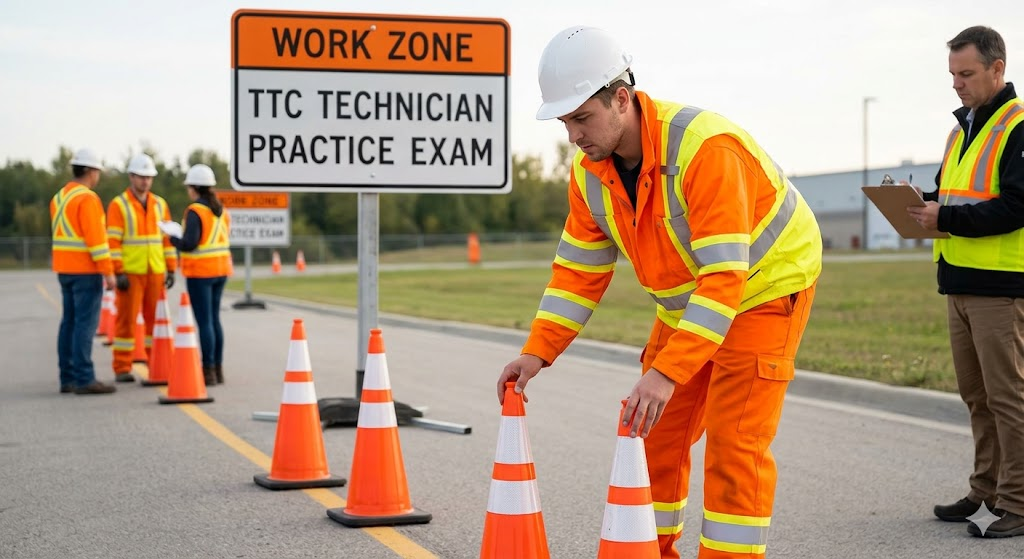
Additional Information
What the Course Entails and Exam Details
The preparatory course for the IPSI Work Zone TTC Technician exam provides a comprehensive review of fundamental concepts and best practices. The curriculum focuses heavily on the Manual on Uniform Traffic Control Devices (MUTCD), primarily Part 6, which deals specifically with Temporary Traffic Control. Key areas covered include:
MUTCD Standards: Detailed study of the federal and state requirements for traffic control.
Fundamental Principles of TTC: The objectives of TTC, worker safety, and the components of a typical work zone (e.g., advance warning area, transition area, buffer space).
TTC Devices: Identification, application, and proper placement of signs, channelizing devices (cones, drums, barricades), pavement markings, lighting devices, and arrow panels.
Flagging Operations: Rules and procedures for flaggers, positioning, and equipment.
Installation and Maintenance: Techniques for the safe setup, removal, and ongoing inspection of TTC devices.
Typical Applications: Practical application of TTC concepts to common roadway situations, such as lane closures, shoulder work, and detours on different types of roads (urban, rural, high-speed).
Legal and Liability Issues: Understanding the technician's responsibilities and the potential legal consequences of improper TTC implementation.
The associated certification exam validates a candidate's mastery of these crucial subjects.
What to Expect in the Final Exam
The IPSI Work Zone TTC Technician certification exam is a formal, proctored assessment designed to evaluate a candidate's understanding of the course material. While specific formats can vary slightly by testing provider, candidates should generally expect the following:
Format: The exam typically consists of multiple-choice and true/false questions. These questions test both factual knowledge and the ability to apply TTC principles to real-world scenarios.
Content: Questions will cover all aspects of the course syllabus, including specific distances for sign placement, taper lengths, flagger procedures, and device specifications.
Passing Score: To earn the certification, candidates must achieve a passing score, which is commonly set around 70% to 80%.
Time Limit: The exam is typically timed, with a duration of 1.5 to 2 hours, which is sufficient for prepared candidates to complete all questions.
Rules: It is a closed-book exam. Candidates are not permitted to use a copy of the MUTCD or any personal notes during the test. Verification of identity is required.
How to Study and Exam Centers
Preparation is key to succeeding on the IPSI Work Zone TTC Technician exam. Here are recommended study strategies and details on how to take the exam:
How to Study:
Attend the Review Course: The most effective way to prepare is to participate in the full IPSI-approved training program, which includes an in-depth review seminar followed by the exam.
Master the MUTCD: Dedicate significant time to studying Part 6 of the Manual on Uniform Traffic Control Devices. Focus on the figures, tables, and specific wording of standards versus guidance.
Use Practice Tests: Seek out legitimate practice exams and review questions that mirror the format and difficulty of the actual test. These are often included in course materials.
Review Practical Scenarios: Practice applying TTC layout principles to different road and work types. Understand the reasoning behind device selection and placement.
Form Study Groups: Collaborating with peers can help clarify complex topics and reinforce learning.
Exam Centers:
Authorized Training Partners: IPSI certification courses and exams are frequently hosted by authorized schools, technical colleges, and industry associations. An example of such a physical testing center is the Martin Electrical & Technical School.
IPSI Portals: The International Public Safety Institute facilitates the examination process, and for those who have completed the requisite training, exams may be administered through their designated physical centers or occasionally through approved online portals, depending on current offerings.
Challenge Exams: Candidates with significant experience may have the option to take a 'challenge exam' without attending the full review course, though this is typically only recommended for seasoned professionals. Contact IPSI directly for the most current information on exam locations and methods.
Job Opportunities from the Course
A certification as an IPSI Work Zone TTC Technician is a valuable asset in the construction and transportation sectors. It opens doors to various career paths and can lead to increased responsibilities and pay. Specific job opportunities and career paths unlocked by this certification include:
Temporary Traffic Control (TTC) Technician
Work Zone Traffic Control Person
Traffic Control Installer
Pavement Marking Technician
Flagger / Flagger Supervisor
Roadway Construction Worker
Highway Maintenance Technician
Utility Crew Member (Water, Sewer, Electric)
Department of Transportation (DOT) Field Personnel
Safety Coordinator (Construction)
Pathway to Work Zone Traffic Control Supervisor (TCS)
This certification provides a critical foundation for advancement in roadway safety and infrastructure projects.
Frequently Asked Questions
Reviews
5.0
Based on 0 reviews
Leave a Review
No reviews yet. Be the first to review!