
IS-241.C Decision Making and Problem Solving Practice Test
$69.00
- Buy to unlock unlimited access to all Quiz questions and Answers in this Quiz.
- After purchase you can print a PDF of the whole quiz at any point. The PDF will contain the questions and the correct answers.
About this Exam
The IS-241.C Decision Making and Problem Solving course, provided by the Federal Emergency Management Agency (FEMA) Emergency Management Institute (EMI), is a fundamental Independent Study course. It is designed to equip individuals with the knowledge and skills necessary to make effective decisions and solve complex problems within diverse environments, particularly those related to emergency management and public safety. This essential course is valuable for emergency managers, first responders, public health professionals, community leaders, and anyone involved in critical decision-making processes, as well as the general public seeking to enhance these universally applicable skills. This comprehensive study guide and practice exam overview will help you master the course material and prepare confidently for the final certification.
Ready to test your knowledge?
Buy Now to Access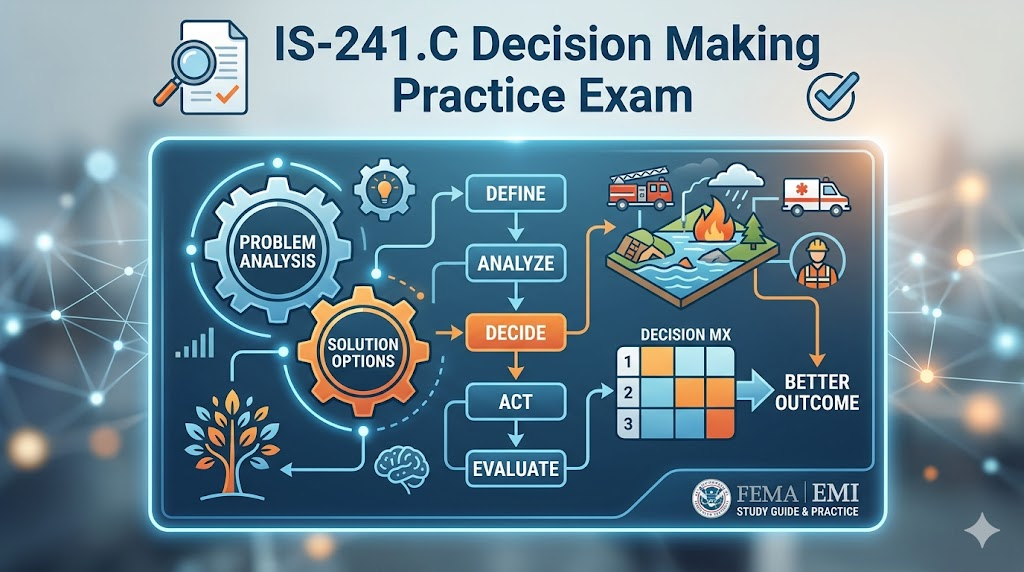
Additional Information
What the Course Entails and Exam Details
This self-paced, online course consists of several interactive units that guide you through structured models and strategies. You will dive into the following core topics and acquire critical skills:
The Decision-Making Process: Understand the systematic steps in effective decision making and how to apply them.
Decision-Making Styles: Identify different decision-making styles and understand how each can be applied to varied situations and with different team dynamics.
Ethical Decision Making: Explore the intersection of ethics and critical choices, especially in challenging or high-stakes scenarios.
The Problem-Solving Model: Learn to use a standard, seven-step model for analyzing and resolving complex issues and challenges.
Group and Crisis Decision Making: Develop strategies for effective collaborative decision-making in teams and under the unique pressures of a crisis environment.
The final exam for IS-241.C is a comprehensive assessment of your understanding of these principles. It is an online, multiple-choice test that typically consists of approximately 20 to 30 questions, evaluating your comprehension and application of the models, steps, and best practices covered throughout the course materials. While you can review the course content as often as needed before attempting the exam, thorough study is highly recommended. The exam is usually taken without a strict time limit within the course interface.
What to Expect in the Final Exam
When you sit for the IS-241.C final exam, you can expect:
Format: The exam entirely uses a multiple-choice format, requiring you to select the best answer from several options. Each question is based directly on the learning objectives from the course.
Passing Score: To successfully pass the exam and earn your FEMA certificate of completion, you must achieve a score of at least 75% or 80%. (Verify the specific requirement in the course portal.)
Conditions: The exam is typically "open-resource," meaning you are allowed to consult your course materials while taking the test. However, it is strongly recommended to prepare thoroughly to understand the underlying concepts rather than relying solely on searching during the exam, as this will improve both your speed and your true learning.
Accessibility: The final test is integrated within the course on the FEMA Independent Study portal. Once you complete all the lessons, you will find a link to the final exam.
How to Study and Exam Centers
Preparing for the IS-241.C exam is best accomplished by deeply engaging with the official course materials provided by FEMA.
How to Study Effectively:
Thoroughly Review Course Content: Go through all interactive lessons, read any accompanying PDFs, and engage with all case studies and examples. These are the primary sources for exam questions.
Take Notes: Actively taking notes on key terms, processes, steps, and best practices will reinforce your learning and serve as a valuable quick-reference during the exam and for future practice.
Utilize Knowledge Checks: The course materials frequently include non-graded knowledge checks after key concepts. Don’t skip these! They are essentially mini-practice questions and are a great way to gauge your understanding and identify areas that need more attention. Review the correct answers carefully if you get any wrong.
Practice Application: Use the scenarios and case studies within the course to actively apply the decision-making and problem-solving models in a practical context. This will help you understand how to use the principles, not just remember the steps.
Simulate and Self-Assess: While there is no separate official practice test, you can essentially create your own by covering your notes and testing yourself on key definitions, steps, and models, or by re-taking the online knowledge checks multiple times until you consistently score perfectly.
Exam Centers (How and Where to Take the Exam):
The entire IS-241.C course and final exam are taken online. There are no physical testing centers required.
FEMA Independent Study Portal: Access the course and final exam through the official FEMA Emergency Management Institute (EMI) website.
Register for a FEMA SID: If you do not have one already, you must register for a FEMA Student Identification (SID) number, which will be your unique identifier for all FEMA training and transcripts.
Enroll in the Course: Once you have your SID, locate course IS-241.C in the online course catalog and enroll.
Complete and Test: Study at your own pace through the lessons. When ready, follow the internal links to access and complete the final multiple-choice exam. Your results are processed instantly, and successful completion will generate a certificate and add the course to your official FEMA transcript.
Job Opportunities from the Course
Successfully completing IS-241.C demonstrates a certified level of competence in critical decision-making and problem-solving, which is highly sought after across numerous fields. This certification is especially relevant for roles in emergency management, public safety, community services, and organizational leadership. Potential job opportunities and career paths that benefit from or may require this certification include:
Emergency Manager: Lead and coordinate disaster preparedness, response, and recovery efforts.
Emergency Management Specialist: Assist in planning, mitigation, and training for local, state, or federal agencies.
First Responder (Firefighter, Law Enforcement, EMS): Make critical decisions in dynamic and high-pressure situations.
Public Information Officer: Assess situations and make strategic decisions about communication.
Disaster Recovery Coordinator: Manage long-term recovery processes in communities.
Community Preparedness Coordinator: Develop and lead local resilience programs.
Safety and Security Manager/Specialist: Assess risks and make critical security decisions in corporate or organizational settings.
Public Administration & Policy Positions: Make informed, structured decisions impacting public well-being and resources.
Leadership and Management Roles: Improve decision quality and team dynamics in various organizations.
This certification is a significant resume booster, showcasing your commitment to professional development and your ability to apply structured, effective decision-making models, which is an invaluable skill set for any career.
Frequently Asked Questions
Reviews
5.0
Based on 0 reviews
Leave a Review
No reviews yet. Be the first to review!