
IT Technical Interview Practice Test
$69.00
- Buy to unlock unlimited access to all Quiz questions and Answers in this Quiz.
- After purchase you can print a PDF of the whole quiz at any point. The PDF will contain the questions and the correct answers.
About this Exam
An IT Technical Interview Practice Test is not a single, specific certification exam, but rather a crucial simulation and preparation tool designed for individuals aspiring to secure technical roles in the Information Technology sector. This process is essential for software engineers, developers, data scientists, cloud architects, and various other specialized tech positions. These simulations aim to mirror the challenging environment of real company technical interviews, evaluating not just knowledge, but problem-solving capability, communication skills, and real-time critical thinking. It is an indispensable resource for candidates at all experience levels who want to gain confidence and ensure they are fully equipped to showcase their technical prowess to potential employers.
Ready to test your knowledge?
Buy Now to Access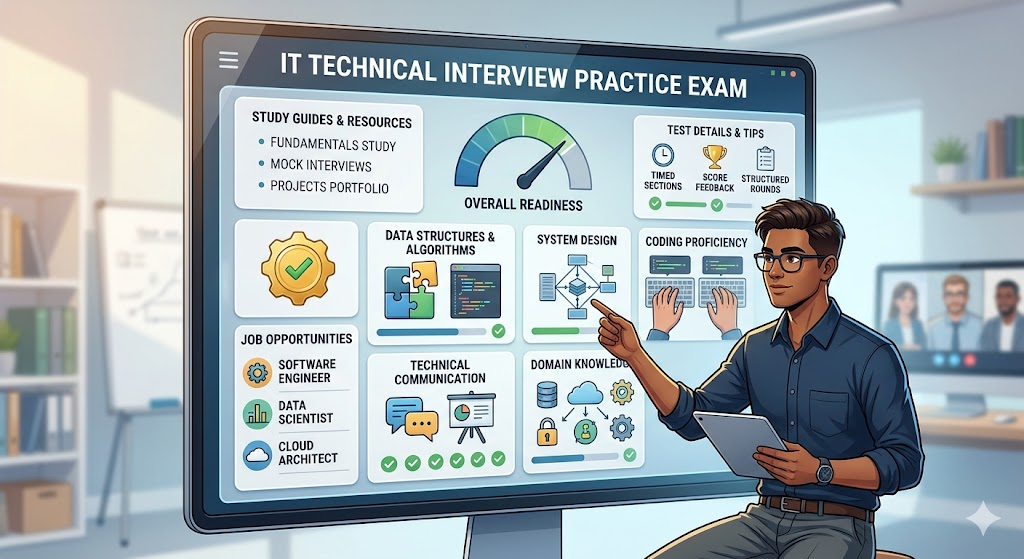
Additional Information
What the Course Entails and Exam Details
As this is a preparatory resource rather than a traditional curriculum-based course, the content directly reflects the typical domains and skills tested in a real technical interview. Preparation covers a wide array of critical technical areas, and you can expect a comprehensive "practice exam" to assess your proficiency in:
Data Structures & Algorithms: Fundamentals like arrays, linked lists, trees, graphs, sorting, searching, and algorithm analysis.
System Design: Understanding scalable and efficient system architecture, trade-offs, and reliability.
Coding & Programming Proficiency: Demonstrating clean, efficient code in relevant languages (e.g., Python, Java, JavaScript, C++).
Domain-Specific Knowledge: Deep dives into areas like database management, cloud technologies, cybersecurity, mobile development, or testing.
Problem-Solving & Logical Reasoning: The ability to break down complex challenges and think through solutions, often under time constraints.
Technical Communication: Articulating thought processes, explaining decisions, and collaborating effectively on technical topics.
Specific platforms offering these practice tests may structure them by level (Junior, Senior, Specialist) or by domain, often including thousands of practice problems and mock scenarios with detailed feedback.
What to Expect in the Final Exam
While the "practice exam" helps you prepare, the true "final exam" is the multi-stage interview process you will encounter when applying for jobs. Understanding this structure is essential for success:
Initial Screening: Often a phone or video call with HR or a hiring manager, covering basic technical knowledge and behavioral alignment.
Online Coding Assessments: Timed coding challenges, typically on platforms like HackerRank or Codility, involving one or more algorithmic or practical problems.
Technical Deep Dives: Multiple virtual or on-site interview rounds, focusing on specific skills like system design, whiteboard problem-solving, pair programming, and domain-specific knowledge.
Time Limits: Online assessments typically have strict time limits (e.g., 60-90 minutes for a coding test). In-person or virtual interviews are usually scheduled for 45-60 minutes per round.
Passing Scores & Requirements: Success isn't always measured by a single numeric score; it's about clearing each successive round. However, some initial online assessments may have a minimum benchmark required to advance. Ultimately, passing requires demonstrating competence and problem-solving ability in all assessed domains.
Specific Rules: Rules vary. In an online test, you must adhere to time limits and submission protocols. In-person interviews emphasize verbalizing your thinking and collaborating, with less focus on perfect code syntax and more on approach and logic.
How to Study and Exam Centers
Effective preparation is the key to conquering technical interviews. Consider these actionable strategies:
Study Fundamentals: Solidify your knowledge of core computer science principles, data structures, algorithms, and relevant technologies.
Leverage Practice Platforms: Utilize online portals like LeetCode, HackerRank, Interviewing.io, and CoderPad. These are your virtual "exam centers" for practice tests. They offer vast question libraries, mock assessments, and sometimes real-time feedback.
Mock Interviews: Practice with peers, mentors, or on dedicated mock interview platforms (like Pramp). The experience of being interviewed and explaining your thought process is invaluable.
Review Sample Questions & Solutions: Analyze successful solutions to common interview questions to understand best practices and different approaches.
Build Projects: Practical, hands-on experience through personal projects or contributing to open source can deeply reinforce technical knowledge and provide great talking points.
Regarding "Exam Centers" for the final assessment:
Online Portals (Practice): As mentioned, these are available globally, and you can take practice tests from any computer with an internet connection, effectively making any space your personalized practice center.
Company Assessments (Real Interviews): Many companies conduct initial technical screens and coding assessments entirely online through video calls and online coding platforms. The virtual space serves as the exam center.
Physical Testing Centers or On-Sites (Real Interviews): Historically, and still occasionally, candidates may be required to attend on-site interviews at a company's physical office or authorized meeting locations for late-stage or final interview rounds. These company locations would act as the physical exam center. Traditional large-scale exam centers (like Pearson VUE) are less common for the interview process itself, but are for vendor-specific certifications that might be prerequisites or supplementary assets.
The crucial point is that while some parts of the practice and initial screening are digital, the overall assessment is an engagement with an employer, often initially virtual, and potentially including physical attendance. Use practice platforms as your virtual training grounds.
Job Opportunities from the Course
Successfully preparing for and clearing IT Technical Interviews unlocks a wide array of career paths in the tech industry. This preparation is a gateway, not a qualification in itself, and positions successful candidates for roles such as:
Software Engineer
Front-End/Back-End/Full-Stack Developer
Data Scientist / Data Analyst
DevOps Engineer
Cloud Architect / Engineer
Systems Administrator
Cybersecurity Analyst
Machine Learning Engineer
Mobile Application Developer (iOS/Android)
Software Development Engineer in Test (SDET) / QA Engineer
IT Support Specialist / Desktop Support Engineer
IT Project Manager / Scrum Master
User Experience (UX) Engineer / Designer (depending on the role's technical demands)
Mastering the skills and strategies covered in IT technical interview practice tests is an investment in your future, directly leading to exciting job offers and career growth in the dynamic and rewarding world of technology.
Frequently Asked Questions
Reviews
5.0
Based on 0 reviews
Leave a Review
No reviews yet. Be the first to review!