
ITE Traffic Bowl Practice Test
$69.00
- Buy to unlock unlimited access to all Quiz questions and Answers in this Quiz.
- After purchase you can print a PDF of the whole quiz at any point. The PDF will contain the questions and the correct answers.
About this Exam
The Institute of Transportation Engineers (ITE) Traffic Bowl is one of the most exciting and unique collegiate competitions in the transportation field. Rather than a standard, silent certification exam taken at a desk, the Traffic Bowl is a high-energy, "Jeopardy!"-style trivia competition. It is designed specifically for ITE student members, bringing together the brightest undergraduate and graduate students to test their knowledge in a dynamic, competitive environment. The competition aims to promote a comprehensive understanding of transportation engineering and planning, encourage student participation in ITE, and provide a fun platform for networking. This guide is your foundational resource for preparing to conquer the challenge.
Ready to test your knowledge?
Buy Now to Access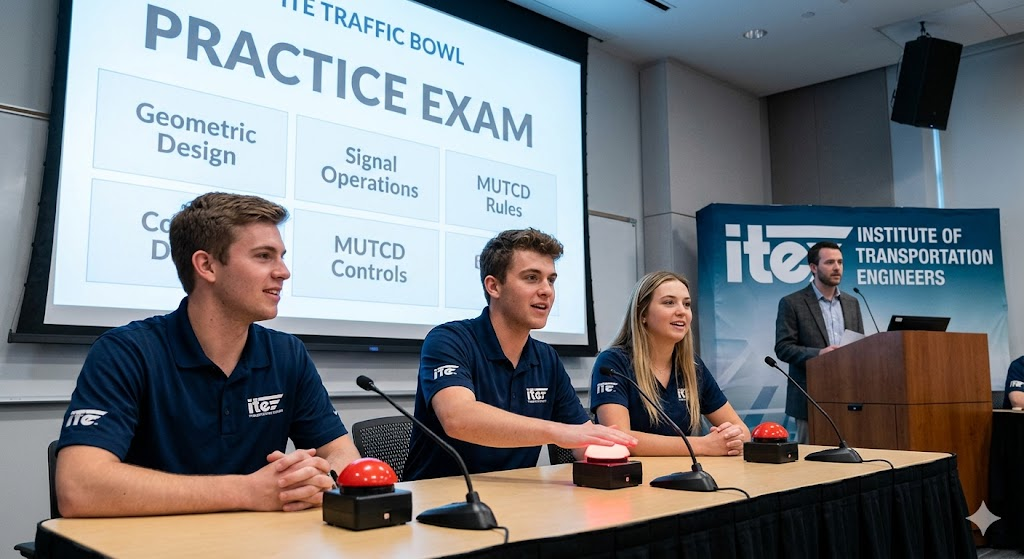
Additional Information
What the Course Entails and Exam Details
As this is a preparation resource for a dynamic competition, the content mirrors the standard syllabus of advanced transportation programs. The core topics focus heavily on technical concepts found within key industry reference materials. Participants must show proficiency in geometric design principles for roads and intersections, referencing sources like the AASHTO Green Book. Traffic flow theory, signal timing operations, and capacity analysis based on the Highway Capacity Manual (HCM) are heavily tested. A significant portion covers the standards in the Manual on Uniform Traffic Control Devices (MUTCD).
Furthermore, you must study general transportation planning principles, modeling concepts, and traffic safety analysis techniques. The course also uniquely requires a knowledge of ITE’s history, structure, and current events. Mastering these diverse topics is essential for quick recall during the live event.
What to Expect in the Final Exam
When you advance to the final competition, forget the quiet testing centers; expect a fast-paced quiz bowl atmosphere. The format is a direct question-and-answer competition, using a physical buzzer system. Teams compete live in front of a panel of judges and a public audience. Questions are typically presented visually on a screen or read aloud by a moderator, often divided into specific categories of increasing difficulty and point value. You must be the first person to buzz in correctly to earn points.
The competition typically consists of multiple rounds, starting at sectional levels and culminating in the international finals. Time limits are not measured by an exam timer but by your rapid response speed on the buzzer against opposing teams. There is no traditional "passing score"; the goal is simply to outscore your opponents and win the match to advance. Incorrect answers often carry a penalty, rewarding accuracy alongside speed.
How to Study and Exam Centers
Effective preparation requires a collaborative team strategy rather than just solitary studying. You should use this ITE Traffic Bowl Practice Test as a tool to organize your team’s knowledge base and practice scenario-based recall. It is recommended to create flashcards from the key manuals, such as the HCM, MUTCD, and Green Book. Organize regular team mock sessions where you rotate roles, acting as competitors, the moderator, and the judge. Utilize online buzzy-system simulators to sharpen your reaction times.
Reviewing past Traffic Bowl question banks is a critical strategy for understanding the typical wording and common trick questions used in previous competitions. The "exam centers" for the Traffic Bowl are physical locations at official ITE events. You will take the "exam" live during authorized physical meetings of your specific ITE section or district. Winners from these local competitions then proceed to compete in the highly anticipated Grand Finale hosted annually at the ITE International Annual Meeting and Exhibit.
Job Opportunities from the Course
Participating in the Traffic Bowl offers incredible visibility and is highly regarded by industry recruiters. It is not a course that provides a singular certificate but a prestigious accomplishment that serves as a massive boost to any resume. Mastering this knowledge and competing at a high level opens direct paths to numerous exciting careers. Graduates with Traffic Bowl experience are often highly sought after for the following roles:
Traffic Engineer
Transportation Planner
Intelligent Transportation Systems (ITS) Engineer
Traffic Safety Analyst
Geometric Design Engineer
Municipal Traffic Manager
Highway Planning Consultant
FHWA (Federal Highway Administration) Specialist
Public Works Engineer
Transit Operations Analyst
Frequently Asked Questions
Reviews
5.0
Based on 0 reviews
Leave a Review
No reviews yet. Be the first to review!