
ITS Certiport Networking Practice Test
$69.00
- Buy to unlock unlimited access to all Quiz questions and Answers in this Quiz.
- After purchase you can print a PDF of the whole quiz at any point. The PDF will contain the questions and the correct answers.
About this Exam
The Information Technology Specialist (ITS) Networking certification, managed by Certiport, is an entry-level credential designed to validate foundational knowledge of networking concepts. This exam is ideal for high school or college students, career changers, and early-career IT professionals who want to demonstrate their understanding of how networks operate, including the devices, media, and protocols that enable network communication. As the digital world expands, validating these core skills is the critical first step toward a successful career in network administration, cybersecurity, or cloud computing.
Ready to test your knowledge?
Buy Now to Access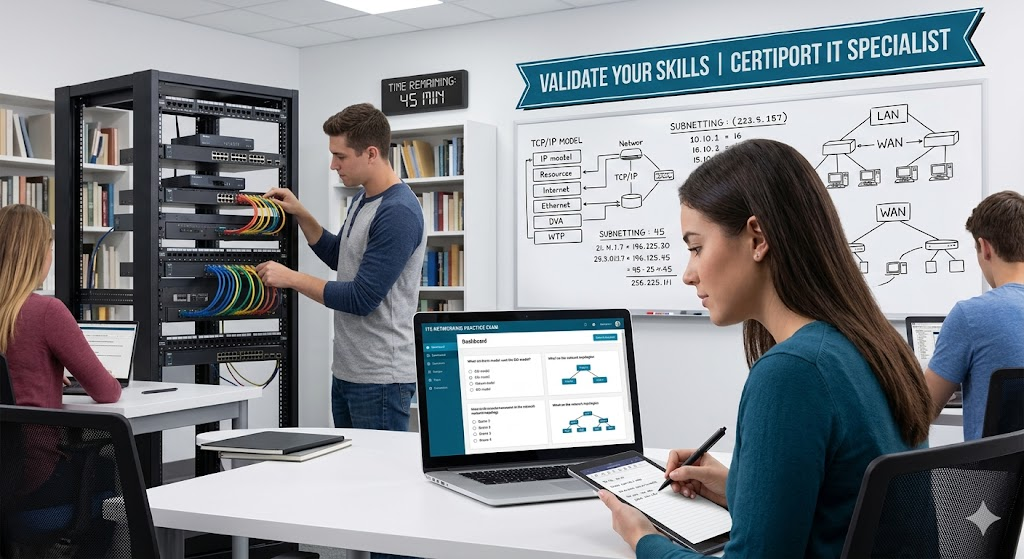
Additional Information
What the Course Entails and Exam Details
The ITS Networking exam focuses on practical knowledge and conceptual understanding rather than advanced configuration. The core topics, or Objective Domains, covered in this certification course include:
Networking Fundamentals (20-25%): Demonstrating knowledge of OSI and TCP/IP models, network topologies (LAN, WAN, MAN, PAN, WLAN), and fundamental conceptual building blocks of networks.
Addressing and Subnet Formats (15-20%): Identifying IPv4 and IPv6 addresses, subnet formats, private vs. public addresses, and the concepts of NAT and broadcast domains.
Endpoints and Media Types (15-20%): Differentiating between wired and wireless media types (e.g., fiber, copper, Wi-Fi), identifying standard network connectors, and describing endpoint devices like IoT, servers, and mobile devices.
Infrastructure (15-20%): Explaining the purpose and basic operation of network hardware such as routers, switches, bridges, hubs, and access points. It also includes basic switching and routing concepts (like default gateways).
Diagnosing Problems (15-20%): Demonstrating effective troubleshooting methodologies, running basic diagnostic commands (like ping, ipconfig/ifconfig, tracert), and interpreting the results to resolve connectivity issues.
What to Expect in the Final Exam
The official certification exam is a timed assessment taken in a proctored environment. Knowing what to expect can significantly reduce test anxiety.
Exam Format: The exam typically consists of 40 to 60 questions. The question types are diverse and include multiple-choice (single and multiple-select), drag-and-drop, matching, and "hot spot" questions where you interact with a graphical interface.
Time Limit: Candidates are generally given 50 minutes to complete the exam. Time management is crucial.
Passing Score: The exam is scored on a scale of 1 to 1000, with a typical passing score of 700.
Languages: The exam is available in multiple languages, including English, Spanish, French, and others depending on the region.
Exam Integrity: This is a closed-book exam. No reference materials or outside electronic devices are permitted during the testing session.
How to Study and Exam Centers
Successfully preparing for the ITS Networking exam requires a blend of study materials and hands-on practice.
Actionable Study Strategies:
Utilize Official CertPREP: Certiport offers official practice tests (often powered by GMetrix) that accurately simulate the actual exam environment. These are essential for testing your knowledge pace and format familiarity.
Review Objective Domains: Download the official ITS Networking Objective Domains from Certiport. Use this document as your primary checklist to ensure you have studied every required topic.
Use Hands-on Labs: Don’t just read about networking—do it. Use network simulators (like Packet Tracer) or set up a simple home lab to configure basic IP settings, use troubleshooting commands, and understand topology layouts.
Join a Study Group: Collaborating with peers can provide unique insights and keep you motivated.
Exam Centers:
You must take the official exam at a Certiport Authorized Testing Center (CATC).
CATCs include academic institutions (high schools, colleges), commercial training centers, and some government organizations.
You can locate the nearest testing center using the locator tool on the official Certiport website. In some instances, centers may offer "Certiport Exams from Home" or other remote proctoring options.
Job Opportunities from the Course
Earning your ITS Networking certification validates your skills to employers and opens doors to several entry-level IT roles. It serves as a vital stepping stone toward more advanced certifications like CompTIA Network+ or CCNA. The career paths unlocked by this certification include:
IT Support Specialist
Help Desk Technician (Tier 1)
Network Support Technician
Entry-Level Network Administrator
Computer Repair Technician
NOC (Network Operations Center) Technician
Field Service Technician
Junior Systems Administrator
By mastering the foundational concepts validated by this exam, you are setting yourself on a clear pathway toward a rewarding and high-demand career in the technology sector. Use this guide to structure your preparation, practice consistently, and approach your test day with confidence. Good luck!
Frequently Asked Questions
Reviews
5.0
Based on 0 reviews
Leave a Review
No reviews yet. Be the first to review!