
ITS Networking Practice Test
$69.00
- Buy to unlock unlimited access to all Quiz questions and Answers in this Quiz.
- After purchase you can print a PDF of the whole quiz at any point. The PDF will contain the questions and the correct answers.
About this Exam
The Information Technology Specialist (ITS) Networking certification is a cornerstone credential designed to validate foundational knowledge in the field of computer networking.
This exam is an ideal starting point for students, aspiring IT professionals, and individuals seeking to launch a career in network administration or support.
It serves as a benchmark, proving to employers that a candidate understands the essential concepts and terminology required to manage and troubleshoot modern network environments.
By earning this certification, you demonstrate competence in handling key networking services, topologies, and the security principles needed to protect a company’s infrastructure.
Ready to test your knowledge?
Buy Now to Access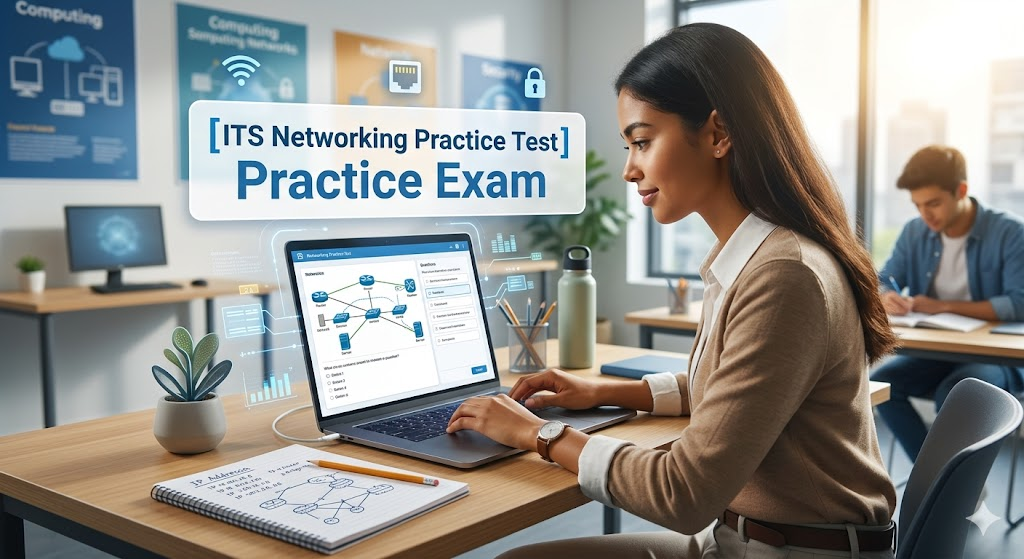
Additional Information
What the Course Entails and Exam Details
This practice guide is structured around the core domains of the final certification exam, ensuring comprehensive coverage of critical topics.
The curriculum delves deeply into five primary pillars of networking that every beginner must master.
Candidates will first explore Networking Fundamentals, which defines essential concepts like the internet, intranets, and extranets, as well as different network types such as client-server and peer-to-peer.
This section also introduces fundamental cloud concepts and visualization technologies, including hypervisors and virtual switches.
The second domain, Network Infrastructures, focuses on the physical and logical layout of networks, including detailed characteristics of Local Area Networks (LANs), Wide Area Networks (WANs), and wireless networking standards.
You will learn to differentiate between wireless security types like WPA2 and 802.1X, and understand the impact of interference.
In the third domain, Network Hardware, you will study the roles and capabilities of core devices such as switches, routers, and physical media.
This includes understanding how routers create best-route decisions and the specific characteristics of different cable types like fiber optic and CAT cabling.
Fourth, the Protocols and Services section is pivotal, requiring a mastery of the OSI model and the TCP/IP suite, including classful and classless IPv4 and IPv6 addressing.
You will also be tested on the purpose of critical networking services and protocols, such as DNS, DHCP, HTTP, HTTPS, and SSH.
Finally, the Troubleshooting domain provides real-world scenarios to assess your ability to apply a systematic troubleshooting process to resolve connectivity and performance issues.
What to Expect in the Final Exam
The final ITS Networking certification exam is a timed, computer-based test delivered in a proctored environment.
It is a multi-modal assessment that typically incorporates a variety of question types designed to measure both your theoretical knowledge and practical skills.
Candidates can expect a mix of traditional multiple-choice questions, which test quick recall of definitions and ports, and performance-based questions.
Performance-based questions (PBQs) are interactive simulations that require you to perform tasks within a simulated network interface, such as configuring an IP address on a workstation or diagnosing a faulty network connection on a visual map.
To achieve success, you must achieve a specific passing score, which is determined by the vendor (Certiport) and reflects a mastery of the core objectives.
Because the final passing threshold and time limit can vary slightly between versions of the exam, it is highly recommended to consult the official Certiport webpage for the most current specific exam specifications.
How to Study and Exam Centers
Preparing for the ITS Networking exam requires a dedicated and structured approach that combines active studying with realistic simulation.
A proven effective strategy is to utilize comprehensive practice test platforms, which offer both learning and testing modes.
In "Practice Mode," you can learn passively by taking untimed tests and viewing detailed explanations for every correct and incorrect answer, reinforcing key concepts.
In "Certification Mode," you should simulate the real exam environment by taking timed tests without access to immediate feedback, which helps build endurance and time management skills.
Consistency is vital; you should aim to score consistently high on full-length practice exams in certification mode before scheduling your actual test.
When you are ready, you can register for the exam through an authorized vendor portal, such as Pearson VUE, which provides options for both in-person testing at an authorized testing center and online proctored exams from the comfort of your home.
Additionally, many high schools, community colleges, and technical training centers are authorized Certiport testing centers, allowing you to take the exam in a familiar environment.
Job Opportunities from the Course
Earning your ITS Networking certification unlocks a variety of promising entry-level career paths across multiple sectors.
This credential validates the core skills needed for the following common roles:
IT Support Specialist: Providing essential technical assistance and troubleshooting network and hardware issues for an organization's users.
Network Support Technician: Focused specifically on diagnosing, repairing, and maintaining networking hardware and software infrastructure.
Help Desk Analyst (Tier 1 & Tier 2): Serving as the first line of defense for a wide array of technical problems, including network connectivity.
Junior Network Administrator: Assisting in the day-to-day operations and configuration of a company’s local and wide area networks.
Field Service Technician: Traveling to client sites to install, configure, and troubleshoot network equipment and infrastructure.
These roles often serve as foundational steps that, with experience and further specialization, can lead to careers as a senior network engineer or security analyst.
Frequently Asked Questions
Reviews
5.0
Based on 0 reviews
Leave a Review
No reviews yet. Be the first to review!