
Ivy Tech Accounting 101 Final Practice Exam
$69.00
- Buy to unlock unlimited access to all Quiz questions and Answers in this Quiz.
- After purchase you can print a PDF of the whole quiz at any point. The PDF will contain the questions and the correct answers.
About this Exam
The Ivy Tech Accounting 101 Final Practice Exam is a comprehensive study resource designed for students enrolled in ACCT 101, often titled Financial Accounting. This fundamental course is the bedrock for all future accounting and business studies. It introduces students to the full accounting cycle and the creation of essential financial statements. The practice exam serves as a simulation, mimicking the scope and challenge of the actual final, allowing candidates to evaluate their readiness. It is ideal for degree-seeking accounting students, those on transfer pathways to four-year institutions, and business professionals looking to master financial reporting.
Ready to test your knowledge?
Buy Now to Access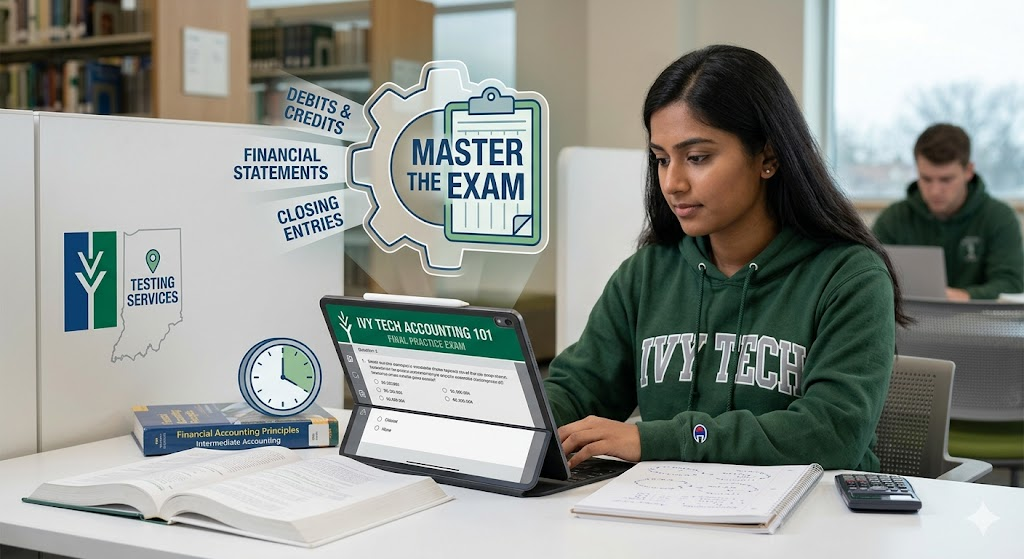
Additional Information
What the Course Entails and Exam Details
This course provides a robust foundation in the language of business. Candidates will gain deep theoretical and practical knowledge of the fundamental accounting cycle and the regulatory environment. Key topics covered by the exam include:
Conceptual Framework: Understanding GAAP, FASB, and the basic assumptions and principles of accounting.
The Accounting Cycle: Mastering the steps from analyzing source documents and journalizing transactions with debits and credits to preparing the Trial Balance, Adjusted Trial Balance, and Post-Closing Trial Balance.
Financial Statement Preparation: Generating and interpreting the four key statements: Income Statement, Statement of Retained Earnings, Balance Sheet, and Statement of Cash Flows.
Adjusting and Closing Entries: Knowing how to record accruals, deferrals, depreciation, and close temporary accounts to Equity.
Asset and Liability Management: Specialized sections on accounting for cash (including bank reconciliations), accounts receivable, bad debts, and long-term assets.
Inventory Systems: Applying valuation methods such as FIFO, LIFO, and Moving Average under perpetual and periodic systems.
What to Expect in the Final Exam
The actual Ivy Tech ACCT 101 Final Exam is a proctored, comprehensive assessment that evaluates knowledge from the entire semester. The exam is often administered digitally through the Ivy Tech IvyLearn online portal.
While the exact structure can vary, a typical final consists of approximately 50 to 60 multiple-choice questions. A specific review for Ivy Tech lists the format as 58 multiple-choice questions worth 100 points, with a strict 90-minute (1.5-hour) time limit. These questions are split between conceptual understanding and computational problems. To ensure academic integrity, the exam is often closed-book, meaning students are not allowed to use their textbook or personal notes. Preparation is key to managing the time effectively and navigating the technical nature of the problems.
How to Study and Exam Centers
Effective preparation for this high-stakes exam requires targeted, active study strategies rather than passive reading.
Actionable Study Strategies:
Complete Practice Exams: This is the single best predictor of success. Use the Ivy Tech Accounting 101 Final Practice Exam to familiarize yourself with the question style and time constraints.
Master Debits and Credits: Revisit transaction analysis until recording journal entries is second nature.
Redo Comprehensive Problems: Work through complete accounting cycle problems from beginning to end, including preparing worksheets and financial statements.
Focus on Key Concepts: Don’t just memorize computational steps; ensure you understand why adjusting and closing entries are necessary.
Review Instructor Resources: Use strategic reviews, Module study guides, and the practice materials available in the IvyLearn course shell.
Exam Center Information:
The final practice exam is typically available online, offering flexible access via dedicated educational platforms or within the college's internal learning management system. For the official, credit-bearing final exam, Ivy Tech utilizes robust proctoring solutions. Students may take the final exam in person at an official Ivy Tech Testing Center, located at campuses across Indiana. Alternatively, online proctoring services (such as Respondus or other standardized portals like Pearson VUE, which are standard for many certifications) may be used, depending on the course section’s specific requirements.
Job Opportunities from the Course
Successfully completing ACCT 101 is the first critical milestone toward a rewarding career. While it is a foundational course, it immediately qualifies individuals for key entry-level support roles. It also unlocks technical and transferable pathways, leading to roles such as:
Accounting Clerk
Accounting Assistant
Assistant Tax Specialist
Bookkeeper
Payroll Clerk
Tax Preparer
This course also serves as the prerequisite gateway for technical certificates and advanced degrees, ultimately leading to licensure as a Certified Public Accountant (CPA) or Certified Management Accountant (CMA).
Frequently Asked Questions
Reviews
5.0
Based on 0 reviews
Leave a Review
No reviews yet. Be the first to review!