
Ivy Tech APHY 101 – Skeletal System Practice Test
$69.00
- Buy to unlock unlimited access to all Quiz questions and Answers in this Quiz.
- After purchase you can print a PDF of the whole quiz at any point. The PDF will contain the questions and the correct answers.
About this Exam
The Ivy Tech APHY 101 Skeletal System Practice Test is an essential study tool designed for students enrolled in Anatomy and Physiology I at Ivy Tech Community College.
This foundational course is a critical requirement for individuals pursuing careers in nursing, dental hygiene, physical therapy assisting, and other health science fields.
The skeletal system component focuses on the intricate structure and function of the human framework, which provides support, protection, and movement for the body.
This practice test aims to reinforce learning, identify knowledge gaps, and build confidence before the graded unit exam or the comprehensive final.
Ready to test your knowledge?
Buy Now to Access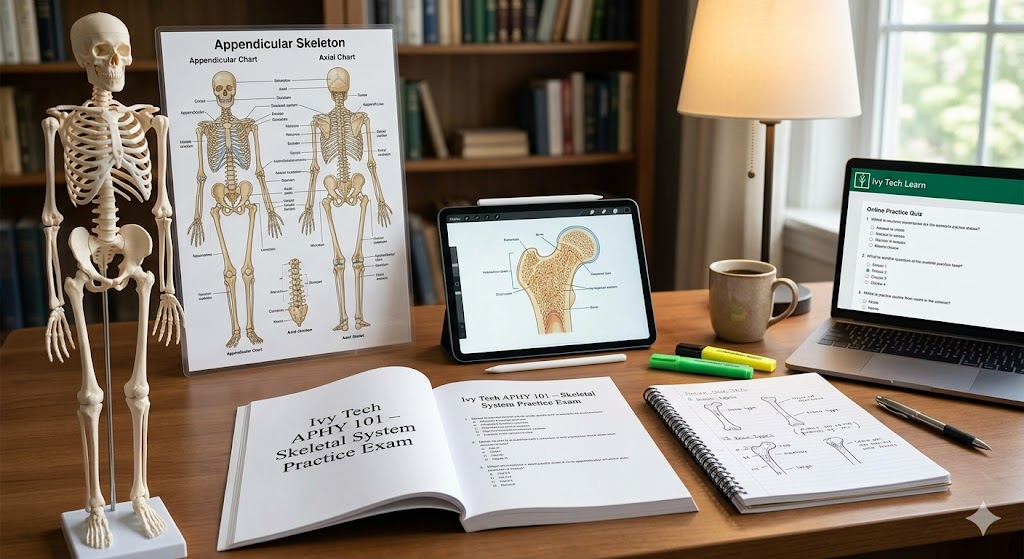
Additional Information
What the Course Entails and Exam Details
This segment of APHY 101 delves deeply into the osseous tissue and the overall skeletal architecture.
Students will be expected to master several core topics.
First is bone histology and physiology, which covers the microscopic structure of compact and spongy bone, the roles of osteoblasts, osteocytes, and osteoclasts, and the processes of intramembranous and endochondral ossification.
Second is the gross anatomy of the skeletal system, requiring the identification of all 206 bones in the adult human body, categorized into the axial skeleton (skull, vertebral column, thoracic cage) and the appendicular skeleton (pectoral and pelvic girdles, and upper and lower limbs).
Students must also be able to identify major bone markings, such as foramina, fossae, condyles, and tubercles.
Third is the classification and articulation of joints, including a detailed understanding of synovial joint types and the range of movements they allow, such as flexion, extension, abduction, and rotation.
Finally, the course addresses basic bone homeostasis and common disorders like fractures and osteoporosis.
What to Expect in the Final Exam
The actual exam covering the skeletal system within Ivy Tech APHY 101 is typically structured as a combination of a traditional written test and a practical component.
Students should prepare for multiple-choice questions that assess their understanding of concepts and terminology.
Additionally, matching questions are common, where students link definitions to structures or functions.
A significant portion of the assessment often involves diagram labeling, where students must correctly identify specific bones, bone markings, or features from a clear image, which may include "fill-in-the-blank diagram photos."
The exam is designed to be rigorous, requiring a passing score, often 70% or higher, and is usually timed.
It may be proctored online or administered in person at a designated testing center, depending on the course format.
How to Study and Exam Centers
Effective preparation for the APHY 101 skeletal system exam requires an active, multi-faceted approach.
First, heavily utilize visual aids, as this is a visually dominant subject. Create and color-code diagrams of the skeleton, individual bones, and bone markings. Use physical skeletal models in the lab.
Second, practice active recall by using flashcards for bone names, markings, joint types, and historical terms. The practice test should be used multiple times, not just as a quiz but as a diagnostic tool.
Third, focus on directional terms and precise spelling, as these are critical for correct identification on practicals. Watch supplementary educational videos to reinforce difficult concepts, particularly joint movements and ossification.
Finally, confirm your exam details. Graded exams are typically administered online through IvyLearn, often proctored by services like SmarterProctoring, or can be taken in person at an official Ivy Tech Community College testing center or authorized physical testing location.
Job Opportunities from the Course
Successfully mastering APHY 101 and the skeletal system is a fundamental stepping stone for numerous rewarding and in-demand healthcare careers.
This knowledge is a prerequisite for entry into several competitive programs and career paths.
It can lead to a career as a Registered Nurse (RN) or Licensed Practical Nurse (LPN), where understanding patient anatomy is crucial for assessment and care.
It is foundational for those pursuing roles as a Physical Therapist Assistant or Occupational Therapy Assistant, who work directly with rehabilitation and movement.
Furthermore, it is essential for Radiologic Technologists and Surgical Technologists, who must have expert knowledge of human structure for imaging and operative procedures.
Other related fields include Respiratory Therapy, Dental Hygiene, Medical Laboratory Technology, and Mortuary Science, all of which require a strong grasp of human anatomy and physiology.
Frequently Asked Questions
Reviews
5.0
Based on 0 reviews
Leave a Review
No reviews yet. Be the first to review!